Institutional Context
Summary
Based in a World Heritage City with campuses in London and partners around the globe Bath Spa University’s distinctive approach to professional creativity addresses both global challenges and local opportunities. We drive regeneration, business innovation and engagement with our research community meaning we are embedded in a vibrant network of knowledge exchange that supports our position as one of the UK’s most dynamic and creative Universities.
Bath Spa University is where creative minds meet. Offering a wide range of courses across the arts, sciences, education, social science, humanities and business to around 14,000 students the University employs outstanding creative professionals who support its aim of expanding the application of creativity into the least expected and most necessary places.
Institutional context
Bath Spa University is distinctive for its professional creativity and its commitment to the synergies between employers, civic place and creativity that are the drivers of sustainable economic development.
The University’s Strategy to 2030 is clear on the four elements of our mission:
1. Bath Spa Creativity
A creative community, engaged in the production of new knowledge, objects, ideas and narratives.
2. Bath Spa Enterprise
We build partnerships to foster economic and cultural development; improve our student learning and graduate outcomes; ensure that our work is relevant, useful and needed. Examples include our work with the West of England Combined Authority (WECA) on Innovation and also creative industries developments: the South West Creative Industries Network, the My World Creative Hub, the The Studio creative incubator, Short Course Unit and the ISTART Creative Innovation Centre which all speak to the way in which we are growing adept in our role as an essential creative partner and facilitator.
3. Bath Spa Talent
We identify and develop talent wherever we find it, in our staff, our students and our partnerships and ensure that our culture is one of trust known for nurturing potential: through The Studio and EMERGE our creative incubators,, through Skills Bootcamps and through ISTART’s leading national pipeline for talent development.
4. Bath Spa Enablers
We will work ethically and inclusively, towards the highest external standards of corporate behaviour.
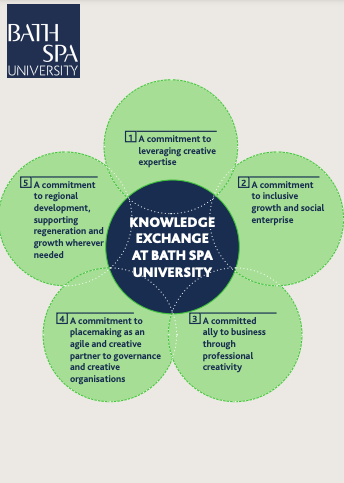
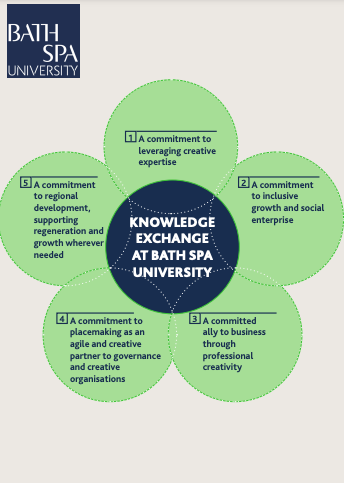
These strands of the University’s mission map onto our approach to Knowledge Exchange which is characterised by five guiding principles.
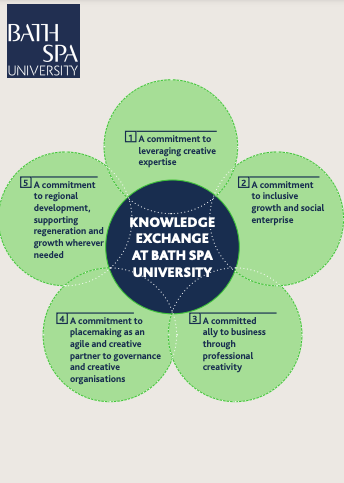
These strategic commitments and guiding principles have been translated into action with the support of two KE funding allocations from Research England in 2021/22 and 2022/23. These allocations have been invested in partnership development including establishing a Short Course Unit that has secured £3.7m of funding, supported over 1000 learners and generated new relationships with hundreds of regional businesses since 2021. The support of Research England KE funding has also been used to amplify the activities of our AHRC IAA by co-funding nine KE projects and has pump-primed activities that now secure external investment.
Our portfolio of knowledge exchange activities is set within a highly differentiated local socio-economic context that underscores the importance of our partnership approach. The University is situated in the City of Bath which encompasses areas amongst the most deprived 10% nationally and the least deprived 10% (UK Indices of Deprivation). As a consequence of this, the University has a commitment to the regional development agenda and has increased its regeneration income reported via HE-BCI by over 3000% during the reporting period. It is embedded in the regional policy landscape through the involvement of the Senior Leadership Team in the boards of Bath and North East Somerset Council (BaNES) One Shared Vision and Economic and Skills Boards and the West of England Combined Authority (WECA) Investment Plan and Cultural Compact. The University also enjoys a broad and deep network of relationships with businesses, schools and social and community organisations that supports its role as an anchor institution that animates the public space.
For further information, please send queries to researchsupportoffice@bathspa.ac.uk
Local Growth and Regeneration
Summary of approach
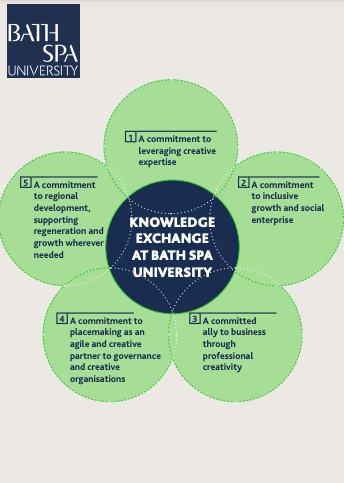
This approach has developed both from our own vision of knowledge exchange and its central importance to our civic mission. It is an intentional response to the needs of the West of England Combined Authority (WECA), Bath and North East Somerset Council (BaNES) and the Swindon and Wiltshire LEP (SWLEP) that focuses on our strengths in cultural policy, future jobs initiatives and applying creativity to sustainability challenges.
Aspect 1: Strategy
The University’s approach to local growth and regeneration is
shaped by our five principles of knowledge exchange: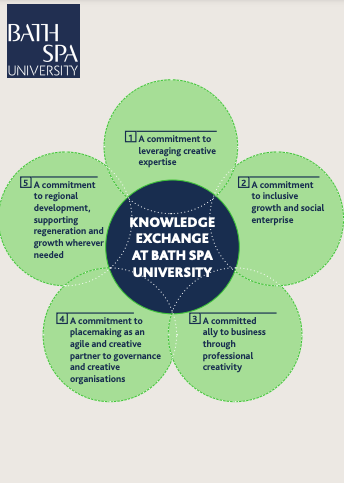
Geographical Area
The campuses of Bath Spa University are located in and around the city of Bath in Somerset and the town of Corsham in Wiltshire. The Bath-Bristol and Wiltshire areas are therefore of strategic importance to the University as defined by the local governance structures in which its campuses are situated: The West of England Combined Authority (WECA), Bath and North East Somerset Council (BaNES) and the Swindon and Wiltshire LEP (SWLEP). Since 2021 we have also had a presence in London at our Hoxton campus Bath Spa London and we are working to bridge and broker the interests of both geographies, finding synergies and mutual benefits wherever they present themselves.
The Bath geography encompasses areas amongst the most deprived 10% nationally and the least deprived 10% (gov.uk). There is a similar schism between the Swindon and Wiltshire area which is 49% rural (SWLEP) and Bath and North East Somerset which is classified as urban with significant rural areas (gov.uk). As a consequence of this Bath Spa University takes a partnership approach to identifying the needs of the local area in order to create an appropriately differentiated strategy (Bath Spa University Strategy to 2030: Enterprise).
Identifying Strategic Needs
The needs of these local geographies have been identified primarily through engagement with the local governance bodies, their respective Local Industrial Strategies and a series of cultural partnerships in these areas. This has helped to refine the areas in which the University offers specific support around placemaking and regeneration.
With regard to the strategic needs for cultural regeneration In the WECA area the Director of our Centre for Creative and Cultural Industries sits on the WECA Cultural Strategy Board and has helped to shape their Covid-19 Recovery Plan. Our Vice-Chancellor chairs the Cultural Compact to amplify the economic and social contribution of the cultural sector while the University has also funded a secondment into WECA to co-ordinate the Compact. Further, our Pro-Vice-Chancellor External helped to draft the BaNES Cultural Strategy to 2026.
Local economic regeneration strategy is also profoundly shaped by the University’s involvement. The University’s Vice Chancellor is Vice Chair of the West of England’s Local Enterprise Partnership while the Pro-Vice-Chancellor External sits on the WECA Business Board, the WECA Innovation Group, the WECA Living Labs Group and the WECA Employability and Skills Board. Collectively these Groups have oversight of the 45,000 businesses in the local economy which are worth £33bn per year (WECA: Business). Our PVC External’s seat on the West of England Growth Hub affords the University an excellent understanding of the business needs, innovation challenges and skills requirements of its local area as well as the influence needed to address them. Furthermore, the University is represented by the Pro-Vice-Chancellor External on the Bath and North East Somerset Council (BANES) Renewal Board and the Bristol and Bath Regional Capital (BBRC) Growth Board and supported BaNES in drafting the One Shared Vision plan (post C-19 recovery) and their Economic Strategy to 2030.
Supporting Regeneration
The WECA area has the highest survival rate for SMEs in England and this has helped to inform the University’s commitment to offer support through initiatives like The Studio - the University’s startup incubator, EMERGE the Graduate incubator and the ISTART programme for business and skills support in Bath. These activities serve both the growth of the region but also support the University's objectives in knowledge exchange to be an ally to business with particular support for the creative community.
A second core area of regeneration activity for the University is the programme of bootcamps in digital skills that have been created in response to labour market intelligence and conversations with local governance organisations. To date, the University’s Short Course Unit has won bids worth £3.7m to deliver government funded Skills Bootcamps, a training programme funded by a large internet based organisation, and a training programme for future tech entrepreneurs funded by the WECA. Since 2021 these contracts will have reskilled or upskilled over 1000 learners and supported the University’s commitment to placemaking as an agent of knowledge exchange. In addition, we are developing a portfolio of short courses in collaboration with academic Schools and organisations in areas such as Immersive Audio, Ethical Marketing, and Sustainable Fashion.
In May 2022, Bath Spa University recruited a Creative and Cultural Development Officer whose role focuses on connecting local people with creative businesses to benefit the region. The purpose has been to make it easier for people to access the arts for free, to secure spaces for artists to create and showcase work, and to open up access to funding. We have also connected freelancers and emerging small organisations with larger, established companies to support them developmentally. To date, two new community arts spaces have been created to support creativity in Twerton and Radstock, providing valuable resources for these communities.
Aspect 2: Activity
The activities that the University undertakes are in direct support of the five elements of our approach to knowledge exchange detailed below.
A commitment to leveraging our creative expertise
The University has enjoyed huge success over the past three years in securing research grants that use our creative expertise in support of the creative industries. For example, the University is a partner on the £46m UKRI-funded My World project which is supercharging the screen based media industry in the South West. Partnering with Bath Spa on the Experimental Productions strand are Aardman, Lux Aeterna, and Bristol Old Vic while the wider consortium is expected to boost the economy by £223m and to further establish the South West as a centre of cultural production the UK.
During this KEF period we also partnered in the Bath+Bristol Creative R+D project, part of the AHRC’s Creative Industries Cluster Programme. Through a mix of development labs, fellowships and large project funding the programme focused on immersive experiences, live performance, voice activation and 5G to strengthen micro businesses in the creative sector, producing new jobs in new start-ups. The Bazalgette Report reported Bristol/Bath as one of three regions outside London to have international growth potential with a 50% advantage in productivity over other creative clusters, contributing £780m back to the Treasury, mainly from small and micro businesses and so this project was designed to develop this potential. A similarly creative project on which we have partnered is the South West Creative Technology Network (SWCTN) awarded under Research England’s Connecting Capabilities Fund. The collaboration invested in interdisciplinary R&D fellowships and prototype production across immersion, automation and data. The project developed new, networked models of knowledge exchange for creative technologies’ innovation; a key focus is to facilitate creative technology and creative practices into other sectors including the Creative Industries, Health, and Manufacturing all of which were identified as priorities in the WECA Local Industrial Strategy.
A commitment to inclusive growth and social enterprise
Social purpose is a defining part of the University’s vision and one that extends well beyond core educational objectives. The University has Gold Mark Accreditation for Social Enterprise. demonstrating Outstanding Practice across areas which are central to social enterprise excellence including governance, stakeholder engagement, business ethics, financial transparency and social impact. The University received particular praise for its emphasis on providing employability opportunities for students, as well as linking students to the needs and opportunities within the local economy.
Our social enterprise excellence is manifest in our Top 40 Sustainability ranking; Sustainable Business compulsory module; our sector leading inclusive practice partnership in Film and Television; Social Justice and Special Educational needs in Education; Arts Council-funded inclusive growth creative digital engagements via Bath Cultural Educational Partnership and a whole series of local and regional business collaborations around ISTART to build the UK's first inclusive growth innovation pathways in digital skills from Level 2 to Level 7, community based and co-created.
An ally to business through professional creativity
In 2020 The University opened The Studio a centre for innovation, research and enterprise in the heart of Bath. The Studio provides a space for local micro-businesses, Bath Spa University students, academics and graduates to work on projects and ideas which focus on creativity and technology. The Studio provides a mixture of free and affordable desk space as well as business support and £25k per year into The Studio Innovation Fund meeting the high demand for targeted support for the micro-business sector in the Bath area. Our EMERGE studio also offers a unique creative practice residency for our graduates to support their next steps to private practice.
A commitment to placemaking
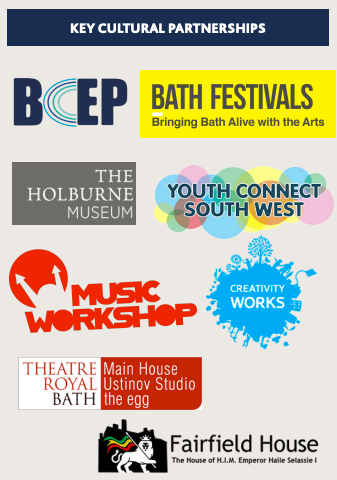
Cultural partnerships are essential knowledge exchange bases at Bath Spa. We have formal relationships that all focus, in different ways, on aspects of inclusion: with the Holburne Museum, Komedia, the Bath Festival and the Bath Cultural Education Partnership amongst others. These partnerships afford the University a dialogue with the key organisations in the local cultural economy that can both highlight priorities and needs and also a means of shaping and responding to the outcomes. We also support specific initiatives such as Creative Twerton which has repurposed an empty shop in an area of deprivation into a creative community hub, illustrating the vital impact of arts and community engagement on wellbeing for a community, and as importantly simultaneously offer vital basic services for those in need.
A commitment to regional regeneration
The economic regeneration agenda is addressed through the ISTART programme for business and skills support in Bath, The Studio startup incubator and EMERGE the studio residency programme and incubator for creative graduates. It is also supported by our short courses and bootcamps in digital skills which will expand over the coming years into other regional skills gaps including sustainability, data, net zero, cyber and health. Since 2021 these contracts will have reskilled or upskilled over 1000 learners and support the University’s commitment to placemaking as an agent of knowledge exchange.
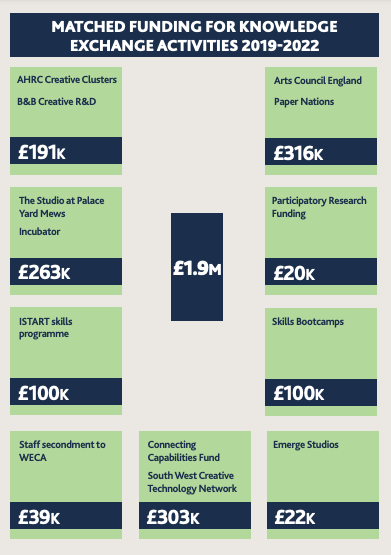
Matched Funding
Aspect 3: Results
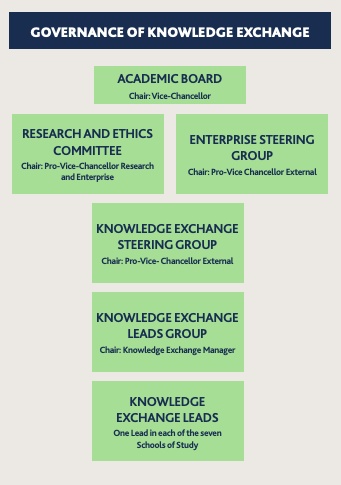
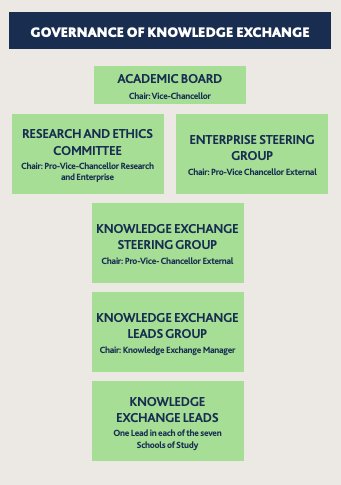
Responsibility for understanding the impact of our knowledge exchange activity sits within the University’s Knowledge Exchange Steering Group which reports to the Research and Ethics Committee and Enterprise Steering Group which reports directly to the Senior Leadership Group and Academic Board and ensures our activity and its outcomes are strategically-led and scrutinised.
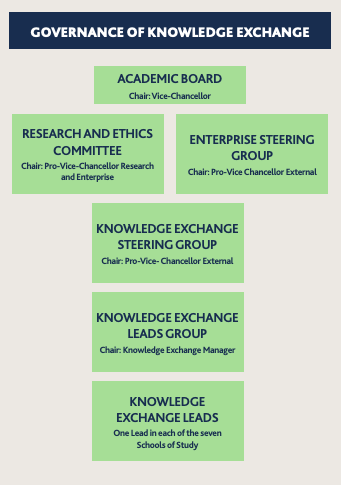
The activity is supported at the level of the Schools of Study by Knowledge Exchange Leads who work alongside the Directors of Research to manage the school’s KE strategy, hypothecate HEQR funding for KE activities, mentor staff in KE and signpost support and resources to colleagues. This governance structure, and a programme of regular meetings, helps to ensure that the overarching goals for KE are aligned with, and supportive of, the activity that is carried out at an institutional and a local level.
Commissioning formal evaluations
Much of the knowledge exchange activity over the reporting period has been delivered through funded projects meaning that interim and final evaluations have been embedded within the application process. For example, The Studio, the University’s incubator space for micro and SME businesses in creative tech has offered The Studio Recovery Fund over successive years as well as The Studio Innovation Fund. Each round of funding has included an evaluation report that situates the outcomes against the KE priorities of the University and spotlights the impact that the investments have had. In another example, the University commissioned a social value assessment of the bootcamps programme which was able to demonstrate the job progression outcomes of the participants six months after concluding the programme and demonstrate new employment, further responsibility in their current job or setting up their own business.
Communicating through established partnerships
One of the underpinning characteristics of the University’s approach to knowledge exchange is its commitment to partnership working. This affords the University both a broad and a deep reach into different sectors and communities and allows us to communicate effectively. We do this through regular partnership meetings with governance bodies, cultural partners and other stakeholders including the WECA, BANES and SWLEP. The University has formal Cultural Partner relationships with nine organisations who meet regularly with the Advancement and Civic Engagement Manager and whose activities span student placements and student knowledge exchange, innovations prototyping and sharing facilities and networks. The University also benefits from working in partnership with, amongst others, for student experience Oracle, Adobe, Ledbury Poetry; for student KE the BBC; for upskilling and reskilling Techspark, 3SG, the Data Place and Bath City Football Club. These multiple feedback loops allow us the opportunity to ensure our strategic priorities are aligned with the needs of our stakeholders and that the results are impactful and representative of our professionally creative approach to knowledge exchange.
Leading by Example
It is also important to note that the objective of the University’s knowledge exchange activity is to contribute to a resilient and agile society and economy. Our own approach therefore strives to embody this approach by using an agile sprint methodology to get projects and collaborations off the ground quickly, iterating as they go, and to work through problems and solutions while the project is in motion. This approach creates a high degree of both resilience and agility in our own internal capacity for knowledge exchange and allows us to embed feedback and evaluation into the process itself rather than seeing it as part of concluding the project. In so doing we create more effective and responsive activity and seek to generate more effective results.
Public & Community Engagement
Summary of approach
At Bath Spa University we are innovative and resourceful and our public engagement is distinctively creative. This dynamism brings a sense of energy to our public engagement activities ranging from collaborative projects with businesses, schools and museums, to citizen science activities, literary festivals, film screenings and exhibitions.
We pride ourselves on our sense of community and the way in which we nurture relationships. We enable communities to engage with research at all stages of a project life cycle so that not only do we aim to share our knowledge, resources and skills, we also listen and learn from those communities. Co-created and participatory research is at the heart of our public engagement and impact activities.
Aspect 1: Strategy
Bath Spa University’s approach to public engagement
Bath Spa University’s approach to public engagement has been informed through working with the NCCPE to undertake an Engage Survey of the University’s public engagement activity and infrastructure. This work in 2018, supported by the AHRC, allowed the NCCPE to undertake a staff/student survey structured around the EDGE tool and to benchmark the results against provision in the sector. The NCCPE’s report remarked ‘There appears to be a strong ethos and culture of embedding public engagement into the research process: not only at the end to share and communicate the results, but right through the research cycle.’ Bath Spa University is a long-standing signatory of the NCCPE’s Manifesto for Public Engagement and as such has a strong sense of the value of dialogue and mutuality that public engagement affords.
The University’s commitment to public engagement is enshrined in the University’s Strategy to 2030 through its ‘partnerships approach’ (University 2030 Strategy). This approach focuses on both the University’s relationships with the city of Bath, the wider region and beyond, but also on the economic and cultural development that these partnerships can foster and Bath Spa’s distinctive approach to professional creativity that also permeates much of our public engagement. Our institutional approach to knowledge exchange, which includes public engagement, highlights the five guiding principles that make our approach notable:
Governance of Public Engagement
At an operational level public engagement is managed locally within each School of Study by academic staff who act as Knowledge Exchange Leads for the Schools. The Leads work with the Knowledge Exchange Manager in the central Research Support Office to access specialist support and meet regularly with the other Leads throughout the year. They are able to promote opportunities for public engagement and champion the work happening in the Schools, mentor their colleagues and signpost other specialist support across the institution. Strategic oversight for public engagement sits within the Knowledge Exchange Steering Group which reports into the Central Research and Ethics Committee and the Enterprise Steering Group meaning that public engagement benefits both from the same rigorous scrutiny as our research activity but is also aligned to larger capstone projects being driven locally by University leadership.
An Inclusive Approach
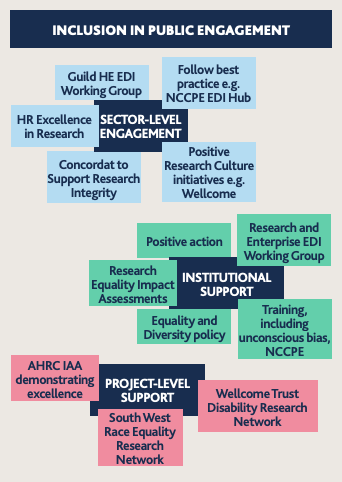
One of the cornerstones of public engagement at the University is our commitment to inclusive research and, by extension, an inclusive approach to public engagement. As detailed above, strategic governance for public engagement is provided by the Research and Ethics Committee whose Research and Enterprise EDI Working Group (REEDIWG) provides leadership on EDI considerations for research and public engagement. Chaired by one of our Strategic Professors whose own work includes a huge amount of public engagement, good practice is both modelled and supported across the institution including ongoing equality impact assessments of our research and enterprise activities. All staff are required to complete unconscious bias training, and internal seed funding for research and public engagement activities include consideration of positive action to address under-represented academic staff groups across the University in line with the University’s Equality and Diversity Policy. Bath Spa not only strives for best practice in inclusive public engagement but also takes a proactive role in leading the agenda. The University’s Equality Officer sits on the Guild HE Equality and Diversity Working Group to further the conversation across the sector, while the University’s AHRC IAA was awarded in 2022 in recognition of our excellence in inclusive practice and co-created research. Participants are fairly remunerated for their participation in the programme, the IAA Steering Group and Forums centre the project’s stakeholders at the heart of the IAA’s leadership, and the various strands of activity makes an inclusive approach the key to the programme’s success.
Aspect 2: Support
The Structures of Support for Public Engagement
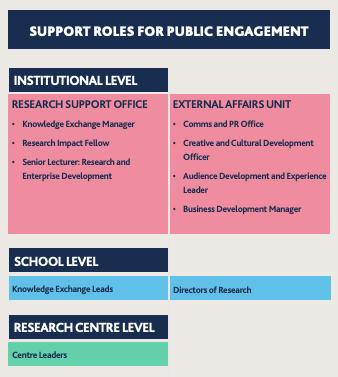
Support for Public Engagement sits, at a central level, primarily in the Research Support Office. In this team, the Knowledge Exchange Manager can provide practical and strategic support for public engagement with research, the Research Impact Fellow can offer specialist support with evaluation and impact capture and our Researcher Development Programme offers training aligned to the Vitae framework that supports staff seeking to undertake public engagement. There is also practical support available for colleagues from Bath Spa Live, our events department, and our Communications Office who can support with audiences, ticketing and promotions respectively. At the level of the Schools and the Research Centres there is mentoring, knowledge sharing and signposting available from the Directors of Research, Directors of the Research Centres and the Knowledge Exchange Leads. All parties work together closely and are able to cross-refer support which is well-signposted on our intranet so staff have a clear sense of where to ask for support.
Recognition and Reward for Public Engagement
Support for public engagement is extended through the University’s promotions criteria which require all promotions to Readerships or Professorships to demonstrate ‘clear [or substantial] influence and impact on non-academic communities through, for example, engagement in knowledge and technology transfer, policy development, changes in practice or engagement with particular community groups.’ All staff are required to complete annual Staff Development Reviews which asks them to report back on their activities and allows them space to identify any training needs including around public engagement, for which they can apply for support from The Research Support Office, HR or their Head of School. These reviews underpin career progressions within the University, underscoring the value of public engagement to their institution.
Support and Resourcing for Public Engagement
At a central level there is a rolling programme of training in various aspects of public engagement for all research postgraduates and staff across the University. These events vary from introductions to workshops tailored to particular career stages or disciplines. Our Impact Research Fellow is an NCCPE Ambassador and provides 1:1 support for individual researchers, and together with the Knowledge Exchange Manager provides wider advice to each of the Schools on issues such as public engagement, co-created research and the ethics of external engagement.
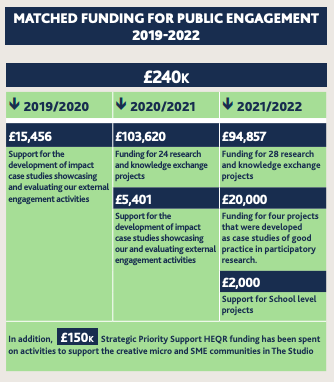
Over the reporting period the University has provided financial support for public engagement from its QR allocation through the HEQR Seed Fund which provides for up to £5,000 per project. Seed funding is also available for public engagement at a devolved level within some of the Schools - for example in 2022 the School of Art, Film and Media provided Knowledge Exchange Seed funding of £2,000 for projects working on areas of strategic importance to the School. We have also employed Impact Research Assistants to document good practice in impact and external engagement.
Aspect 3: Activity
The University’s public engagement activities are framed by the five aspects of our approach to knowledge exchange, and we consider some of our exemplar projects in relation to these principles below.
A commitment to leveraging creative expertise
The Public Lecture Series – lectures and conversations led by our Professors, Early Stage Researchers and Guest speakers attracts an audience of around 500 per year and provides a discussion platform for creative thought. The distinctiveness of Bath Spa’s approach to professional creativity is also apparent in some of our cornerstones public engagement projects. The West of England Visual Arts Alliance (WEEVA) partnership supports inclusive and sustainable practice for artists around Bath, Bristol and Weston-super-Mare with a vibrant programme of activities for artists, schools and communities. Forest of Imagination uses creativity to transform urban spaces in an effort to change lives, cities and economies. Now in its tenth year, the pop up arts and architecture festival offers a multi-sensory array of participation art installations, workshops, architecture, sculptures and audio experiences online and encourages young people in particular to engage with, and advocate for, a better built environment. CAR T Treatment: Family Stories - A Research Participatory Film Series created a series of films to provide peer-to-peer support for families with children who are undergoing CAR T-cell novel treatment for leukaemia sharing their valuable lived experiences. Working with Great Ormond Street Hospital Bath Spa researchers supported the participants to co-create the films, sending out filming equipment and providing training, with the impacts reaching far beyond the participants to those undergoing CAR T treatment, participatory filmmakers and the development of podcasts as evaluation tools.
A commitment to inclusive growth and social enterprise
Paper Nations is a creative writing incubator funded by Arts Council England and hosted by the University’s Research Centre for Transnational Creativity and Education. Working thematically, the project directly addresses diversity and inclusion through its Writing for All initiative that breaks down the barriers to writing, enabling writers from all places and backgrounds to write, learn their craft, and pursue a creative career. The University also achieved Social Enterprise Gold Mark accreditation in 2022 and has leveraged its network to support B-corps and social enterprise communities with a series of events that help to mutually inform our understanding of inclusive growth.
An ally to business with focussed support for the creative community
The Research Programme for Story: Exploring the value of story in life, learning and work is an AHRC-funded project that centres on the idea of a ‘story skillset’ that can be applied in a wide variety of professional settings. Story Associates are placed within businesses to apply their skillset to the benefit of the organisation and its stakeholders and to amplify the impact that storytelling can have in a professional context. The Studio incubator space also undertakes regular public engagement with the micro and SME businesses working in creative and digital tech in Bath and the surrounding area, and the community in turn regularly feeds back into the development of the University’s enterprise support.
A commitment to placemaking
The University enjoys formal relationships with the Holburne Museum, Komedia, the Bath Royal Literary and Scientific Institution, the Bath Festival and the Bath Cultural Education Partnership amongst others. These partnerships allow us to extend the audiences who collaborate on our research and with whom we engage. For example, our creative writers participate in the Bath Childrens’ Literature Festival and the Schools Without Walls project uses the children of local primary schools to take up residency in the Egg Theatre co-creating festival events. Our engagement draws on the research expertise of our staff and embeds that into the local community to ensure it responds to their needs and enriches our environment.
Aspect 4: Enhancing practice
External evaluation
Where possible Bath Spa University costs external evaluation into its applications for external funding and therefore many programmes of work have benefitted from external scrutiny and their contribution to our strategic objectives is clear. An example is Forest of Imagination, an annual immersive arts festival for families that reimagines familiar urban spaces in the city of Bath to inspire creativity and a sense of nature. An evaluation of the project remarked that the project showcased the school’s expertise in producing interactive arts for those with SEN, demonstrating how small adjustments can make a massive difference to access to the arts. The AHRC IAA offers another model for evaluation that was informed by previously successful trials within the Bristol+Bath Creative R+D project. A series of funded fellowships help to develop innovative and robust evaluation strategies that are adaptable to different research contexts. Research participants and partners decide themselves what meaningful impact looks like for them rather than have a logic model applied to their situation and develop evaluation strategies that are meaningful for both those whose experiences are being captured and researchers.
Internal evaluation
Projects seed-funded by the University are required to conduct an internal evaluation of their outcomes, impacts, how these aligned to the University’s strategic objectives and any learning that could be shared. These reports are then reviewed centrally by members of the Research Support Office and contribute to a repository of resources that can be accessed by other staff who are undertaking public engagement activity. The University has also employed, since 2021, a series of Impact Research Assistants who sit within the Research Support Office and help to evaluate and document the impact of our research and externally-facing activities.
Co-creation for iterative evaluation
In addition to formal evaluation there is a strong ethos that research should be co-created with the communities involved which means that success and learning are embedded in the project and iterated during the project lifetime. The Teacher Assessment in Primary Science (TAPS) programme which works with over 85 Schools to improve the way in which science is taught at primary level. These models of co-creation are being strongly encouraged in all University research applications and are supported by the Research Support Office and the programme of training detailed in Section 2.
Support mechanisms for evaluation
The University’s Research Impact Fellow, trained by the NCCPE is available to support all staff undertaking public engagement with appropriate strategies to maximise the impact of the work, considerations of EDI during the project lifecycle, and mechanisms for capturing impact. Bath Spa University has invested in ImpactTracker (hiive) software meaning researchers are provided with an account training from the Research Impact Fellow at the beginning of each project and supported to document the impact of their public engagement which can be evaluated and displayed in various ways to share back with stakeholders or for other professional purposes. In addition, the University acts in a leadership role as the South West Hub for NCACE, the National Coordinating Centre for Academic and Cultural Exchange. NCACE supports a positive ecology of knowledge exchange including evidence and impact and affords us the ability to act as a broker for best practice nationally and to ensure this learning is embedded in our own approach to evaluation.
Aspect 5: Building on success
Strategic leadership for public engagement
The governance of public engagement is supported from the level of the School to the University’s Academic Board and provides a mature infrastructure to monitor public engagement activity against our strategic goals.
Involving the public and communities in our leadership
The University strongly encourages researchers to consider the most appropriate mechanisms for including the public and community in setting the direction for their work and models good practice in this area through the AHRC IAA. The IAA is led by a Steering Group with membership drawn for the community stakeholders who sit alongside representatives of the University in a flat hierarchy. The programme is also supported by three forums: creative industry practitioners, policy engagement and community who provide guidance on the activities of the IAA aligned to the University’s strategic priorities to support the creative industries, place based partnership approaches, and tackling the UN Sustainable Development Goals through inclusive growth.
Reporting on our Performance
At an institutional level The University has invested in Vertigo Venture’s (hiive) ImpactTracker software in 2015 and has been using that to capture evidence of the impact of individual research projects and their public engagement activity. This has improved the availability of evidence and also the quality of insight. Internally it has further supported the periodic reporting of impact through the monthly Research Newsletter, annual reporting of activity to the University Research and Ethics Committee and annual reporting to the University Governors to support a culture of continuous improvement for public engagement across the institution.
Note You are currently viewing the latest version of this narrative statement. View the previous version as published in previous iterations of the KEF (KEF1 and KEF2)