Note You are currently viewing a previous version of this narrative statement as published in previous iterations of the KEF (KEF1 and KEF2). View the latest version
Institutional Context
Summary
Bath Spa University is where creative minds meet. Offering a wide range of courses across the arts, sciences, education, social science and business to around 8,000 students, the University employs outstanding creative professionals who support its aim to be a leading educational institution in creativity, culture and enterprise. Based in stunning countryside just a few minutes from a World Heritage City, Bath Spa University ensures its students graduate as engaged global citizens who are ready for the world of work. It is integral to the University’s 2030 Strategy that staff and students apply their skills to global challenges and local opportunities and to this end knowledge exchange is a vibrant area of growth at Bath Spa University.
Institutional context
Bath Spa University started life as the Bath School of Art in 1852 and our origins, as one of the finest Schools of Art in the country, have shaped the creative University we have become. Although the disciplines taught and researched at the University have increased now spanning art, science, education, social science and business, our commitment remains to the synergies between employers, civic place and creativity that are the drivers of sustainable economic development.
The University’s Strategy to 2030 is clear on the four elements of our mission:
Bath Spa Creativity
A creative community, engaged in the production of new knowledge, objects, ideas and narratives.
Bath Spa Enterprise
We build partnerships to foster economic and cultural development; improve our student learning and graduate outcomes; ensure that our work is relevant, useful and needed. Examples include the South West Creative Industries Network, My World Creative Hub, the Global Academy of Liberal Arts and the ISTART Creative Innovation Centre which all speak to the way in which we are growing adept in our role as a creative partner and facilitator.
Bath Spa Talent
We identify and develop talent wherever we find it, in our staff, our students and our partnerships and ensure that our culture is one of trust, known for nurturing potential. For example through EMERGE our Graduate Creative Industries Studio.
Bath Spa Enhancements
We will grow organically and sustainably, at a scale and pace commensurate with our character.
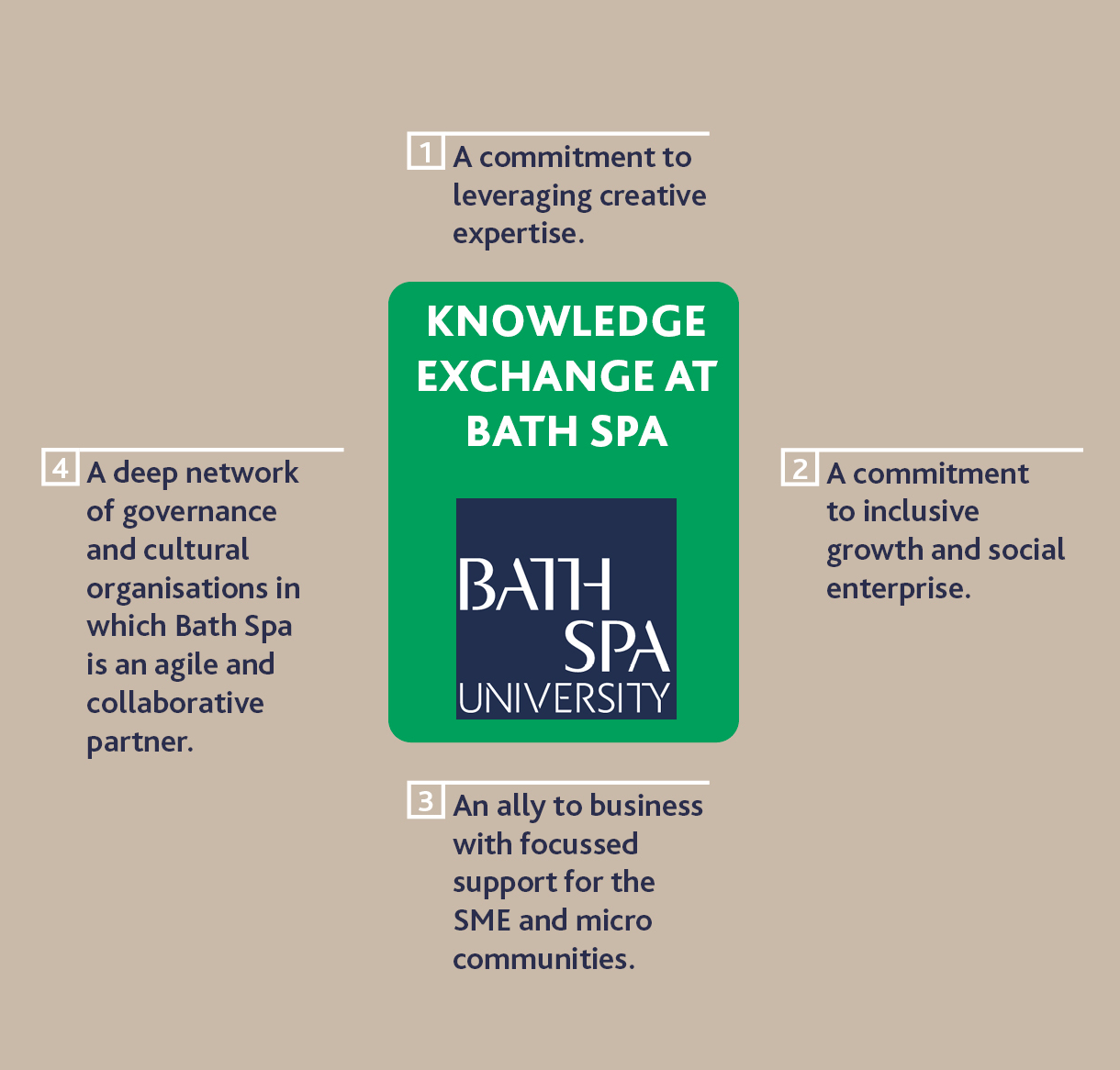
These strands of the University’s mission map onto our approach to Knowledge Exchange which is characterised by four guiding principles.
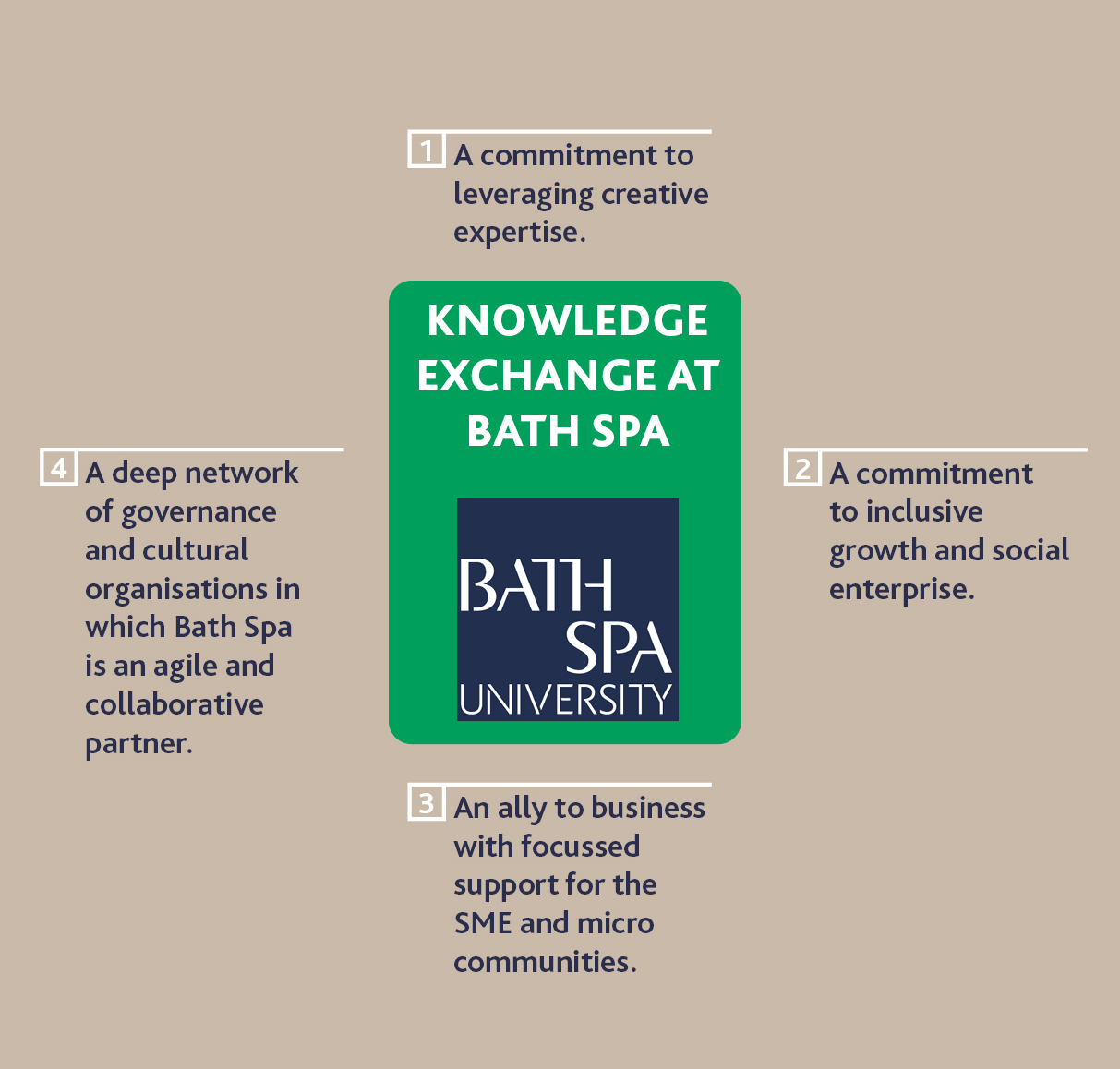
Our portfolio of knowledge exchange activities is set within a highly differentiated local socio-economic context that underscores the importance of our partnership approach. The University is situated in the City of Bath which encompasses areas amongst the most deprived 10% nationally and the least deprived 10% (UK Indices of Deprivation). As a consequence of this, the University has a broad and deep network of relationships with local governance bodies, businesses, schools and social and community organisations which means the University is embedded into the life and work of the surrounding area. The Narrative Templates detailing our approach to local growth and regeneration, and public and community engagement explain these principles in more detail.
For further information, please send queries to researchsupport@bathspa.ac.uk
Local Growth and Regeneration
Summary of approach
Bath Spa University has a long history as an education institution dating back nearly 170 years meaning it is well-embedded as the local University for the arts, culture and creative industries. We use our local and regional anchorage to generate activities of national and international significance guided by the University’s approach to Knowledge Exchange:
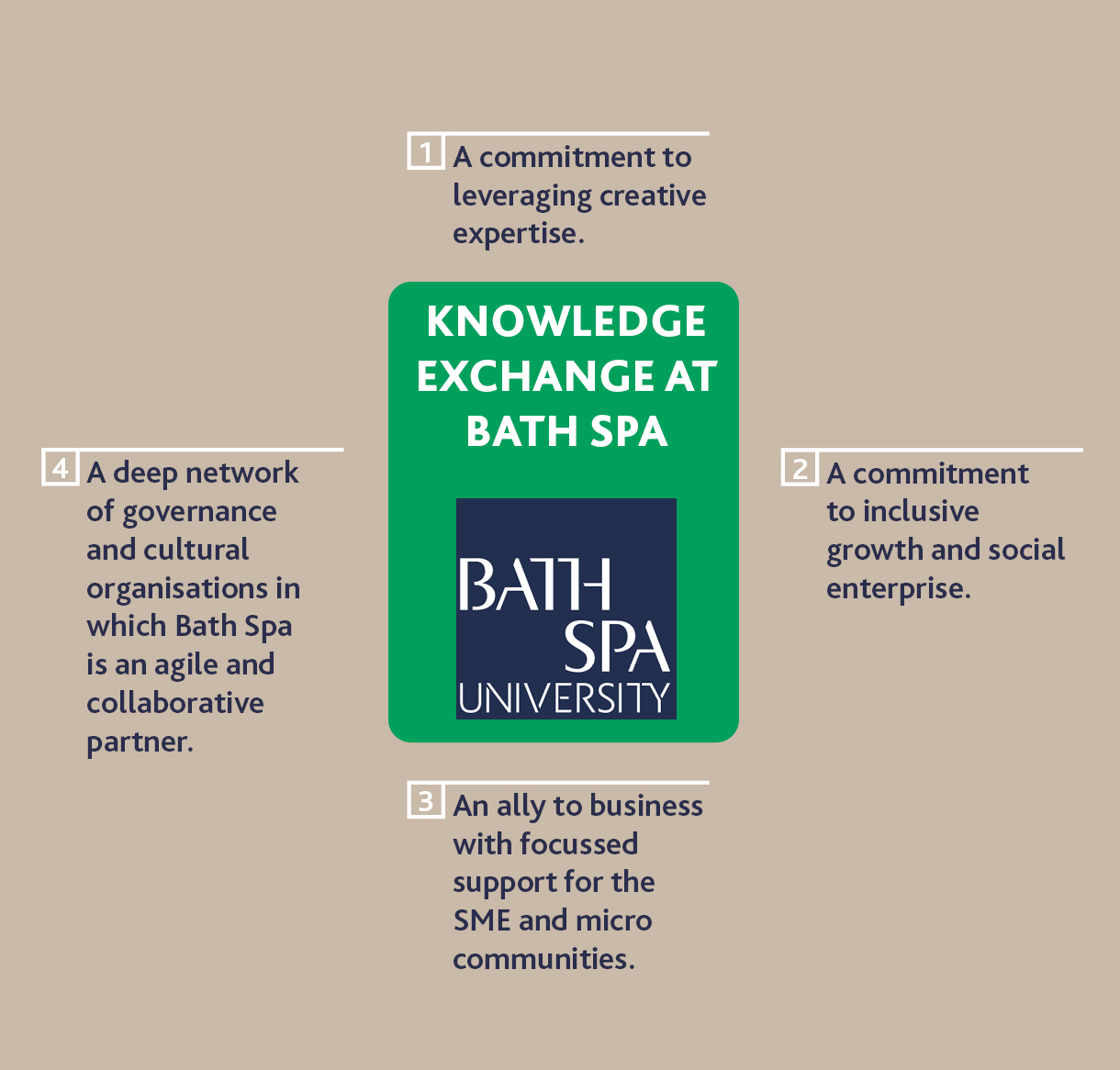
This approach has developed in response to the needs of the West of England Combined Authority, Bath and North East Somerset Council and the Swindon and Wiltshire LEP amongst other local partners. Our strong partnership behaviours are based on our University values: inclusion, sustainability, collaboration and respect and a commitment to co-creative and design thinking.
Aspect 1: Strategy
The University’s approach to local growth and regeneration is shaped by our four principles of knowledge exchange:
A commitment to leveraging our creative expertise
A commitment to inclusive growth and social enterprise
An ally to business with focussed support for the SME and micro communities
A deep network of governance and cultural organisations in which Bath Spa is an agile and collaborative partner
Geographical Area
The campuses of Bath Spa University are located in and around the city of Bath in Somerset and the small town of Corsham in Wiltshire. The Bath-Bristol and Wiltshire areas are therefore of strategic importance to the University as defined by the local governance structures in which its campuses are situated: The West of England Combined Authority (WECA), Bath and North East Somerset Council (BANES) and the Swindon and Wiltshire LEP. We work strongly across all areas via overarching projects, and in contribution to the Western Gateway.
The Bath geography encompasses areas amongst the most deprived 10% nationally and the least deprived 10% (gov.uk). There is a similar schism between the Swindon and Wiltshire area which is 49% rural (SWLEP) and Bath and North East Somerset which is classified as urban with significant rural areas (gov.uk). As a consequence of this Bath Spa University takes a partnership approach to identifying the needs of the local area in order to create an appropriately differentiated strategy (Bath Spa University Strategy to 2030: Enterprise).
Identifying Strategic Needs
The needs of these local geographies have been identified primarily through engagement with the local governance bodies, their respective Local Industrial Strategies and a series of cultural partnerships in these areas. In the West of England Combined Authority (WECA) in which our Bath campuses are located, the University’s Pro-Vice-Chancellor External sits on the WECA Business Board, the WECA Innovation Group, the WECA Living Labs Group and the WECA Employability and Skills Board. These Groups have oversight of the 45,000 businesses in the local economy which is worth £33bn per year (WECA: Business). The Director of our Centre for Creative and Cultural Industries also sits on the WECA Cultural Strategy Board and has helped to shape their Covid-19 Recovery Plan. Our PVC External’s seat on the West of England Growth Hub affords the University an excellent understanding of the business needs, innovation challenges and skills requirements of its local area as well as the influence needed to address them. The WECA area has the highest survival rate for SMEs in England and this has helped to inform the University’s commitment to supporting the micro and SME community through initiatives like the University’s The Studio startup incubator and the ISTART programme for business and skills support in Bath. The University is also represented by the Pro-Vice-Chancellor External on the Bath and North East Somerset Council (BANES) Renewal Board and the Bristol and Bath Regional Capital (BBRC) Growth Board as well as being in regular contact with South Gloucestershire Council and The Swindon and Wiltshire LEP meaning that the University can be responsive and agile in the wider region. The combination of these strategic positions enables BSU to exert strong partnership influence around social change for Build Back Better trans-disciplinary innovation.
All of these relationships and resultant activities help to ensure that our distinctive approach to creative enterprise and knowledge exchange are part of a thriving ecosystem that supports local growth.
Aspect 2: Activity
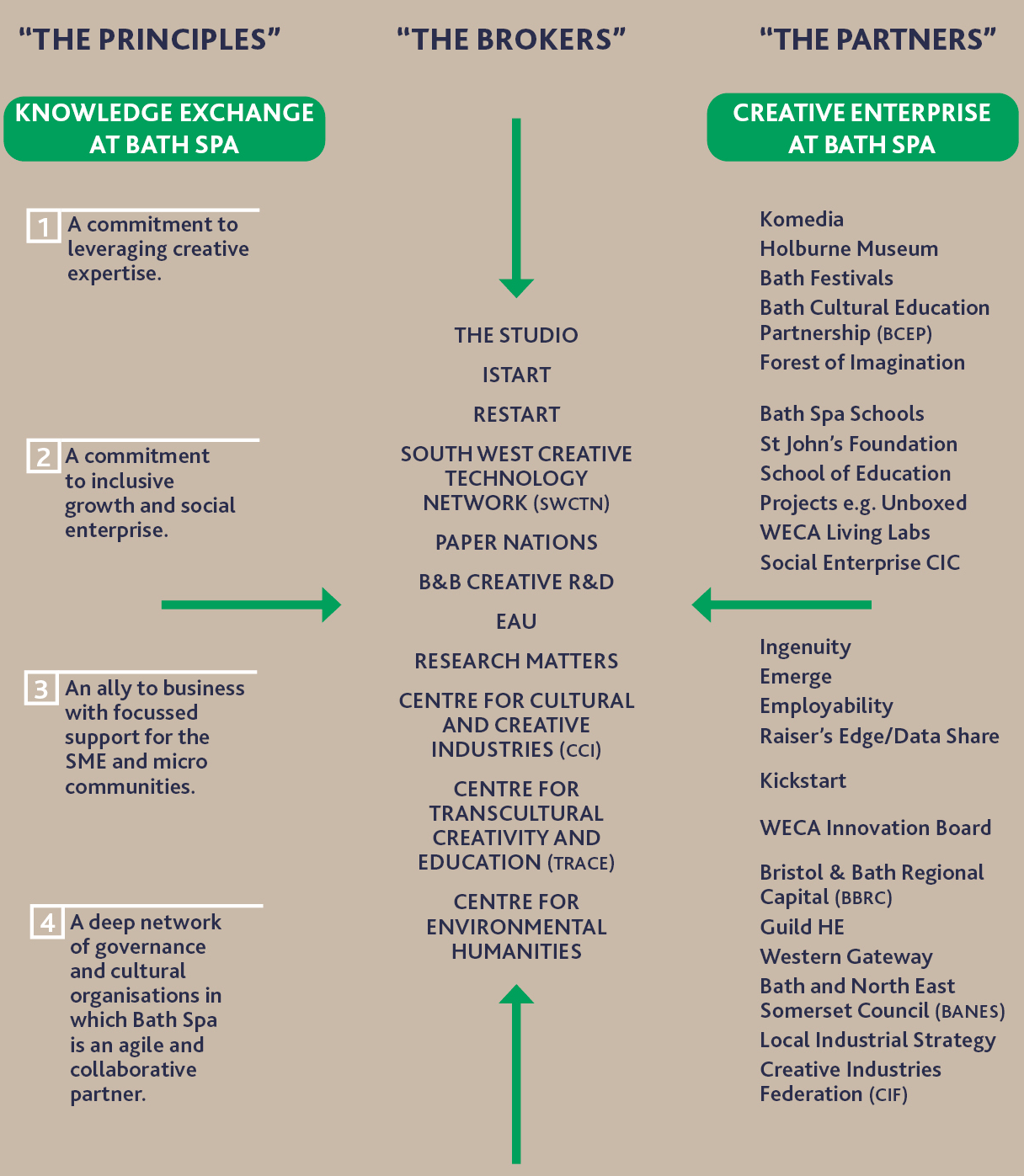
The activities that the University undertakes are in direct support of the four elements of our approach to knowledge exchange detailed below.
A commitment to leveraging our creative expertise
The University has enjoyed huge success over the past three years in securing research grants that use our creative expertise in support of the creative industries. For example, we are a partner in the Bath+Bristol Creative R+D project, part of the AHRC’s Creative Industries Cluster Programme. Through a mix of development labs, fellowships and large project funding this programme focuses on immersive experiences, live performance, voice activation and 5G to strengthen micro businesses in the creative sector, producing new jobs in new start-ups. The Bazalgette Report reported Bristol/Bath as one of three regions outside London to have international growth potential with a 50% advantage in productivity over other creative clusters, contributing £780m back to the Treasury, mainly from small and micro businesses and so this project was designed to develop this potential.
A similarly creative project on which we partner is the South West Creative Technology Network (SWCTN) awarded under Research England’s Connecting Capabilities Fund. The collaboration invests in interdisciplinary R&D fellowships and prototype production across immersion, automation and data. The project is developing a new, networked model of Knowledge Exchange for creative technologies’ innovation; a key focus is to facilitate creative technology and creative practices into other sectors including the Creative Industries, Health, and Manufacturing all of which were identified as priorities in the WECA Local Industrial Strategy. Bath Spa is also one of the partners on the new UKRI Strength in Places project, My World, which brings together cutting edge technology in film and television. ISTART is synergizing the same 'creativity +' methodologies into the inclusive growth agenda.
A commitment to inclusive growth and social enterprise
Social purpose is a defining part of the University’s vision and one that extends well beyond core educational objectives. The University is consolidating its track record in social enterprise education by applying for the Social Enterprise Gold Mark, having achieved the standard accreditation from the Social Enterprise CIC in July 2020. Our social enterprise excellence is being manifest in our top 40 Sustainability ranking; Responsible Business; our sector leading inclusive practice partnership in Film and Television; Social Justice and Special Educational needs in Education; Arts Council-funded inclusive growth creative digital engagements via Bath Cultural Educational Partnership and a whole series of local and regional business collaborations around Restart and ISTART to build the UK's first inclusive growth innovation pathways in digital skills from Level 2 to Level 7, community based and co-created.
There is also a deliberately inclusive dimension into much of the research and enterprise collaboration we undertake. For example, Bath+Bristol Creative R+D project is also host to Creative Workforce for the Future working with cultural organisations and companies across the region to connect them to exceptional talent from underrepresented backgrounds. Similarly the Arts Council funded project Paper Nations actively promotes inclusion and diversity within the writing and media industries through Writing for All, Time to Write and The Great Margin. Their Creative Writing in Schools programme focussed on areas of low cultural engagement and high deprivation and worked with a number of local schools to elevate creative confidence. All of these projects command close collaboration across the University and with key partners in local governance and Guild HE with whom we connect on multiple fronts and which afford us the chance to maximise the impact of our work.
An ally to business with focussed support for the SME and micro business community
In 2020 The University opened The Studio a centre for innovation, research and enterprise in the heart of Bath. The Studio provides a space for local micro-businesses, Bath Spa University students, academics and graduates to work on projects and ideas which focus on creativity and technology. The Studio provides a mixture of free and affordable desk space as well as business support and has already grown the number of business supported from 10 to 23 during the period of lockdown, meeting the high demand for targeted support for the micro-business sector in the Bath area. Early feedback has been extremely positive and as the space adapts for post-Covid working it begins a new programme of business support through training, pro-bono advice clinics and additional resources.
Two further ambitious streams of work are underway designed specifically to support the skills and business needs identified by the WECA’s Local Industrial Strategy and Skills Plan. ISTART was awarded funding from Bath and North East Somerset Council in 2020 which will create a campus in the centre of Bath designed to offer skills training and business support in the creative and digital sector. Restart is a pilot prototype for ISTART, devising a new digital business skills blended curriculum in partnership with the National Institute of Coding and Bath College. Based around a modular pathway structure designed to articulate with ISTART's research and innovation pathways, it is Britain's first inclusive growth transdisciplinary talent escalator and will provide a route to economic stability for a profoundly destabilised section of the working population of the West of England over the next five years. The Bath Business School also delivers a programme of creative networking events for industry, a partnership with Santander to support enterprise opportunities and live briefs for students to strengthen our relationships with local businesses.
An agile and collaborative partner
Cultural partnerships are essential knowledge exchange bases at Bath Spa. We have formal relationships that all focus, in different ways, on aspects of inclusion: with the Holburne Museum (mental health issues), Komedia (grass-roots social enterprise), the Bath Festival (crossing high/contemporary cultural barriers) and the Bath Cultural Education Partnership (creative pedagogy) amongst others. These partnerships afford the University a dialogue with the key organisations in the local cultural economy that can both highlight priorities and needs and also a means of shaping and responding to the outcomes.
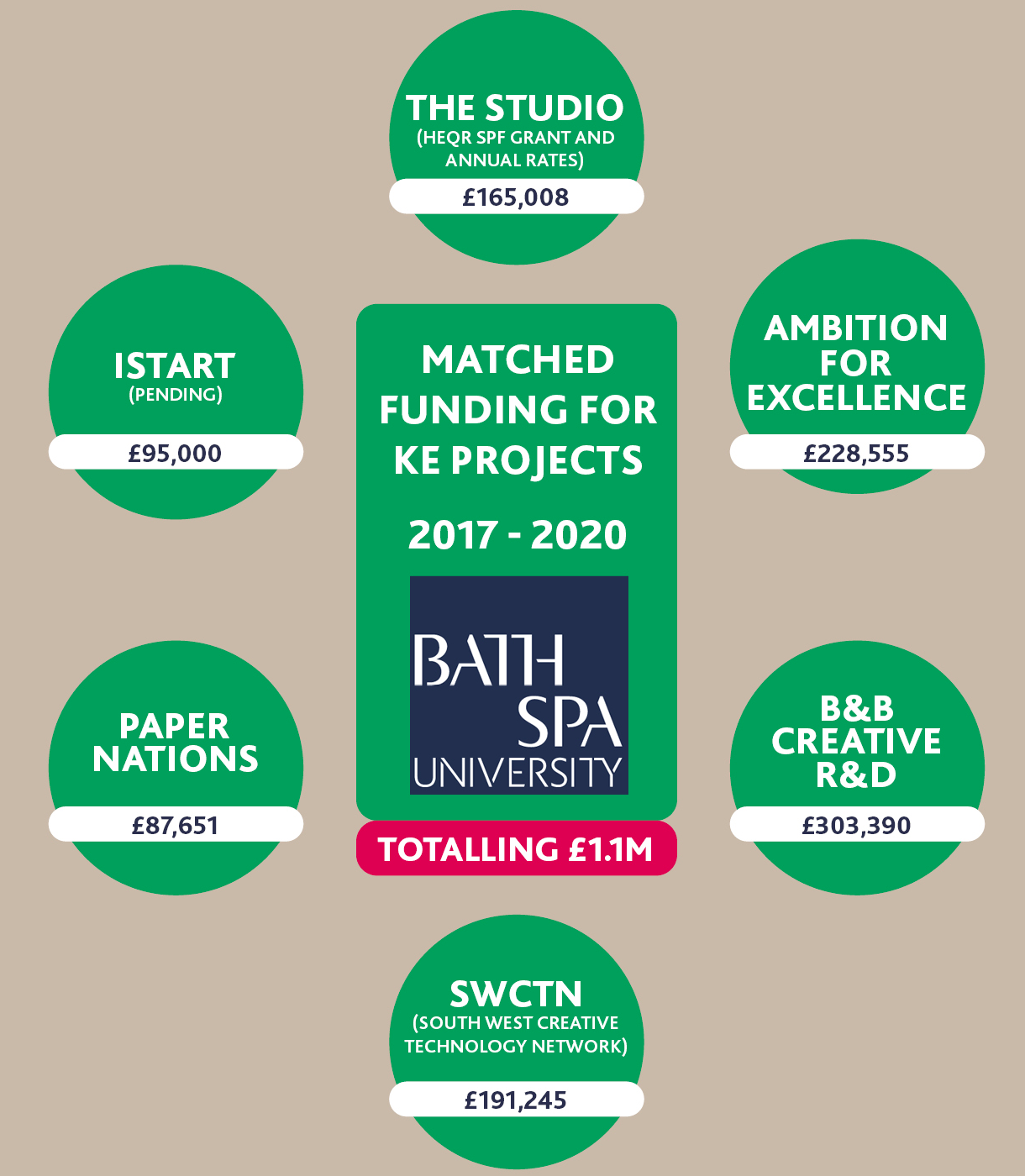
Matched Funding
As the University is not in receipt of HEIF all of these achievements have been facilitated by the University’s own investment. In support of projects that leverage these commitments to KE the University has provided matched funding of £1.1m during the KEF review period.
Aspect 3: Results
Responsibility for understanding the impact of our knowledge exchange activity sits within the University’s Enterprise Steering Group which reports directly to the Senior Leadership Group and ensures our activity and its outcomes are strategically-led and scrutinised.
Commissioning formal evaluations
As much of our recent knowledge exchange activity has been delivered through funded projects we have been able to plan for interim and final evaluations within the application process. For example, Paper Nations employed independent evaluator LKMco to evaluate their Creative Writing in Schools programme. The results show a number of successes including that young people writing less often than their peers at the beginning of the intervention wrote more often by the end of their involvement. Similarly, Bath+Bristol Creative R+D and the South West Creative Technology Networks both include formal reporting and evaluation milestones and are able to ensure that their impacts continue to be effective in the ways originally intended. For example: SWCTN’s interim report highlighted:
583 Network Members
80 projects
16 Prototype Teams
50 Microgrants
19 Business Development Grants
Over £1 million in leveraged funding
Communicating through established partnerships
One of the underpinning characteristics of the University’s approach to knowledge exchange is its commitment to partnership working. This affords the University both a broad and a deep reach into different sectors and communities and allows us to communicate effectively. We do this through regular partnership meetings with governance bodies, cultural partners and other stakeholders including the WECA, BANES and SWLEP.
Leading by Example
It is also important to note that the objective of the University’s knowledge exchange activity is to contribute to a resilient and agile society and economy. Our own approach therefore strives to embody this approach by using an agile sprint methodology to get projects and collaborations off the ground quickly, iterating as they go, and to work through problems and solutions while the project is in motion. The Restart project is a particularly clear example which mobilised quickly in response to the Covid-19 crisis in the WECA area. This approach creates a high degree of both resilience and agility in our own internal capacity for knowledge exchange and allows us to embed feedback and evaluation into the process itself rather than seeing it as part of concluding the project. In so doing we create more effective and responsive activity and seek to generate more effective results.
For further information, please send queries to s.priston@bathspa.ac.uk
Public & Community Engagement
Summary of approach
At Bath Spa University we are innovative and resourceful and our public engagement is distinctively creative, involving stakeholders in all we do. This dynamism brings a sense of energy to our public engagement activities ranging from collaborative projects with businesses, schools and museums, to citizen science activities, literary festivals, film screenings and exhibitions.
We pride ourselves on our sense of community and the way in which we nurture relationships. We enable communities to engage with research at all stages of a project life cycle so that not only do we aim to share our knowledge, resources and skills, we also listen to and learn from the many different communities with which we engage.
Aspect 1: Strategy
Bath Spa University’s Strategy for Public Engagement is underpinned by four strategic commitments: to explore the distinctiveness of public engagement with our research, to celebrate our successes and learn from our challenges, to coordinate and strengthen our support for public engagement and to build on what we learn to develop our engagement offering. Developed in 2018 the strategy has allowed us to consolidate our support for public engagement and to extend the relationships with the communities around us.
The strategy was informed through working with the NCCPE to undertake an Engage Survey of the University’s public engagement activity and infrastructure. This work in 2018, supported by the AHRC, allowed the NCCPE to undertake a staff/student survey structured around the EDGE tool and to benchmark the results against provision in the sector. The NCCPE’s report remarked ‘There appears to be a strong ethos and culture of embedding public engagement into the research process: not only at the end to share and communicate the results, but right through the research cycle.’
Furthermore, the commitment to public engagement has been enshrined in the University’s Strategy to 2030 through its ‘partnerships approach’ (University 2030 Strategy). This approach focuses on both the University’s relationships with the city of Bath, the wider region and beyond, but also on the economic and cultural development that these partnerships can foster. Bath Spa University is a long-standing signatory of the NCCPE’s Manifesto for Public Engagement and as such has a strong sense of the value of dialogue and mutuality that public engagement affords.
Oversight of public engagement activity sits with the University’s Central Research and Ethics Committee which reports directly to the University’s Academic Board. These governance structures provide accountability for the ethical and effective delivery of the strategy, but they also ensure that considerations of public engagement are embedded in the highest level of research planning and that opportunities can be quickly embedded within all of the Schools of Study. At a senior level the Pro Vice-Chancellor Research and Enterprise has oversight of public engagement governance, Public Engagement Champions are embedded within each of the Schools of Study to provide local level leadership and to signpost resources and the three Professors leading the three University-wide Research Centres are all tasked with delivering the public engagement agenda within the University’s research centres and groups.
Aspect 2: Support
Institutional support for public engagement sits centrally within the University’s Research Support Office but is also available locally within the Schools of Study. Our Researcher Development Manager and Research Impact Fellow are trained NCCPE Ambassadors and the University has supported the training of three further Ambassadors among the academic body.
At a central level there is a rolling programme of training in various aspects of public engagement for all research postgraduates and staff across the University. These events vary from simple introductions to workshops tailored to particular career stages or disciplines. Over the past three academic years we have run 16 workshops reaching almost 350 of our staff and PhD students, meaning 52.5% of that cohort have received public engagement training. Training is provided in house by our Researcher Development Manager and our Impact Research Fellow who are NCCPE Ambassadors but the University has also invested in external trainers from the NCCPE.
Support for public engagement is extended through the University’s promotions criteria which require all promotions to Readerships or Professorships to demonstrate ‘clear [or substantial] influence and impact on non-academic communities through, for example, engagement in knowledge and technology transfer, policy development, changes in practice or engagement with particular community groups.’
Within each of the Schools of study sit a set of University-wide Public Engagement Champions. Between them, this group spans the many interdisciplinary-research groups that exist at Bath Spa. The Champions provide peer-level support and aim to increase and promote internal discussion around public engagement.
Over the past three years the University has provided financial support for public engagement from its QR allocation through the Public Engagement Seed Fund which has supported over 75 projects with grants of up to £500 each. It has also supported a number of externally-funded projects including the MSCA European Researchers’ Night (2017, 2018, 2019), Follow-on Funding for Public Engagement (Parry 2016, Penrhyn-Jones 2017, Purcell-Gates 2018) and a British Academy Rising Star Engagement Award (Etchells 2017).
Aspect 3: Activity
The University’s public engagement activities are framed by the four aspects of our approach to knowledge exchange and we consider them each in turn.
A commitment to leveraging our creative expertise
In 2018 we opened up our Research Open Day to the general public, showcasing the research taking place within the University in a variety of accessible ways including readings from Terry Gifford's latest poetry collection A Feast of Fools, a creative writing workshop with award-winning children's author David Almond, and a performance and choreography workshop with Senior Lecturer Thomas Kampe. We plan to build upon the success of these events including on-line participation as circumstances permit. The Public Lecture Series – lectures and conversations led by our Professors, Early Stage Researchers and Guest speakers attracts an audience of around 500 per year and provides a discussion platform for creative thought.
A commitment to inclusive growth and social enterprise
A proportion of the University’s public engagement activity is centred on working with marginalised groups. A recent example is The Great Margin, a community project giving voice to writers and readers experiencing marginalisation and isolation. As part of the initiative to support and develop writers during the covid crisis they teamed up with international bestselling author and poet Carolyn Jess Cooke to launch the Stay-at-Home! Literature Festival (March-April 2020). Over 20,000 people joined in with 145 digital events run by 220 writers. The Creative Writing in Schools programme funded by the Arts Council also focussed on supporting children in areas of low cultural engagement and deprivation – the independent evaluation completed at the end of the project concluded that ‘young people writing less often than their peers at the beginning of CWiS wrote more often by the end of their involvement.’ Similarly, the £20m ISTART project and its immediate prototype Restart are targeted at core areas of social and economic deprivation to enable digital skills and will involve working with a wide range of publics in a way that carries our humane values and a commitment to creative technology to make us more human.
An ally to business with focussed support for the SME and micro business community
The University’s engagement with the businesses community has been focussed around The Studio our innovation space and the South West Creative Technology Network (SWCTN) – an AHRC-funded Connected Capability project that brings together businesses working in creative technologies to develop new products and services. Opened in 2020 The Studio has created workshops with the micro business residents and has facilitated them to discuss their work with one another and the wider SME community in Bath. Although much of this activity has been hampered by covid-19 there is an ambitious programme of public engagement being co-produced by the residents. The SWCTN has, by virtue of its network structure, a reach across the South West of England and has successfully brought together business, academic and community partners to increase awareness of the myriad applications of creative technologies. Examples include the Immersing Audiences podcast about creative people and technologies across the South West, working with Raucous Theatre Company to produce an immersive ‘play in a day’, and an app Shared Pasts: Decoding Complexity that offers a way to explore the past through different narratives and contests bias in historical interpretation.
A deep network of governance and cultural organisations in which Bath Spa is an agile and collaborative partner
The University has participated in a number of public engagement initiatives in collaboration with other Universities including the MSCA European Researchers’ Night (2017, 2018, 2019). We also have formal relationships with the Holburne Museum, Komedia, the Bath Royal Literary and Scientific Institution, the Bath Festival and the Bath Cultural Education Partnership amongst others. These partnerships allow us to extend the audiences who collaborate on our research and with whom we engage. For example, our creative writers participate in the Bath Childrens’ Literature Festival and the Schools Without Walls project uses the children of local primary schools to take up residency in the Egg Theatre co-creating festival events. Our engagement draws on the research expertise of our staff and embeds that into the local community to ensure it responds to their needs and enriches our environment.
Aspect 4: Results and learning
Where possible Bath Spa University costs external evaluation into its applications for external funding and therefore many programmes of work have benefitted from external scrutiny and their contribution to our strategic objectives is clear. An example is Forest of Imagination, an annual immersive arts festival for families that reimagines familiar urban spaces in the city of Bath to inspire creativity and a sense of nature. The evaluation report of the 2019 festival concluded that ‘This direct impact on participants includes making people aware of the varieties of ways in which creativity can be experienced in artistic and other participatory activities … Research into this impact on participants is part of Bath Spa University’s engagement with the event.’ Similarly the Creative Writing in Schools programme funded by the Arts Council focussed on supporting children in areas of low cultural engagement and deprivation – the independent evaluation completed at the end of the project concluded that ‘young people writing less often than their peers at the beginning of CWiS wrote more often by the end of their involvement.’
In addition to formal evaluation there is a strong ethos within the University that research should be co-created with the communities involved, and this is especially evident in the School of Education that works with hundreds of schools nationally. This ethos means that success and learning are embedded in the project and iterated during the project lifetime. Examples include the flagship Attachment Aware Schools which works with schools, pupils and education bodies to create the nurturing environments that support children, or the work with Special Educational Needs Co-ordinators and the National Education Union to research workload, recruitment and retention issues. These models of co-creation are being strongly encouraged in all University research applications and are supported by the Research Support Office and the programme of training detailed in Section 2.
Not withstanding the work outlined above, the University has identified that more must be done to embed the routine capturing of evidence and to this end it has been made a priority workstream. for 2021, endorsed by the University’s Senior Leadership Group in September 2020.
Aspect 5: Acting on results
Acting on the results of our public engagement evaluation is a nascent area of activity at Bath Spa. At an institutional level we invested in Vertigo Venture’s Impact Tracker software in 2015 and have been using that to capture evidence of the impact of individual research projects and their public engagement activity. This has improved the availability of evidence and also the quality of insight, for example it was data captured through the software that helped to secure Wellcome Trust Follow-on Funding for Public Engagement in 2017 for the medical theatre project The Depraved Appetite of Tarrare the Freak. Internally it has further supported the periodic reporting of impact through the monthly Research Newsletter, annual reporting of activity to the University Research, Consultancy and Ethics Committee and annual reporting to the University Governors.
The Public Engagement Steering Group was the University’s main mechanism for soliciting feedback on our public engagement activity from staff and students. Although this activity was collapsed into the broader Research, Consultancy and Ethics Committee in 2017 the reinvigoration of this focus on public engagement and the inclusion of external stakeholders is a priority area of activity for the University in 2020-21. An exploration of becoming a Civic University will form part of this ongoing package of work and will in turn help to ensure that our public and community engagement meets the University’s own strategic ambitions and the needs of stakeholders.
For further information, please send queries to s.priston@bathspa.ac.uk