Note You are currently viewing a previous version of this narrative statement as published in previous iterations of the KEF (KEF1 and KEF2). View the latest version
Institutional Context
Summary
Edge Hill University is based on an award-winning, 160-acre campus in Ormskirk, Lancashire, with additional sites in Manchester and across the North West.
Founded in 1885 to provide teacher-training, Edge Hill now delivers in a broad range of disciplines and topic areas, including Computer Science, Biosciences, Geosciences, Medicine, Health and Social Care, Social Sciences, Business, Arts & Humanities and Sport and Physical Activity, while remaining one of the UK’s largest providers of teacher-training.
Underpinned by TEF Gold teaching, research excellence, and a longstanding commitment to the creation of opportunity for all, Edge Hill works through partnerships with business, public bodies and the third sector to tackle key organisational, economic and societal challenges though the application and transfer of knowledge.
Institutional context
Edge Hill’s mission is to provide an intellectually stimulating, creative and inclusive environment. Teaching and learning of the highest standard are central, supported by pure and applied research of international significance, providing a firm foundation for graduates and other stakeholders in a rapidly changing world.
This is reflected in the University’s approach to knowledge exchange (KE), developed since 2015 and marked by:
Opportunities for students to apply knowledge through work in non-academic settings and gain experience and insight into the skills and attributes required for workplace success. Student-based KE, supported by academic and professional services staff, is a key plank of Edge Hill’s approach to knowledge exchange.
Partnerships with business, public sector, third sector organisations to tackle organisational, economic and societal challenges (including workforce development, productivity, innovation, leadership, new processes and products).
Developing strategy, particularly at local and regional scale, through engagement with local authorities, business, LEPs, other HEIs
Clear points of entry for stakeholders to engage with staff and student expertise and efficient management of enquiries, facilitated by research and knowledge exchange institutes, research centres, and a dedicated business unit working with SMEs.
Professional KE support, working with stakeholders to develop projects
Public engagement activity addressing targeted audiences
This approach is delivered across a broad disciplinary mix (arts, humanities, social sciences, medicine, healthcare, education, computer sciences, biosciences and geosciences). Edge Hill continues to expand STEMM provision, with further developments planned in engineering, mathematics.
Edge Hill is located on the edges of the Liverpool City Region near Liverpool and in the Lancashire LEP area, with strong connections (transport, economic, organisational) to both. It also enjoys good connections with Greater Manchester where the University has a campus. This is reflected in the composition of the University community and its KE activity. The University predominantly serves a mixed rural and urban hinterland, characterised by:
Relatively low business density in the immediate area but a larger, more diverse pool of businesses in the Liverpool, Manchester and Preston conurbations.
Low population density in the immediate area but access to large population centres, (Merseyside, Greater Manchester, Preston).
A region with major strengths in key sectors but lagging best performing regions of the UK on measures including output, GVA, employment, business density, productivity, innovation.
As such, public policy and investment emphasizes:
Key sectors (including digital, arts and culture, engineering, manufacturing, transport, logistics, and healthcare).
Key competencies including digital capability leadership, innovation capacity and behaviours
Regeneration of urban areas, and
Tackling labour market disadvantage.
The University’s investment in research and knowledge creation capability, as evidenced by progression over REF cycles (successive doubling of the percentage of staff submitted, doubling of research income) has been accompanied by strategic KE investment that responds to this socio-economic and policy context, marked by:
Rapid expansion of STEMM capability
Delivery of major projects that respond directly to local economic development priorities (innovation, leadership, skills)
The development of research institutes to respond to the needs of key sectors (e.g. digital, creative, education, healthcare) and public policy priorities, and
a dedicated SME-facing business unit.
For further information, please send queries to hughesch@edgehill.ac.uk
Local Growth and Regeneration
Summary of approach
Working across the North West, with an emphasis on West Lancashire, the Liverpool City Region and the wider county of Lancashire, Edge Hill’s approach to local growth and regeneration is based on responding directly and strongly to local economic development priorities, partnership working and the development of strategic relationships. We focus our efforts and strategic investments into clearly defined action areas:
Business Performance & Key Sector Growth – action on productivity, innovation and leadership, and helping to stimulate the growth of the cultural, creative and digital industries
Public Sector Innovation – helping to improve public sector policy and practice in order to address inequalities of outcome and opportunity
Helping to strengthen communities and extend opportunity with a focus on community-led responses.
Aspect 1: Strategy
Edge Hill University is active across North West England, the UK and beyond, but its strategic approach to local growth and regeneration is focused on Lancashire and the Liverpool City Region. This includes:
the West Lancashire district, which includes the market town of Ormskirk, Skelmersdale (with significant areas of deprivation and large manufacturing and logistics sectors), and villages within a predominantly rural setting
the wider county of Lancashire, which includes the city of Preston, the cathedral city of Lancaster and other major towns, a major advanced manufacturing and logistics sector (centred on the M65 and M6 corridors) and a large land-based industries sector (tourism, farming)
The Liverpool City Region, with a population of 1.5m people and a large and diverse industrial base including professional services, arts and culture, advanced manufacturing, maritime and other logistics, tourism, retail and public administration services).
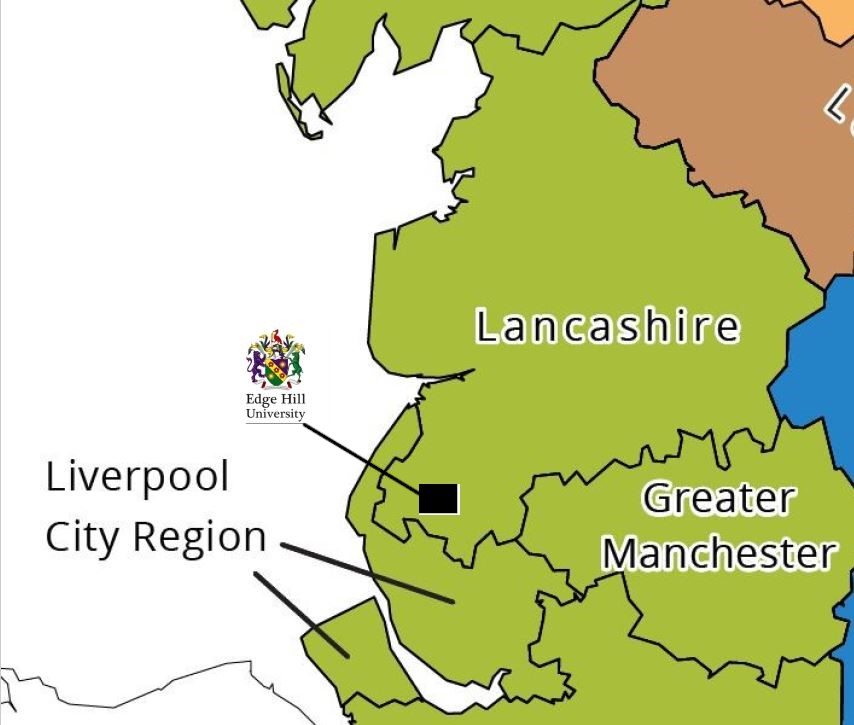
The strategic importance of these areas to Edge Hill’s local growth and regeneration activity stems from:
Long-established patterns in local economic geography including travel-to-work areas, the key role of Liverpool as a service centre and population centre and the more distributed and poly-centric nature of the Lancashire economy. Some 80% of our graduates live and work within the West Lancashire and Liverpool City Region area
The density of business, public sector and third sector partner organisations
The presence of significant socio-economic challenges and opportunities
The administrative boundaries within which public investment is delivered.
Edge Hill is an active partner in the development and delivery of local growth and regeneration strategy, and this has informed our needs assessment. This is demonstrated through our:
Membership of the Skills and Employment Advisory Panel Board of the Lancashire LEP
Active role in the development of strategic plans at LEP level, including Local Industrial Strategy documents
Co-founding of the Lancashire HEI Innovation Forum, through which we work with Lancashire County Council and other HEIs to bring together the innovation capabilities of the region. We have jointly-funded an innovation development post at Lancashire LEP
Extensive networking and strategic engagement with key external partners across the cultural industries and the creative and digital economy of the North West
Work with Liverpool Health Partners, a collaboration between HEIs and NHS organisations to unify clinical and academic strengths within the region in order to improve population health outcomes and economic productivity
Role within Boost, Lancashire’s Business Growth Hub, a key co-ordinating mechanism for SME business support
Membership of the Universities Economic Development Unit, and our active participation in the BEIS North West – Lancashire HEIs forum.
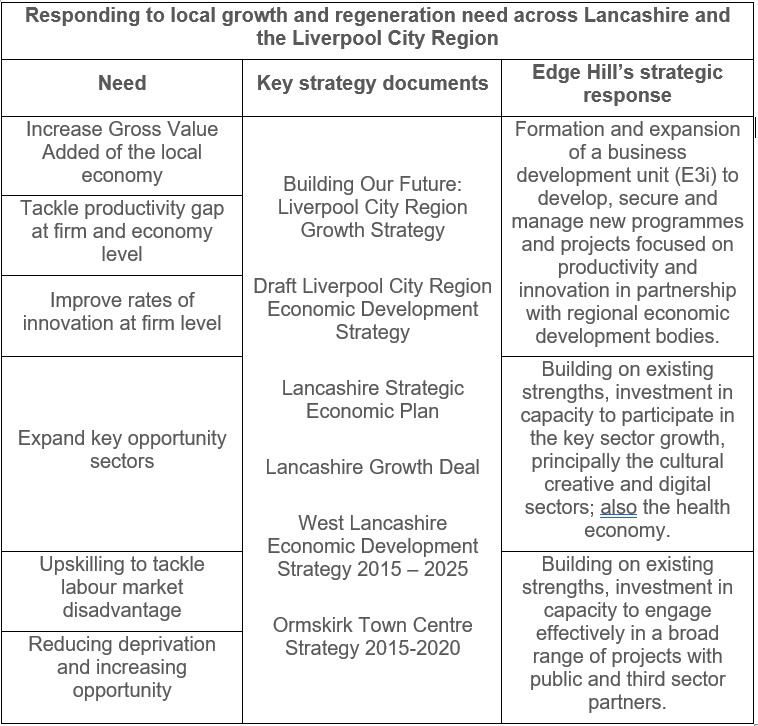
This has informed the key strategic activities that we undertake, as summarised below.
Reflecting our increased emphasis on broad area-based partnerships the University began an ambitious collaboration with Wigan Council and other local partners in July 2020. This aims to transform life chances in Wigan through the creation of opportunities for people to develop skills, enhance their ability to gain employment and make sectors such as health, social care and education more attractive as career options. This will be delivered through a range of actions including collaborative policy research, labour market studies and work with schools and colleges.
Covid-19 required a significant shift in priorities in 2019/20. The work of the Productivity & Innovation Centre has been rapidly refocused from business growth to business resilience via the React, Stabilise, Refocus: The Resilient Recovery Support Plan Programme (engaging with 105 businesses over three sessions from July 2020), working with Lancashire Business Review, and crisis recovery with Lancashire BOOST. Work on the management of high street environments has similarly been re-focused towards resilience.
Source: Office for National Statistics: Adapted by Edge Hill University under OGL.Aspect 2: Activity
Much of our work takes place within three action areas.
Action Area 1: Business Performance & Key Sector Growth
Work on Business Performance is centred on the Edge Hill Technology Hub, built at a cost of £13m and opened in 2015/16 with financial support from Lancashire LEP Growth Deal Funding, via Lancashire County Council) and housing the Enterprise, Employability, Entrepreneurship and Innovation (E3i) team, E3i labs for business and student interaction and the academic departments of Computer Science and Biology.
The E3i team works with regional partners (including Lancashire BOOST) to stimulate enquires from SME businesses and provide a single point entry for all businesses. E3i works with businesses to understand their needs, define projects and route them as appropriate to:
Our large ESIF-funded business support programmes:
Productivity and Innovation Centre (PIC), with distinct programmes for Lancashire and Liverpool City Region (LCR), part-funded by the European Regional Development Fund, the PIC addresses the need to combat lower rates of productivity and productivity growth, innovation and growth through data-driven work with SME management teams on new product, service and process development, accelerating the uptake of established digital business practices and targeted work with SMEs with clear scaling-up potential. In the LCR this support will be forming part of the High Growth programme.
Upskilling Lancashire: Part-funded by the European Social Fund, supporting Lancashire based SMEs and micro businesses to increase the skills and capability of their employees,
Leading Lancashire: part-funded by the European Social Fund, supporting employees of Lancashire based SMEs to acquire leadership skills though CMI-accredited courses
Our Innovate UK-funded Manufacturing Connect (a partnership with the Advanced Manufacturing Research Centre), a management-focused, short, intensive scheme to help firms quickly build confidence and a clear business case for adopting new digital technologies (focused on Customer Relationship Management, Resource Management, Production Planning)
Business development support for the development of bespoke projects, including:
Student-led projects (placements, live curriculum-based projects) in all disciplines
Collaborative grant applications e.g. KTP projects and other Innovate UK competitions)
Contract research and consultancy projects across all disciplines but particularly Computer Science, Business).
Our ESIF-funded projects respond directly to strategic priorities and calls for proposals for specific interventions issued by regional partners, led by LEPs, directly addressing need. Similarly, our Innovate UK-funded Manufacturing Connect programme addresses strategic economic priorities. Our performance against contractually agreed output and outcome targets is monitored closely.
Responding to key sector growth priorities in the LCR, Lancashire, North West and UK, Edge Hill’s Institute for Creative Enterprise (ICE) acts as the gateway for academic staff to collaborate with external partners across the cultural industries and creative and digital economies. ICE works with core cultural partners (including Tate Liverpool, Arts Council England) in long-term relationships, underpinned by MoUs. ICE also works closely with project partners on specific projects, including:
Local cultural institutions (e.g. Bluecoat, FACT, National Museums & Galleries Liverpool, Tate Liverpool, Blackpool Grand Theatre, Liverpool Everyman and Playhouse)
Sector development bodies (e.g. Liverpool Film Office, Culture Liverpool, Creative Lancashire, Professional Liverpool, UNESCO Liverpool World City of Music)
Festival organisers (e.g. Writing on the Wall, Liverpool Irish Festival, Liverpool Biennial and Liverpool Sound City)
Businesses in the cultural, creative and digital sectors (e.g. Hurricane Films, LA Productions, Doc Society, British Film Institute, Film Hub North, Screenlife UK, British Interactive Media Association, Agent Marketing).
Key projects and initiatives in the last three years include:
Working in partnership with Liverpool Film Office, Culture Liverpool, FACT and Screenlife UK to establish a strategy for the talent pipeline in LCR of creative, digital and media professionals, including an AHRC funded project to connect LCR cultural producers to the Shanghai City Region
Work with partners on the cultural offer of town centres as a driver for revitalising high streets, such as Culture Warrington, Morecambe international theatre initiative, Wigan Old Courts and Heart of Glass, St Helens
Contributing to efforts to promote regional economic development through cultural knowledge exchange activity (including working with the Chapel Gallery to strengthen the role of Ormskirk as a cultural and visitor destination; supporting the Lancashire City of Culture bid; supplying impact analysis to National Museums of Liverpool enabling jobs, growth and student opportunity.
Action Area 2: Public Sector Innovation
Edge Hill has a long tradition of knowledge exchange with public sector organisations, often on locally targeted projects addressing inequalities of outcome and opportunity in health, education, labour markets and access to resources and services, particularly in:
Health and social care services (with work led by Edge Hill’s Health Research Institute)
Education (primary, secondary, tertiary)
Charity, community, voluntary sector responses to community needs.
In addition to traditional income-bearing knowledge exchange work (e.g. contract research, consultancy, evaluation studies), this also takes the form of academic-supported student-led work.
Key examples include:
Service evaluations for NHS and emergency services organisation, including Hospital Trusts, Clinical Commissioning Groups
Evaluations of efforts to use culture, sport, arts to address wellbeing, mental and physical health and to tackle social problems including crime. These include: Culture Cures, an evaluation of an investment scheme overseen by Wakefield Council’s Culture and Health Improvement teams
Policy and strategy work, including
West Cheshire & Chester’s Poverty Truth Commission, exploring new ways of working with an explicit commitment to supporting those whose lives have been directly affected by poverty and who are willing to testify through a formal process in order to influence decision-makers.
Integrated working in communities across public sector organisations, including a major review of the application of co-operative principles in public sector reform within Rochdale.
We use a range of evidence to verify that we are meeting needs, including repeat commissions, client/ partner feedback.
To build on our expertise in this area and scale-up activity, we established the Evaluation and Policy Analysis Unit in 2019, nested within our Institute for Social Responsibility (ISR). Evaluation specialists within the Unit work with our subject-matter experts in order to design and deliver evaluations of public-sector interventions and policies, providing an evidence base for innovation.
Action Area 3: Helping to strengthen communities and extend opportunity
The ISR acts as the focal point for knowledge exchange engagements with community partners, local regeneration initiatives and local authority partners, providing expertise, and seed corn funding for new project development.
Work in this action area is focused on geographically targeted action to:
Tackle the emergence of inequalities that lead to deprivation and reduced life chances, including lower levels of literacy e.g. What’s Your Story, Chorley? and Liverpool Reads
Improve education delivery and attainment e.g. the emerging School Improvement Offer working with schools in Liverpool to improve provision in specific subjects; work with the National Centre for Computing Education (funded partnership work with STEM Learning, Computing at School and Raspberry Pi) to improve computing education for women
Helping to shape the design and delivery of charity, community and third sector action on health and wellbeing, including
A collaboration with Everton in the Community, delivering projects including Tackling the Blues (focused on mental health) and Active Blues (promoting physical activity)
Build community capacity and resilience, including
exploring community wealth-building in Skelmersdale, West Lancashire.
Fostering strong, vibrant voluntary organisations (e.g. CULTIVATE, an arts-based project at Burscough Community Farm in West Lancashire).
Aspect 3: Results
Outcomes are monitored by the HEIF and KE Steering Group, reporting to University Research and Innovation Committee. Major projects are monitored by dedicated groups, including the University-level ESIF Steering Group which receives and reviews monitoring and evaluation evidence collected and undertaken in preparation for future funder-commissioned evaluations. These groups use the emerging evidence of outputs and impacts to inform decisions about the management, operation, expansion and extension of these projects and allocation of match-funding to them, ensuring that we make decisions based on evidence of need and demand.
As activity is varied there is no single evaluation framework for all our activity, although work to design an integrated framework is underway in preparation for the Knowledge Exchange Concordat. However, all monitoring and evaluation is expected to, as a minimum:
Assess (continuing) strategic fit/ contribution
Engagement levels: e.g. the number of business or CPD assists, projects, income levels
Qualitative assessment of feedback on the extent to which the event met its stated aims from:
Project team
Beneficiaries, partners
Outcomes: A wide variety of outcomes may need to be tracked according to the logic chain within the project. These include:
New products, services, processes developed
CPD attainment.
Adoption of specific recommendations
Client/ stakeholder feedback.
For further information, please send queries to hughesch@edgehill.ac.uk
Public & Community Engagement
Summary of approach
Edge Hill’s approach is to identify, understand and work together with communities of place (particularly our local community), communities of interest and communities of practice. Public and community engagement is regarded as a central element of our University mission and a key concern of the University as a whole, rather than the mission of a single team or unit. Our approach cuts across all aspects of University life, involving academic staff, our students and professional services. We plan for and support public and community engagement via our research groups, centres and institutes, set within a central framework to celebrate, reward and support it and to provide opportunities to engage in major initiatives, including our annual Festival of Ideas.
Aspect 1: Strategy
Edge Hill University’s strategic approach to public and community engagement (PCE) is founded on an understanding of PCE as a central element of University mission, enabling us to form connections with the public, share our work with them and involve them in it. It recognises that effective PCE is a goal that must be delivered through a broad spectrum of activity, encompassing the co-production of knowledge via the design, delivery and dissemination of research, the generation of research impact, outreach to the community and efforts to enrich public life.
Our strategy recognises that PCE is an activity that must be both driven (planned, targeted, resourced) and allowed to happen naturally, emerging from the commitment and interests of our staff. It must be recognised, celebrated and supported by the University.
PCE involves use of a full range of intellectual, physical and other resources, including our people, campus and facilities.
Effective, rich PCE requires an understanding of the needs of all participants. Our strategy involves the identification of multiple publics and specific communities, allowing us to target and tailor our work. These include:
Communities of place: these include the local communities of Ormskirk, West Lancashire, wider Lancashire and the Liverpool City Region with which we have strong ties. They also include other geographical communities in which we engage in specific initiatives (Skelmersdale, Wigan).
Communities of interest: these reflect the range of disciplines at Edge Hill and the topics and challenges to which our work is applied. Our academic staff are rooted in these communities through the co-design and co-production of knowledge. Our three research institutes – the Health Research Institute (HRI), the Institute for Social Responsibility (ISR) and Institute for Creative Enterprise (ICE) – have been established to facilitate, support and enable work with these communities. They provide a focal point to bring together communities outside and inside the University, encouraging, modelling and facilitating PCE.
Communities of practice: particularly in our Faculty of Education and Faculty of Health, Social Care & Medicine our work is directly relevant to the needs of large communities of professional practitioners. Our staff are rooted in these communities (often as current or ex-practitioners, membership of professional associations and working groups) and engage with them through co-design and co-production of knowledge, outreach and dissemination.
We plan PCE activity and allocate resources through the following framework:
Research and research impact: Research leadership, guidance and support emphasise the importance of engagement with external partners to inform the identification of research questions, and co-design, delivery and dissemination of research questions.
Internal priming funds, the design of internal funding calls and support for external funding applications reflects this. Researchers are encouraged, supported and trained to identify non-academic groups who may benefit from application of their research insights, to identify and plan how best to promote impact, including through targeted PCE.
Research Institutes and research centres: All research institutes and research centres produce strategies and business plans that identify targeted approaches to PCE, the promotion of PCE internally and support to be provided.
Student engagement in volunteering, project-based work and major initiatives.
Widening Participation: Central to our University mission, we design and deliver a wide range of activity intended to promote higher education in general and specific disciplines in particular to under-represented communities and groups. This is reflected in our approach to the education and training of doctors in our new Medical School.
Leveraging our campus and facilities: We place great importance on opening the campus to the local community and to communities of interest and practice.
Recognising and celebrating PCE: we recognise and celebrate PCE activity, ensuring that it is understood as an important, valued activity. We recently established a formal knowledge exchange-based career progression track, including recognition for PCE.
The University provides a central framework within which PCE activity can be brought forward. This includes major events-based initiatives (e.g. Festival of Ideas, training and opportunities to address PCE audiences e.g. The Conversation.
Professional support for events, press and media production.
Aspect 2: Support
Practical support is provided through:
The provision of research leadership and research support
Research impact support: identifying the potential impact and users of research insights, mapping out routes to impact. Where impact can be achieved via PCE we work with our researchers to develop and bring forward activity, signposting, facilitating or brokering in support from across the University.
Development of strategic partnerships and relationships with key stakeholder organisations: In order to design and deliver effective PCE with maximum impact and reach we develop strategic relationships with a wide range of partner organisations including local authorities, professional associations, cultural institutions. These help to extend our reach and amplify our work.
Funding: Internal funds for the priming of research and impact can be used to meet the costs of public and community engagement.
Event management support: dedicated professional events management support.
Access to University spaces: Venues (for example, The Arts Centre and Rose Theatre), lecture theatres, open air spaces and specialist facilities are made available. We ensure that residential events can be held on campus during summer.
Centrally programmed events, creating opportunities for colleagues to bring forward activity e.g. our Wonder Women programme, celebrating the centenary of women’s suffrage.
Engaging with the media: Our Press Team provides one-to-one support for researchers engaging with the media, training events and other resources. We provide training and opportunities for researchers seeking to write for a lay audience, including via The Conversation. Between August 2017 and July 2020 our authors published 82 articles, read to date by 1.8m readers and republished by 148 outlets across the world including Vice, Australian Broadcasting Corporation, El Pais and The Independent.
Production of digital media via our Media Team.
Aspect 3: Activity
Edge Hill has a well-developed approach to the engagement of the public and communities in our research, ranging across work in health and social care (following best practice on Public and Patient Involvement (PPI) provided by NIHR INVOLVE) to our work in the primary, secondary and tertiary education sectors, social policy, environmental science, arts and culture and other topics. Examples include:
Tackling the Blues: a sport, physical activity and education-based mental health awareness programme delivered by Everton in the Community and Edge Hill, targeting young people. To date it has engaged nearly 1,000 young people weekly in primary schools, secondary schools and community groups in some of the most deprived geographical areas of the Liverpool City Region. Drawing on our strategic relationship with Tate Liverpool this work is expanding, through funding from the Office for Students and Research England Development Fund, adding an arts and wellbeing strand and involving Edge Hill students in the delivery of activity.
Children, Young People and Families Research Cluster: Researchers design engagement with the public into their work. Examples include:
Establishing the Young Peoples Research Advisory Group (YPRAG) to work collaboratively with researchers to inform health-related research
Running a PPI project working with children and parents to design an information resource (info sheets, animation).
Producing a resource pack - Telling My Friends - (animation, information sheets) through work funded by Crohn's and Colitis UK and developed with input from YPRAG plus wider PPI. This pack has now been translated into Portuguese and is used in Portugal and Brazil.
We Are Not Amused! Work in the digital humanities has taken the humour of the Victorian era and presented and interpreted it for modern audiences through engagement with communities of interest (e.g. via social media) and the local community (e.g. through an exhibition and performance at the Atkinson Theatre, Southport, within AHRC's Being Human Festival).
Coastal Science: Research teams at Edge Hill are engaged in work at the nearby Sefton Coast as part of the Sefton Coast Partnership and in Thailand to help understand the impact of coastal processes and climate change and options for adaptation, working with non-academic stakeholders and local communities.
More broadly, Edge Hill engages with specific communities of interest and practice, primarily driven through the work of our research institutes and centres. Examples of this work include:
MONITOR: Through a formal partnership with the European University Institute’s project MONITOR, Edge Hill’s International Centre on Racism contributes an academic advisor to the multi-media magazine Monitor: Global Intelligence on Racism.
Culture Cures: following a research evaluation for Wakefield Council of their Culture Cures programme, research findings and recommendations have been disseminated extensively at public and community events.
The Lonely Arts Club podcast, now in its third series, provides acclaimed interviews with cultural producers reflecting on careers in the arts and the value of training/education.
Good Society: Building on the work of the Webb Memorial Trust, a report and series of public events exploring notions of a ‘good’ society. Public events included What makes a Good Childhood? , What makes for good child mental health?, What makes an economy good?, and What makes for good youth engagement?
Our work to engage with our local community includes:
Festival of Ideas; Established in 2016, the Festival of Ideas is Edge Hill’s annual month-long programme of themed public engagement events. Since 2016 a total of 135 events have been held, (17 in 2019 attended by over 500 people). Events (public lectures, workshops and performances) are held primarily at venues on campus as part of our commitment to welcome members of the local community on to campus.
Public lecture programme: public lectures are held on campus and at venues in the surrounding area. Much of this work is co-ordinated by ISR, ICE and HRI.
Wonder Women series: events, installations and activities campus throughout 2018 to mark 100 years since suffrage was first extended to women.
What's Your Story, Chorley?, community-focussed event promoting reading.
Storytelling to engage disadvantaged groups in decisions over changing landscapes: Funded by AHRC, working with Burscough Community Farm to capture the voices of marginalised communities to inform participatory decision-making about landscape.
To ensure that our activities meet the identified needs of public and community groups we make extensive use of steering committees and groups to plan events and programmes, consultation and the collection and analysis of feedback.
Aspect 4: Results and learning
Public and community engagement activity is reported to the HEIF and Knowledge Exchange Steering Group (itself reporting to University Research and Innovation Committee) to identify and share good practice. Where public and community engagement is developed by research centres/ research institutes the review of results is undertaken via their strategic and management groups (often with input from external members).
The organising committee of the Festival of Ideas undertakes an annual review of the Festival in order to shape future events (theme, locations, formats, timings).
Our public and community engagement work takes a wide variety of forms. As such we review and evaluate these activities at project or programme level, aiming to take a proportionate approach. As part of our preparation for the Knowledge Exchange Concordat, work is underway to create a unified framework for evaluation information, allowing further standardisation and aggregation.
For all activity our approach to monitoring and evaluation comprises an assessment of:
Strategic fit/ contribution
Engagement levels: quantitative measures of engagement (attendees, downloads, views, etc).
Consultation and/or analysis of feedback to gauge the extent to which the event met its stated aims from:
Project/ event team
Key stakeholders
Audiences.
Outcomes: A wide variety of outcomes may need to be tracked (including feedback on the impact on audience members (understanding, awareness, etc) and follow-on activity.
Aspect 5: Acting on results
Public and community engagement activity is reported to the HEIF and Knowledge Exchange Steering Group and the University Research and Innovation Committee. This enables an assessment of strategic contribution and impact. The Steering Group provides a mechanism to share good practice across the University. The management groups of the research institutes undertake similar assessments of the outcomes of activity. The lessons learned feed into the planning of activities for the following year.
To date there has been limited formal sharing of these assessments externally.
For further information, please send queries to hughesch@edgehill.ac.uk