Note You are currently viewing a previous version of this narrative statement as published in previous iterations of the KEF (KEF1 and KEF2). View the latest version
Institutional Context
Summary
The University of Essex (UoE) is committed to excellence in teaching and research for the benefit of individuals and communities. It was named University of the Year at the Times Higher Education Awards 2018 for its determination to do things differently. Essex is gold rated for teaching excellence (TEF 2017) and ranks in the top 20 of UK universities for research excellence (REF2014). UoE’s research focus is wide ranging, ensuring local, national and global communities benefit from the work carried out by its researchers. It has achieved significant growth in knowledge exchange activity (doubling collaborative research income with five years) alongside creating long-term initiatives to support the region, such as investing £60m in its Knowledge Gateway research and technology park.Institutional context
People are at the heart of everything the UoE does. It boasts world-class researchers tackling established and emerging challenges that are shaping the present and the future; from food security and genetics to health and artificial intelligence.
It is committed to knowledge exchange (KE) and sharing expertise. In partnership with government bodies, businesses and charities from regional to international level, it puts its research into action to improve people’s lives and inform debates around policy development and implementation.
It is among a group of 11 ‘dual-intensive’ universities who feature in the top 25% of performance in both the Teaching Excellence Framework and Research Excellence Framework.
KE is integral to its dual-intensive mission to deliver excellence in education and research and has two objectives:
Embedding business engagement University-wide, ensuring its research and the potential of its students can support new knowledge-based businesses;
Embedding external engagement by requiring every research project to consider an impact strategy and every department to engage proactively with business and external agencies.
UoE contributes over £500 million to the regional economy annually. Its role in the region is vital due to a fragmented economic area with multiple LEP bodies and diffuse business clusters. Its KE strategy is to position itself as the region’s key asset for innovation within and to create global impact.
Activities focus on supporting start-up and SME businesses and promoting the public policy impact of its research and evaluation. Institutional strengths include its Institute for Analytics and Data Science - a centre of excellence connecting scholars with businesses and authorities to work on their data needs. It brings together all disciplines including the world-renowned Human Rights Centre and hosts UNESCO’s chair in Data Analytics and Data Science.
UoE works: locally (participating on county and borough enterprise, innovation and business bodies); regionally (working with South East LEP, business-led groups and other universities); nationally in areas where its research expertise is world-leading; and internationally through strategic education and research links.
Key achievements include:
Securing £60m investment for research and technology park, ‘the Knowledge Gateway’ (KG), which forms a regional hub for innovation.
A portfolio of 35 KTPs, involving 78 academics in partnerships that have delivered substantial value to business – such as Signal Media, whose KTP enabled them to attract over £40m investment and grow to over 100 employees.
25 evaluations including Sport England (£700k) and an evaluation of A Better Start Southend, a programme (UoE work: £640k) supporting children in areas of deprivation.
Spin-outs, including Ultrasoc Ltd, which was acquired by Siemens in 2020 (for circa £100m) demonstrating the value of UoE’s research.
Angel investment network, developed by UoE with University Enterprise Zone funding, which accelerates growth with early-stage finance to support the development of a new cluster of innovative businesses in combination with its £14m Innovation Centre.
Helping businesses respond to COVID-19 challenge by delivering Business Resilience webinars to 218 businesses.
A new AI Innovation Centre collaboration with TWI Ltd, where its AI expertise augments TWI’s capacity to provide new services to international corporate members.
For further information, please send queries to rjsingh@essex.ac.uk
Local Growth and Regeneration
Summary of approach
The University is committed to stimulating economic growth and enhancing the cultural environment. It aims to apply world-class research for societal and commercial benefit to make the world a better place.
Knowledge Gateway has been a gamechanger to the local economy and is the location of choice in the East for knowledge-based science, technology and digital creative companies. The Southend Campus includes The Forum, co-created with Southend Borough Council to include public facilities such as a library and art gallery.
Essex was awarded a University Enterprise Zone in 2019 and is ranked second in the UK for the number of KTPs in 2020. It works closely with local authorities and regional business to support innovation and joined-up regional strategy development.
Aspect 1: Strategy
The University of Essex’s (UoE’s) mission, set out in its strategic plans and grounded in the principles laid down by its founding Vice-Chancellor Albert Sloman, is excellence in education and research for the benefit of individuals and communities.
UoE strategy makes clear its commitment to supporting growth of the regional economy and its KE Strategy delivers on this commitment by embedding business engagement across the University and embedding external engagement, making the university an asset for the regional economy (as set-out in the East of England Science and Innovation Audit).
The University has three campuses (Colchester, Southend and Loughton), over 2,300 staff, over 16,000 registered students and makes over £500m contribution to the regional economy per year. The geography of Essex has great diversity in economic activity, with affluent areas existing alongside some of the most disadvantaged communities in the UK.
UoE is driving growth and innovation in the Eastern region through its Knowledge Gateway (KG) technology and research park at its Colchester Campus. It is already stimulating the creation of innovative businesses, building capacity, infrastructure and support systems, which are key to its core objective of embedding business engagement across the University. KG has been developed through partnership working with local authorities and SELEP to understand the requirements of the region and this has led to a step-change in regeneration income returned to HEBCI in the last 5 years.
The Essex business landscape is characterised by SMEs with proportionately few large employers, benchmarking low for productivity and growth. Despite Essex being a very enterprising economy, with many business start-ups (ONS data shows 14,980 SMEs in Essex), evidence suggests smaller businesses experience a number of constraints developing into more substantial, high-productivity enterprises, which includes relatively low skill levels and difficulty in finding suitable premises for development and expansion.
To optimise its impact in this context, UoE’s strategic ambitions include:
Expanding our Knowledge Gateway research and technology park, which is set to be home to more than 2,500 high value jobs when fully developed
Use its research expertise to support business innovation within the region to improve productivity and achieve impact.
The KG has been growing since 2010, with the first phase of business units opening in 2014 and the new Innovation Centre opening in spring 2019. The KG aims to contribute to the regional economy by providing a hub for a growing cluster of high-value businesses. SMEs on the Colchester Campus employ student and graduate interns and engage in research collaborations. Business tenants are active members of the university community, enjoying the full range of campus facilities. KG also provides resources for collaboration and innovation for the wider region.
The Innovation Centre, run in partnership with Oxford Innovation, acts as a catalyst for business creation by delivering flexible space and business support for start-up and early stage businesses. The Innovation Centre also houses a state-of-the-art digital creative space, Studio X, a base for its business start-up programme for students, with a focus on the creation of digital products. Student and graduate entrepreneurship activities have been integrated within wider KE activities to broaden the benefit from business relationships and commercialisation initiatives, such as i-teams. This has led to higher levels of participation (over 1,000 students in 2019-20), increased numbers of starts-up returned in HEBCI (Higher Education Business and Community Interaction) and improved commercialisation skills enabling a successful iCure application in 2020.
The second priority of its KE Strategy supports regional businesses to innovate and grow by developing new products, driving efficiency and increasing productivity.
UoE leads the £4.7 million Enabling Innovation: Research to Application (EIRA) project, creating a university network to support business innovation in Essex, Norfolk, Suffolk and Kent. Its Research and Enterprise Office supports companies to access its expertise and co-ordinates a programme of research-informed training. The EIRA project has transformed the KE landscape by enabling KE opportunities for early career researchers, students, graduates and professional services staff.
UoE is in partnership with the Universities of Kent and East Anglia in the Eastern Academic Research Consortium (Eastern ARC) - building on complementary research strengths that enable new and innovative projects to emerge, and extending beyond research into an integrated approach to KE.
To support its wider business engagement, it offers a range of support for start-up, micro and SME businesses, including Innovation Vouchers, Seedcorn Funding, and project funding for collaborations. Through EIRA, it offers Innovation Internships, Innovation Vouchers and Research and Development Grants.
Expanding its KG is a priority and in 2019, UoE was announced as one of 24 new University Enterprise Zones (UEZs). UEZ status drew major funding of £800,000 from Research England and the UK Government towards its £1.3 million Accelerating Innovation at the Knowledge Gateway project, to nurture and support new digital and creative businesses at its Colchester Campus. This means from 2019 for two years it will aim to support business and job creation through several initiatives – from its Angels@Essex crowdfunding platform to a “Space to Grow” programme, where participants work with academics to help make their business and product ideas a reality.
As part of its KE strategy, UoE embeds external advisors within committees and steering groups to provide business and social perspective on activities and enable innovation that is problem led. There are three external members on our Enterprise Board, providing experience of large corporates, regional economy and technology investment. The regional Director of the CBI participates in the steering group for our EIRA programme. Drawing on this problem-led approach, it has developed a facilitated workshop approach (Challenge Labs) to bringing together regional businesses and local authorities with Essex researchers to identify priority challenges and co-produce solutions.
Aspect 2: Activity
The Parkside Office Village at the KG is already at full occupancy, housing more than 25 businesses. Many recent tenants have been driven by collaborations the University has established within the past three years where businesses have relocated or based project teams nearby. These include KTP partners (e.g. MSX International, Mondaq and Above Surveying), its CPD delivery partners (e.g. TT Education), research collaborators (e.g. Willis Palmer) and strategic partners (e.g. Haven Gateway Partnership). It is also home to its academic centres: the Institute for Analytics and Data Science and the Economic and Social Research Council (ESRC) Business and Local Government Data Research Centre.
It works in partnership with a range of regional business bodies (including Essex Chambers of Commerce, BEST
Growth Hub, East of England CBI, Agri-techE and The UK Innovation Corridor), running and supporting events
and collaborations with businesses to benefit the local and regional economy.
It has a strategic collaboration with Essex County Council (ECC), underpinned by a Memorandum of
Understanding (MoU), which includes an innovative joint appointment of a Chief Scientific Advisor, tasked
with helping researchers and policymakers work together to identify needs and improve public services across
the county. It also has a MoU in place with the local hospital trust and works with them to support
improvement in efficiency of healthcare delivery.
The UoE is represented on two South East Local Enterprise Partnership (SELEP) federated area boards, due to its campus locations, and also works closely with Colchester Borough Council (CBC) through senior quarterly partnership meetings and joint working on local strategic projects.
SELEP has a focus of growth of the creative sector along with Southend Borough Council and CBC. Broadening links with the creative sector and embedding cultural experience across UoE teaching and research forms part of its Cultural and Creative sub-strategy and led to the University’s successful partner role in a £4.3m Arts Council England Cultural Development Fund (CDF) bid focusing on development of the Thames Estuary Production Corridor.
Its collaboration with Cerium Visual Technologies (based in SELEP region) benefits the business partner via a licensing deal, which enables it to have a competitive advantage around the world on the sale of their new product, the Curve Colorimeter, based on intellectual property discovered at UoE.
More widely, it tailors its offer to industry needs, including sector-based programmes to support the logistics sector, creative sector and a series of projects to support the agri-sector (partners include PES technologies, Wilkin & Sons, ADC Bioscientific, Anglian Salads).
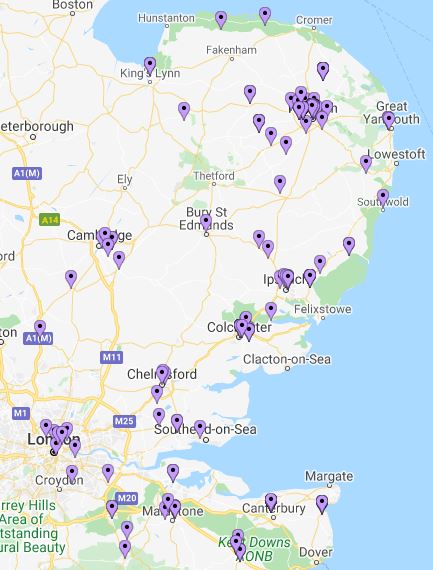
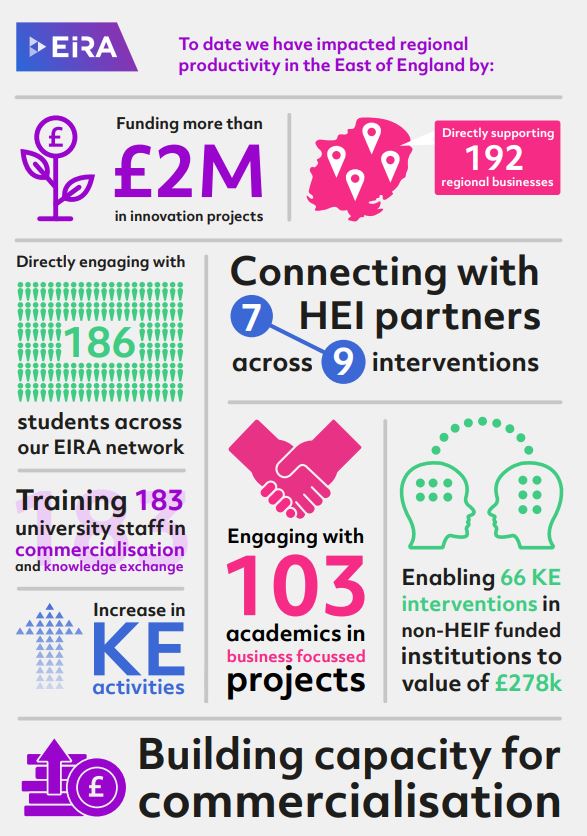
Regional productivity is being improved by the UoE-led EIRA project, which has worked with over 190 regional businesses, delivering over £2million in business support and involved 186 students in the creation of innovation. Additional leverage of over £2million has been brought to the region as a direct result of EIRA, reaching over 2000 businesses to make contribute £8.3m GVA to the region. The programme was tailored to meet the specific needs of the type and scale of businesses in the region and use University capability to create growth. The map shows the level of engagement with businesses in the Eastern region enabled by EIRA.
Aspect 3: Results
UoE’s strategy for the KG has resulted in a substantial increase in regeneration and development income returned in HEBCI in the last three years, up from ~£100k to consistently >£1.5m per year. This growth results from its more general engagement approach with local and regional partners, such as SELEP and ECC.
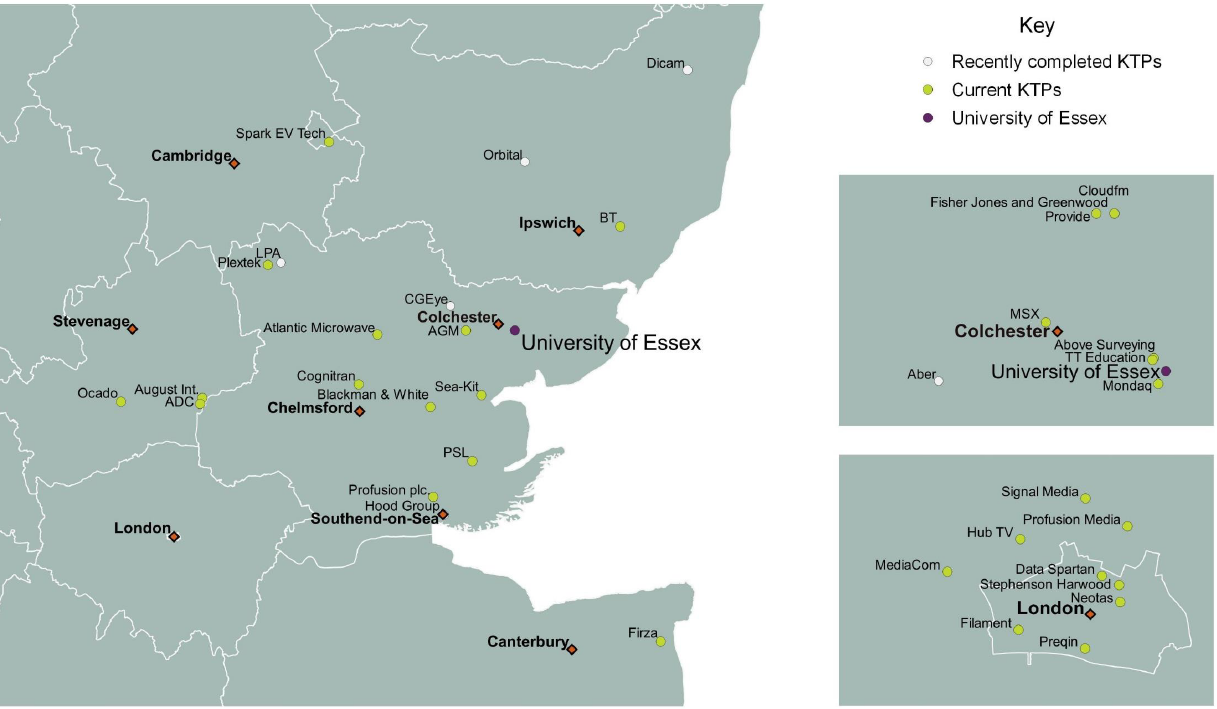
The growth in scale of work with regional businesses has increased leverage of Innovate UK funds with the UoE being in the top two in the UK for its KTP portfolio, which now stands at more than 30 live projects. It holds an annual KTP Celebration and Awards event, inviting companies from across London and the South East to celebrate and recognise these successful partnerships. The infographic details KTP partner locations:
Its research and engagement activity with the creative sector are being driven by its University Cultural and Creative Sub-strategy. The creative industries in its region contribute £2.5bn GVA, support 30,000 jobs and have been identified as a priority by SELEP. New facilities in its Innovation Centre include a 360˚ VR Projection Space, and, together with dedicated KE professionals, this offer is already stimulating close partnership working with local businesses in Colchester and beyond, enabling it to support the regional economic growth strategy.
Its collaborations also extend to clusters in the east of London and along the Thames Estuary (Thames Estuary Production Corridor). It plays an active role at all levels, with its Deputy Vice Chancellor Chairing the Creative Colchester Partnership and being co-Chair (Essex) of the South East Creative Economy Network.
Analytics and data science are a key part of the University’s strategy, maximising the opportunities for businesses to benefit from the value of their data. Researchers in its Institute for Analytics and Data Science (IADS) seek to have a positive impact on the world through partnerships with, for example, telecoms giant BT, Suffolk and Essex County Councils, and the Port of Felixstowe.
Within IADS, its ESRC-funded Business and Local Government Data Research Centre collaborates with private sector, public sector and not-for-profit organisations to wield the transformative power of data to benefit communities. By supporting its partners in implementing best practice, it creates real-world impact, shaping both policy and ways of working.
The newest priorities for UoE’s KE strategy, agricultural sector and public health, are in development. The East of England’s large rural areas and substantial crop growing industry make agriculture crucial, and it is delivering projects with local agricultural businesses that apply robotics and AI to strawberry farming and machine learning to pest detection.
In 2019, it launched the Essex Plant Innovation Centre (EPIC) at an event, which brought together academics and the agri-tech industry from across the East of England to foster relationships for future collaborations and KE. Engagement in its established networks will be a performance measure, as will the impact of its contribution to the success of the EIRA biotechnology theme.
Its effectiveness in supporting business innovation within the region to improve productivity and enable growth is exemplified by the success of EIRA, where Essex as a delivery partner alone has engaged with over 200 business and is actively working with more than 30 on innovation projects ranging from internships to full-scale R&D grants. This infographic details the regional impacts of EIRA over the past 2 years.
For further information, please send queries to rjsingh@essex.ac.uk
Public & Community Engagement
Summary of approach
The University of Essex (UoE) believes universities should be inspirational places that have a transformational impact on society. UoE wants people to understand the value of universities and how their work directly benefits day-to-day lives. It is doing this through a programme of events, interventions and research with the aim of establishing Essex as a national centre for expertise in methods, capacity-building and leadership in public engagement. Its Centre for Public Engagement (CPE) provides a hub for its engagement plans and activities, sharing its knowledge and partnering with communities to tackle the problems that matter. The CPE is central to the University’s Research Strategy (2019-2025) that aims to grow reach and scope of this activity across all disciplines.
Aspect 1: Strategy
Public and community engagement (PCE) aligns with the UoE’s Vision “to tackle with rigour the questions that matter for people and communities, put ideas into action to improve people’s lives, and nurture and celebrate our shared commitment to social action”.
Its University Strategy 2019-2025 demonstrates its commitment to:
Connect its researchers with its communities to realise the benefits of a world-class university for the region through sustainable partnerships
Harness the power of co-production to maximise the effectiveness of its research in improving people’s lives
Engage with the local communities in which the University and its campuses are located, to maximise its opportunities to have impact in the world.
This underpins the UoE’s commitment to equality, diversity and inclusion and drives its PCE priorities, which are incorporated into its Education and Research Strategies and annual action plans owned by the Pro-Vice Chancellors for Education and Research.
Since the University's creation, it has always engaged with communities on a wide range of activities. However, it wanted to streamline its approach to bring all this valuable work together and maximise its potential and impact.
To achieve its goals, the University has:
1. Established a Centre for Public Engagement (CPE) as a formal Centre within the University’s structure, led by the Pro-Vice Chancellor Research (Designate) and reporting to the Deputy Vice-Chancellor, with regular reviews of its activities undertaken by the University’s Research Committee.
The Centre provides a focal point for the co-ordination of PCE activity, founded on a five-year plan to (i) raise the visibility of PCE through effective communications; (ii) share and promote best practice; and (iii) support the development of PCE leadership across the University.
2. Invested resources: time is allocated within Work Allocation Models for academic staff to undertake engagement activities, supported by internal and external funding streams (see Section 2); the CPE has allocated operational and staff resources; the University has appointed a senior academic as Chief Scientific Advisor to Essex County Council to cement its relationship and apply its research to support their decision making and policy development for the benefit of local communities.
3. Developed structures and methodologies for implementation, oversight and review. Beyond the CPE, responsibility for implementation is allocated to Deputy Deans, departmental Directors of Impact, and designated academic roles, such as the Chair of Citizen Participation (School of Health and Social Care) and the Principal Investigator of our ESRC-funded Impact Acceleration Account (IAA). The University’s Research and Enterprise Office has delegated responsibilities for the implementation of PCE actions across knowledge exchange, stakeholder engagement, ethical practice, research impact, support for the CPE, and delivery of projects enabling PCE, including the IAA, and partnership with the Cabinet Office Open Innovation Team.
4. Embedded co-production as an organising principle: its innovative facilitated workshop model – ‘Challenge Labs’ – brings key stakeholders (including Colchester and Southend Borough Councils, Essex County Council and East Suffolk and North Essex NHS Foundation Trust) together with Essex researchers to understand community needs and co-produce solutions to problems that matter.
Aspect 2: Support
The UoE’s campuses are at the heart of their local communities. Through a broad and varied outreach programme, schoolchildren come to explore higher education, businesses work and collaborate with it, visitors attend lectures to learn about its research expertise and audiences enjoy its full and varied arts programme.
The support for PCE across the University is structured around:
(i) Stakeholder engagement: Stakeholders play an important part in the planning process through advising on the development of courses and research: the Service User Reference Group, (Health and Social Care), brings the patient/service-user perspective to the educational experience, and UoE’s Industry and Community Advisory Boards inform curriculum development across our academic Departments.
(ii) Allocating resources: Internal and external funding supports the delivery of PCE activity. For example, there are grants to support community engagement and co-produced research projects from the ESRC-funded IAA, including Challenge Labs to co-design projects with stakeholders that address their immediate challenges. Most recently, a number of local projects have been funded to address some of the economic, social and cultural challenges arising from COVID-19.
(iii) Communication: UoE promotes its PCE activities and successes via its website, news stories in the media, online interviews and social media channels to encourage community engagement. Its ‘in the community’ webpage invites the local community to enjoy a wealth of arts, cultural, sports and recreation facilities and events on its campuses, including its theatres (it is unique in having a theatre at each of its three campuses), art galleries and its Green Flag award-winning Wivenhoe Park, with downloadable resources. It also boasts online interactive platforms, which enable an exchange of ideas on topics of mutual interest. News items and social media posts offer the opportunity to enhance the visibility of its community partners. Websites for major events reach a wide audience – for example the annual Essex Book Festival, sponsored by UoE and based within its Centre for Creative Writing, hosts over 100 events across the county.
(iv) Building capacity: It has a comprehensive package of training programmes that can be tailored to the needs of the individual such as the Impact Academy, Policy Engagement Academy and Newcomers programme. Relevant topics include impact across the research lifecycle, and sharing best practice through a blog series by research staff from different disciplines.
(v) Celebrating successes: The achievements of staff, students and community partners are celebrated through annual awards programmes including Research Impact Awards, student volunteering and engagement with businesses through Knowledge Transfer Partnerships.
Aspect 3: Activity
UoE’s Strategic Vision for PCE (set out in Section 1) structures all its projects and programmes around three key themes.
Supporting our communities
An extensive programme of student volunteering, tackling a wide range of projects to meet the needs of UoE’s local communities, charities and schools, including innovative online projects during the pandemic
Providing services such as the University’s Law Clinic and LGBT + Law Clinic, which provide free, confidential legal advice and UoE’s Human Rights Centre’s Outreach Programme, which explores with local communities the challenges they face.
Sharing knowledge
Improving community service for vulnerable people by using its wealth of expertise in data analytics to help Essex and Suffolk county councils better target public service initiatives where they are needed most.
Public communication of research: e.g. Café Scientifique; Pint of Science; Professorial Inaugural Lectures.
Special webinar series during COVID-19 lockdown exploring pandemics past and present.
Annual programme of events ranging from public debates to film screenings and exhibitions as part of the nationwide Festival of Social Science.
Working with schools - from inspiring interest in science at the annual Big Bang Fair to enhancing knowledge of the Holocaust through its annual schools Dora Love Prize competition.
Working with professionals and practitioners – from offering free CPD for teachers, staff and volunteers working in end of life care to highlighting the value of business archives.
Fostering mutual understanding through projects such as a drama about the stories behind immigration in Colchester co-created by UoE drama academics, its Centre for Migration Studies and historians working with the community to preserve the 200-year history of Essex County Hospital.
Co-producing research
Improving quality of life for stroke survivors through a project involving survivors, carers and UoE occupational therapists, which generated a report into service gaps for Tendring Specialist Stroke Service.
Establishing the Essex Centre for Data Analytics – a unique three-way partnership with Essex County Council and Essex Police which offers a way for regional councils, police, health, and voluntary and community organisations to use the power of data to tackle some of the society’s most challenging issues.
Protecting the endangered European native oyster through its marine biologists partnering with Colchester Oyster Fishery
Building a new and sustainable health and social care research partnership with children and young people, working with Healthwatch Essex, Refugee Action Colchester, the Junior Wardens Project, Jaywick Sands Neighbourhood Team, and Tendring District
Council.
COURAGE network brings together 50 researches to co-design strategy to help people affected by, and living with, neurological conditions.
Aspect 4: Results and learning
Having its campuses at the heart of their local communities means UoE’s students and staff are directly involved a wide range of activities.
From initiatives with local authorities and regional stakeholders, projects and programmes have individual objectives and clear methods of capturing and measuring outcomes, analysing results and incorporating learning. Approaches include:
Formal evaluation
Its School of Health and Social Care commissioned an evaluation of its service user involvement practice from the disabled people’s user-led organisation Shaping Our Lives, who produced a report with recommendations for action.
The findings informed a new approach – Involvement Matters – launched with community partners and service user volunteers at a major event and supported by a new online platform.
Quantitative measures
Its comprehensive work with schools tracks numbers of events delivered and participants attending. Over 900 budding scientists from 27 schools across Essex, Suffolk and London took part in the Big Bang Fair. The Dora Love Prize attracts more schools year-on-year, most recently involving 23 schools and 250 children who participated in learning about the links between the Holocaust and intolerance and discrimination. A popular creative writing competition involved 700 children from primary schools across Essex.
Its students are central to the positive effect it has on its local communities and its student-volunteering programme tracks volunteer hours, which helped develop a new platform to maximise engagement and improve reach. In 2018-19 the Students’ Union V-Team achieved 36,000 hours through 110 projects working with 70 organisations.
Feedback and testimony are also captured at its events including teachers taking part in the Dora Love Prize and charities such as Refugee Action Colchester.
Testimony from co-produced projects
A programme, developed at Essex, is improving the lives of military veterans by helping them overcome the debilitating symptoms of Post-Traumatic Stress Disorder (PTSD). Testimony from participants and support agencies was captured on websites and video.
A collaboration between an Essex historian and business archivists is helping business leaders understand how looking at their past can help their decision making in the future. Testimony from archivists was captured on video including archivists’ “one piece of advice” for academics on how to ensure collaboration works.
Its academics are working with Suffolk and Essex county councils to develop new technology to assess and predict risk and to evaluate the impact of public service initiatives. The aim is to target public service initiatives where they are most needed, improve outcomes through earlier intervention, and introduce new evidence based evaluation techniques to determine their full impact.
Aspect 5: Acting on results
UoE began reviewing its institutional approaches to PCE through a range of actions carried out during 2019-2020:
To enhance the impact of our PCE activities we launched a dedicated area on the University website to showcase and celebrate its work with a series of Centre for Public Engagement blogs, which are promoted on social media and e-newsletters to University staff and external stakeholders.
Its dedicated research showcases pages highlight the best of its research impact.
The National Co-ordinating Centre for Public Engagement facilitated a series of workshops for academic and professional services staff across UoE to explore experiences and perspectives on PCE, identify challenges, and consider ways to enhance its institutional approaches and activities.
A ‘fact-finding’ mission by Research and Enterprise Office (REO) staff, visiting PCE colleagues at other universities to garner best practice and learn from their experiences.
Creating a REO working group, drawing together specialists in communications, knowledge exchange, public engagement and impact, to improve coordination of support for academic colleagues and identify ways of enhancing the work of the Centre for Public Engagement.
Creating a working group involving the PVC Research (Designate) and Director of the Centre for Public Engagement, academics and REO staff to identify and address structural and systemic challenges to PCE.
Securing UKRI funding for the “Community Research and Engagement Project”, in the first round of its “Enhancing place-based partnerships in public engagement” scheme, providing an opportunity to network with other projects and learn from their experiences.
Undertaking a review of its learning and development offer for researchers and developing new approaches to building knowledge and skills in PCE as part of a new programme for 2021.
For further information, please send queries to s.hanshaw@essex.ac.uk