Note You are currently viewing a previous version of this narrative statement as published in previous iterations of the KEF (KEF1 and KEF2). View the latest version
Institutional Context
Summary
The Royal College of Music provides specialised musical education and professional training at the highest international level for performers and composers, within an environment that stimulates innovation and research. The RCM harnesses and exploits the potential of its communities of musicians, educators, production professionals, public artistic programme, community outreach work and its physical and digital resources to support excellent research. Knowledge exchange in the KEF context has been thematically grouped into:
Music for all
Music and innovation
Engaging the public with music research
Knowledge exchange is embedded across multiple RCM strategies. to maximise the impact and dissemination of RCM knowledge resources and research and to the widest range of beneficiaries within and beyond the institution in local, national and international contexts.
Institutional context
Mission and Context for Knowledge Exchange
The Royal College of Music (RCM) provides specialised musical education and professional training at the highest international level for performers and composers, within an environment that stimulates innovation and research. This enables talented students from all backgrounds to develop the musical skills, knowledge, understanding and resourcefulness which will equip them to contribute significantly to musical life in this country and internationally.
A Centre of Excellence
Located in 'Albertopolis', the home of arts culture and science in the heart of South Kensington, the RCM backs onto some of the finest centres of cultural and scientific excellence, giving the College multiple opportunities to develop innovative collaborations in research and knowledge exchange (KE).
Widely recognised for the excellence of its research into the impact of music and musical practice; the RCM had the highest percentage of world-leading research of the London in REF 2014. RCM research spans the creation, analysis and performance of new and historical artistic work; the social and cultural history of music; to advances in the areas of physical and mental health and wellbeing.
Named as the top institution for Performing Arts in the UK for the fifth consecutive year in the 2020 QS World University Rankings, the RCM is top conservatoire for music in the UK in the Complete University Guide Arts, Drama and Music League Table 2021.
A Conservatoire for the 21st Century
‘Elite but not elitist’, the RCM is a performing arts institution which aspires ‘to reflect the diversity of contemporary society in the UK and beyond; (page 4 RCM Strategic Plan 2017–2027).
Knowledge exchange (KE) at the College engages with, and is informed by the public through:
Community activities for underrepresented groups and skills development programmes
Public arts and health research projects and public engagement
Commercial activities, innovations and collaborations with partner institutions
Knowledge Exchange at the RCM
For the purposes of the KEF KE has been grouped into:
Music for all
Music and innovation
Engaging the public with music research.
Local growth and regeneration has been grouped into:
• Music for social inclusion
• Music and skills development
• Music and entrepreneurship
An additional theme of Music and Health has been included in the Public Engagement template.
HEBCI reported income includes:
Courses for business and the community: Summer schools, junior programme fees and CPD income from the Centre for Performance Science’s (http://www.performancescience.ac.uk/) experiential learning programme with Imperial College, and programmes for students from international institutions.
Facilities: Income from concerts, venue hire (which has taken a hit over the last three years during the College’s More Music (https://www.rcm.ac.uk/moremusic) /building programme including RCM Studio commercial hires), and students hired as performers/ teachers.
Consultancy: Examples include Education Department researchers contracted by organisations such as Norfolk Music Service and the Associated Board of the Royal Schools of Music.
Spin-outs: RCM graduates’ micro-businesses, which are consistently still in operation for more than three years.
Regeneration income: Income is being included under this category for the first time in 2020 for income received for the Medtech Superconnector (https://medtechsuperconnector.com/) KE project.
For further information, please send queries to emma.hewett@rcm.ac.uk
Local Growth and Regeneration
Summary of approach
Local growth and regeneration at the RCM actively benefits the local community, demonstrated in our over-reaching aims:
Music for all
Music and innovation
Engaging the public with music research
Our local area is the Borough of Kensington & Chelsea, which, through our partnership with the Tri-Borough Music Hub also includes Westminster City Council and Hammersmith & Fulham.
Sub themes which support the work we undertake with under-represented groups are:
Music for social inclusion
Music and skills development
Music and entrepreneurship
Examples include our pioneering Sparks programme for local children, redeveloping our estate to increase public access, our Creative Careers Centre’s student entrepreneurship programme, and KE projects such as MedTech Superconnector. Additional support is provided by our internal KE Projects Fund.
Aspect 1: Strategy
The RCM's Strategic Plan 2017-27 encompasses local, national and international geographic areas (p6 https://www.rcm.ac.uk/media/RCM Strategic Plan.pdf).
Locally the RCM benefits the immediate environs of Kensington & Chelsea UK by prioritising activities focussing on social inclusion through its Sparks (https://www.rcm.ac.uk/sparks/localarea/) learning and participation programme, and public space improvements funded through the More Music campaign (https://www.rcm.ac.uk/moremusic/).
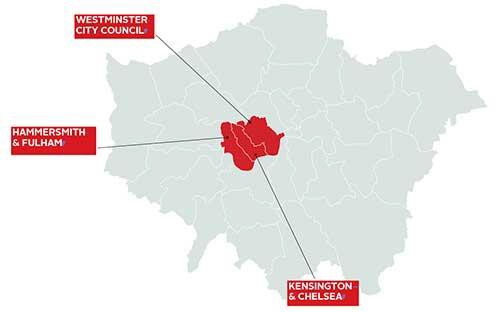
Tri-borough area comprising the Royal Borough of Kensington and Chelsea, the London Borough of Hammersmith and Fulham and the City of Westminster.
-
Nationally regeneration is facilitated through programmes such the Creative Careers Centre’s (https://www.rcm.ac.uk/life/preparingforprofession/creativecareers/) skills development and entrepreneurship training for RCM students, and the Centre for Performance Science’s (https://performancescience.ac.uk/about/) KE activities through its partnership with Imperial College, including externally funded projects such as MedTech Superconnector (https://medtechsuperconnector.com/). Other examples of national impact include a CPD project for SEN early years practitioners in Southampton, supported by the Internal Knowledge Exchange Fund from the HEIF allocation.
Internationally the RCM collaborates with Chinese regional institutions and organisations and provides non-credit bearing training for students from across the USA.
Local growth and regeneration activities reflected in the RCM’s wider institutional objectives address the following challenges:
The theme of Music for Social Inclusion comes under the banner of Access and participation:
The 2019/20 Access and Participation Plan (https://www.rcm.ac.uk/media/RCM Access and participation plan 2019-20.pdf) states ‘with a 10 to 15-year lead time required to develop the skills needed for conservatoire entry and the socio-economic diversity of school leavers with access to music education decreasing rather than increasing, the RCM faces a significant challenge in increasing the diversity of its student body, and long-term change is needed on a national scale to reverse this trend….as one of the UK’s leading music institutions it has a duty to contribute to such change, and a commitment to raising attainment in young musicians has been included in the strategic measures in this plan.’ By 2027 (2020/21 to 2023/4 Access and Participation Plan https://www.rcm.ac.uk/media/RCM Access and participation plan 2020-25.pdf) the RCM aims ‘to reflect the diversity of contemporary society in the UK and beyond and have integrated pre-tertiary provision and community engagement into the RCM's programmes and ethos from age four up. The RCM’s overarching strategic aim for the period of this Access and Participation Plan is to reduce the under-representation of applicants and students from the lowest socio-economic groups and BAME backgrounds in conservatoire education and consequently in the wider music profession.’
Access is also addressed under sustainable fundraising for capital building projects and the commercial uses of RCM facilities: the More Music campaign (https://www.rcm.ac.uk/moremusic/), Museum Strategy 2015-2020 (https://www.rcm.ac.uk/media/2015-20%20Museum%20Strategy.pdf), Research Strategy (page 10, point 8 https://www.rcm.ac.uk/media/Research Strategy.pdf) and Commercial Strategy (currently in development), with a College-wide focus The RCM Museum is among the largest, most extensive and comprehensive anywhere in Britain that focuses on music in general, but the 1970s purpose built gallery has presented irresolvable issues in accessibility, visibility and climate control. Public access has also been an issue for the RCM Library’s Special Collections of manuscripts, prints, letters, concert programmes and books which are of great interest to academic and non-academic audiences. The College’s concert halls and courtyard spaces have also not been easily accessible by the public, and increasing space constraints on campus have been encountered as the College’s student and staff population continues to grow.
Music and skills development and Music and Entrepreneurship
These themes are covered by the Creative Careers Centre (https://www.rcm.ac.uk/life/preparingforprofession/creativecareers/), and in the RCM’s Research Strategy 2020-2027. Graduates starting out as freelance classical musicians (be they performers or teachers) in the highly competitive music business need to be armed with a portfolio of skills, including digital marketing, business planning and financial management, collaboration and negotiation skills. Leaving College as an excellent musician does not guarantee the graduate a long-term income. Established researchers require mechanisms which enable them to engage with, or be engaged by, external organisations to share good practice and to feed into new research ideas and partnerships, and are encouraged to undertake consultancy (page 5, point 4.2 Research Strategy) ‘to exploit their expertise through knowledge exchange and transfer activities within the cultural economy, contributions to national and international policy and governance, and sustaining a flourishing research community.’
Aspect 2: Activity
Music for All: Social inclusion, access and participation activities
The Sparks (https://www.rcm.ac.uk/sparks/localarea) learning and participation programme has the following headline objectives:
To deliver and meet the targets set out by the RCM’s access and participation plan
To provide a pathway of learning from early years through to post-graduate study for all young people particularly focussing on those from hard to reach backgrounds or underrepresented groups.
To provide first access to music via a varied and engaging programme of activities offering a high quality musical experience linking to the objectives in the current 2017-2027 Strategic Plan.
To offer training and first-hand practical experience for RCM students in the field of learning and participation in order to enrich students’ music education portfolio and enhance employability.
To support an innovative and progressive plan of learning and participation delivery offered by the RCM Museum ready for it’s re-opening in 2020.
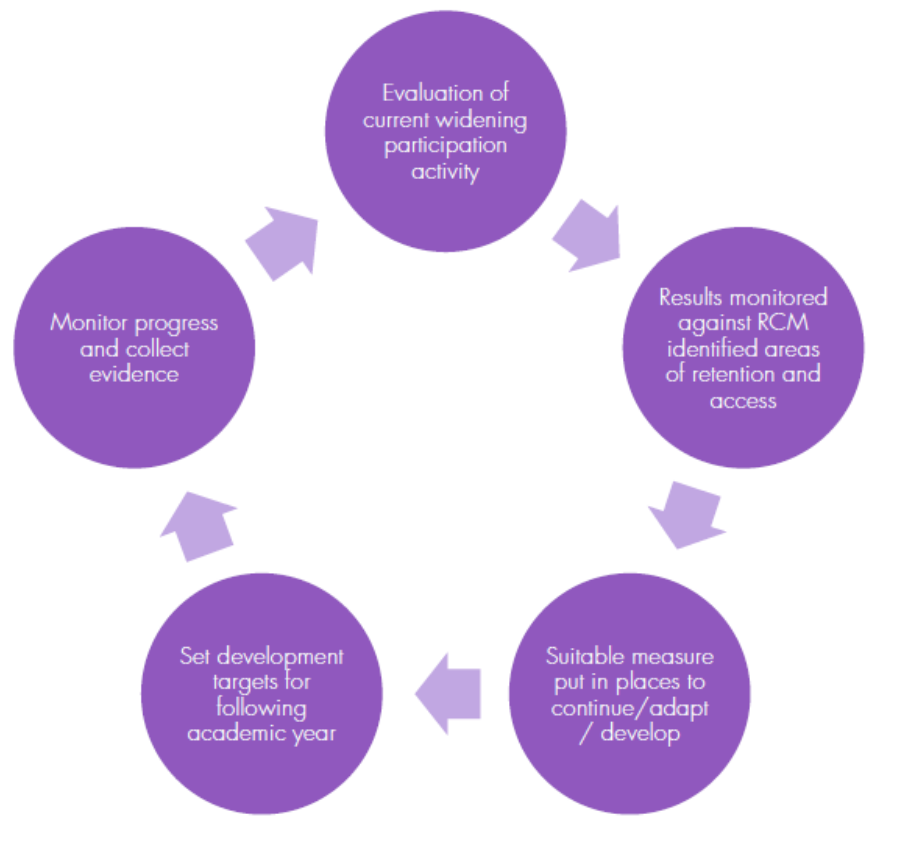
Figure 1: RCM widening participation evaluation monitoring diagram
The HEIF allocation is distributed across the RCM to support for example, the artistic programme, the Centre for Performance Science (CPS) and the Creative Careers Centre. Sparks funding comes primarily from trusts and foundations.
The multi-million pound More Music campaign was developed to address infrastructure and access issues. A £4.9million Heritage Lottery grant underpinned the redevelopment of the RCM Museum - one of the largest ever such investments in a museum of music in the UK.
Engaging the public with music research: Entrepreneurship and skills development activities
MedTech SuperConnector (MTSC): The CPS a partner in the £5million Connecting Capability Funded MTSC project (https://medtechsuperconnector.com/) led by Imperial College, with Queen Mary University of London, Buckinghamshire New University, Royal College of Art, Institute of Cancer Research, Royal Veterinary College and The Francis Crick Institute as HEI partners.
Non HEI partners include medical device companies and global industry partners NHS, private health and patient channels and venture capital companies.
MTSC brings together talented ECRS, academic discoveries and pooled know-how from eight academic institutions with three bioscience incubators, industry expertise, NHS patients and enabling partners to determine the most effective methods for translation of medtech discoveries into clinical practice and consumer use. ECRS will gain insights into career options and start-ups, industry will source new talent and deal flow and the UK will gain a new and valuable regional medtech hub to link up with the network of such centres envisioned in the Life Science Industrial Strategy.
Four cohorts of ECRs are being taken through an eight-month entrepreneurial training programme. In addition to expert business mentoring and training, they have funding and access to state-of-the-art facilities and expertise across the eight institutions, and the opportunity to create connections with industry partners and potential investors to bring their projects to market.
The Creative Careers Centre (CCC): https://www.rcm.ac.uk/life/preparingforprofession/creativecareers/) (supports musicians in bridging the gap between student and professional life while adapting to the parameters of an increasingly competitive and complex music industry.
Success is measured through the annual DLHE return, which in 20172018 reported that 94% of RCM graduates had moved into employment or further study six months after graduating, placing the RCM in the top five of the HESA league table, not just of UK conservatoires but of all UK universities.
Training includes one-to-one sessions on ‘Funding and Fundraising’ and a ‘Real World Ready’ careers programme for students about to graduate. The Creative Enterprise module helps students develop a viable business idea with practical support in entrepreneurial, business, and ‘real-world’ career skills.
Knowledge Exchange Projects Fund: As mentioned in the CPE template, staff and doctoral students can develop their entrepreneurial skills by bidding into the HEIF funded internal Knowledge Exchange Projects Fund, for small scale pilot projects with commercial potential which will lead on to larger scale funding applications.
Aspect 3: Results
Social inclusion, access and participation results
Sparks commissioned a report in 2019 from Sound Connections (https://www.sound-connections.org.uk/ available upon request) to review progress made against strategic goals. What came through most strongly in the consultation was ‘the high quality and professionalism of all of the RCM Sparks programme. The quality of the administration, workshop leaders, students, learning pathways, and the artistic and pedagogical approaches were repeatedly cited as a strength. Some commented that it was the best community outreach programme of any Conservatoire in the UK.’
A carer commented “My experience is that the community has got a huge amount out of the Sparks programme and those families who get involved do develop a relationship with the College, and become part of the RCM family - especially those who are most excluded.”
Venue and facilities hire: Venue hire at the RCM, prior to the £40million More Music development, was approached in a reactive way. The new Commercial Strategy (2020, available on request) is taking ‘a more proactive and commercial approach to bookings in the Events and Venue Team and across the College will be taken to maximise booking conversion and income to make it a commercial success.’
The RCM’s two new performance spaces, designed by architect John Simpson and completed in March 2020, have not yet been used for performance as they were completed just before the UK’s COVID-19 lockdown. COVID-19 has also set back public hire for the refurbished Studios.
Entrepreneurship and skills development results
The Creative Careers Centre (CCC) measures success through the annual DLHE return, which in 2018 demonstrated that 100% of RCM graduates had moved into employment or further study six months after graduating, placing the RCM in the top five of the HESA league table, not just of UK conservatoires but of all UK universities.
Students and recent graduates are hired by organisations and the public and paid at industry rates through The Professional Engagements Service, with over 318 engagements reported in 2018/19.
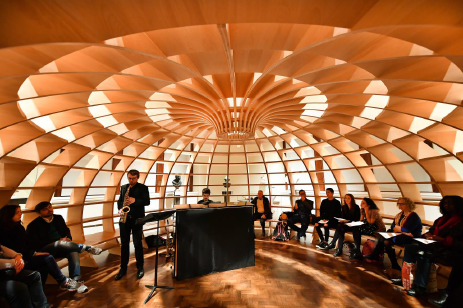
RCM students performing at the V&A
An RCM graduate says; ‘The Creative Careers Centre has been incredibly supportive in providing us with performance opportunities and career advice at a time when this is absolutely essential for emerging artists. Performances in some of the most influential venues in Central London have come alongside many paid engagements, allowing us to be financially independent and able to concentrate our efforts on the development of the Quartet. The Centre has been an absolute rock for us and we are hugely grateful for all their support.’ (Source CCC Report 2018/19).
New individual training for 2018/19 included ‘Funding and Fundraising’ from Arts Council England during Global Entrepreneurship Week, which led to two attendees receiving ACE funding for their Creative Project Management Masters level projects. The CCC celebrated its 20th anniversary in June 2020 with a digital programme of events: https://issuu.com/royalcollegeofmusic/docs/the_modern_musician_events_guide/40
Music and Innovation results
Four RCM early career researchers and the Assistant Head of Junior Programmes have successfully applied for MTSC support. Projects include:
Cohort 1:George Waddell (an ECR from the Centre for Performance Science) developed MedStudio, a digital learning platform (https://medtechsuperconnector.com/ventures/) to enhance the performance of healthcare practitioners, developed with commercial partner HighSkillz, see the short project video (https://vimeo.com/338887544) . The platform is now also being developed for use in performance and business domains.
Cohort 3: Ben Storey, Assistant Head of Junior Programmes, is addressing the needs of patients with severe respiratory problems such as cystic fibrosis, asthma and COPD (chronic obstructive pulmonary disease) with a novel digital medical and musical device which will help to clear mucus and exercise lungs, whilst also measuring real time positive expiratory lung pressures, flow and performance. The prototype will be trialled by respiratory patients at Great Ormond Street Hospital.
Cohort 4: Frederick Lam has been supported by GlaxoSmithKline’s ‘NEXT’ Consumer Healthcare team to develop novel technical solutions to a contemporary challenge to redefine how pain is understood, measured and treated. Frederick’s OccuPain™ project is a web-based mobile platform which will report occupational pain problems more accurately, providing an alternative to long waits for in-person pain evaluation.
Terry Clark, consortium representative from the Royal College of Music says, ‘[pain] is one of the biggest topics we talk about. This is providing a very specific and concrete example of where it is of direct relevance to a lot of the work we do.’
For further information, please send queries to emma.hewett@rcm.ac.uk
Public & Community Engagement
Summary of approach
Community and public engagement (CPE) at the RCM is central to the College’s mission statement to be ‘elite but not elitist’. CPE is firmly embedded in our artistic programme, our junior programme, our curriculum and our research. CPE is summarised in three over-arching themes:
Music for all
Music and health
Engaging the public with music research
Our annual artistic programme of over 500 public concerts features the talents of our world-class students, staff and internationally renowned artists; community workshops are delivered by our Learning and Participation (‘Sparks’) and Museum teams; student performers can be booked through our Professional Engagements Scheme, whilst public health research engage and impact the community, such as the Arts Council funded Music and Motherhood project.
Aspect 1: Strategy
Overarching Strategy and Mission Statement
The RCM Mission Statement (page 2 Strategic Plan 2017-2027 (https://www.rcm.ac.uk/media/RCM Strategic Plan.pdf) gives the College’s purpose as ‘ the promotion and supervision of such musical instruction in schools and elsewhere, as may be thought most conducive to the cultivation and dissemination of the Art of Music in the United Kingdom’.
The RCM is committed to improving access to music-making and specialist music education, opportunities which are currently constrained by limited and diminishing specialist music provision in state schools. The college-wide commitment to increase participation by under-represented groups encompasses student recruitment, widening participation, access to RCM facilities, fundraising for infrastructure and scholarships and access to public-facing research.
Outreach activities are oriented to support study in music and other HE subjects. The Access and Participation Plan sets out the institutions’ commitment to widening participation, aiming by 2027 to ‘reflect the diversity of contemporary society in the UK and beyond and have integrated pre-tertiary provision and community engagement into the RCM's programmes and ethos from age four up.’
Under-represented groups have been identified through HESA benchmarking as low HE participation; low household income and/or low socioeconomic status, BAME, and children, young people and families with disabilities. Public and community groups have been identified to enable interventions during early school years to increase the diversity of the pool of potential applicants to the RCM. Annual access targets/milestones have been set from 2016/17 to ensure adherence to the Equality Act 2010. (2020/21 to 2024/5 Access and Participation Plan https://www.rcm.ac.uk/media/RCM Access and participation plan 2020-25.pdf)
Supplementary Strategies and Campaigns
CPE at the RCM is embedded across multiple strategies particularly the Widen Access (https://www.rcm.ac.uk/moremusic/access/) strand, the More Music (https://www.rcm.ac.uk/moremusic/) campaign, the Museum Strategy (https://www.rcm.ac.uk/media/2015-20 Museum Strategy.pdf) the Artistic Strategy (https://www.rcm.ac.uk/media/RCM Artistic Strategy.pdf).
Communication: PC&E communications are led by the Director of Communications. The main public stakeholders are audiences for paid and free events. Medium and low spectrums of arts engagement audiences have been identified, prioritised and segmented via reports from specialist arts and culture market research agency The Audience Agency. Press releases are available at https://www.rcm.ac.uk/press/.
The RCM’s Artistic Vision and Strategy symbiotically feeds into our communications as an important facilitator of outreach, including partnership building with cultural organisations.(https://www.rcm.ac.uk/media/RCM Artistic Strategy.pdf,
Responsibility for CPE: lies with Directorate members, senior members of teaching and research staff and professional services managers. CPE is the primary job function of many RCM staff such as the Box Office and Sparks community engagement teams.
Strategic support for the More Music campaign (https://www.rcm.ac.uk/media/RCM Artistic Strategy.pdf) lies with the Director of Development & Alumni Engagement.
Aspect 2: Support
Music for All:
RCM Sparks and other outreach initiatives have been identified as the area for most effective investment through the development of a Community Access programme, including a partnership with IntoUniversity reaching local young people who would not normally engage with HE pathways through workshops in Brent, North Kensington and Hammersmith.
RCM investment in time and other resources has significantly favoured outreach and related activity from the outset and our strategy is for this to continue. Most RCM CPE programmes are offered free of charge, funded through active fundraising (for example for Junior Department bursaries) and supported by our core grant.
A recent study by Kings College London identified that only 1.7% of orchestral musicians were from a black or minority ethnic background. Conservatoires, as the training grounds for the UK’s professional orchestras, have a duty in identifying BAME talent and training the diverse workforce of the future. A BAME scholarships scheme was introduced in 2016 aiming to improve BAME representation not just in the RCM, but also in the classical music profession, with an annual expenditure target by 2021/22 in excess of £110,000.
The £40 million More Music campaign (https://www.rcm.ac.uk/moremusic/access/) aims to ‘Strengthen our facilities, support the most talented, widen access, and promote innovation’, including easier access to the Museum to make it more visible and usable, optimising RCM estates and facilities, which from 2016/17 included a more integrated approach to CPE across Sparks and the Museum.
The RCM is committed to embedding public and community engagement in the core curriculum through performance, placement and partnership activities. The College has also invested in its digital technology to extend the reach of its events to new audiences, being the first conservatoire to partner with international opera streaming platform OperaVision in 2018, providing free online access to world-class opera performances with a specific emphasis on engaging young, emerging audiences.
HEIF funding underpins the development of staff and students’ CPE skills and knowledge:
The internal Knowledge Exchange Projects Fund, established in 2018, supports the development of RCM researchers’ CPE and KE skills through small-scale pilot activities such as social and community engagement partnership development, scoping activities, and developing commercial opportunities.
The Creative Careers Centre’s Professional Engagements Service gives students paid opportunities to perform in a wide variety of public settings. In 2018/19 students performed at over 170 concerts at venues including concert halls, festivals, heritage venues, museums and retirement homes (https://www.rcm.ac.uk/life/preparingforprofession/creativecareers/).
Engaging the public with music research:
RCM staff and students create and take part in over 500 public facing events, workshops, performances and exhibitions each year, including faculty-led themed festivals such as the Festival of Percussion (https://www.rcm.ac.uk/percussion/festival).
Annual events include the ‘Music and Ideas’ series of free talks, lecture/recitals, round table discussions, CD and book launches, disseminates research, innovation, scholarship and professional practice (see p24 Summer 2017 programme https://issuu.com/royalcollegeofmusic/docs/rcm_events_guide_summer_2017).
Aspect 3: Activity
Music for all
Children and families: The RCM’s Sparks learning and participation scheme (https://www.rcm.ac.uk/sparks/localarea/) runs a series of public events and activities for schools at the South Kensington campus, and a special programme for families and young people living in the local area. Partnerships with other institutions such as Tri-borough Music Hub (TBMH) and the Royal Albert Hall ensure music education is provided where it is most needed in the community to:
Engage all schools in the area, in order to reach all pupils and provide them with access to high-quality music education opportunities
Raise standards and support musical progression for all pupils
Ensure a broad range of outstanding musical opportunities for pupils, parents and the community
Music and heritage: Since closing in 2015 for the £4.9million HLF redevelopment, the Museum team have developed digital engagement tools including the UKRI funded MINIM-UK (http://minim.ac.uk/), the UK’s largest online collection of historical musical instruments. The public have been given access to Items from the Museum’s collection during a series of Roadshows (see Results section, below).
Public performances: Paid events marketing targets Metroculturals, Experience Seekers and Cultureland Culturebuffs, Commuterland Culturebuffs, Dormitory Dependables, and Kaleidoscope Creativity for free events as part of our civic engagement motivations. The latter two groups are in the medium and low spectrums of arts engagement across the spectrum, so are a key target for our audience development activities.
Engaging the public with music research: RCM researchers are rewarded for undertaking consultancy brokered through the Research Office with funding set aside for research project development, and also to undertake unpaid consultancy on professional bodies and committees (page 5, point 4, Research Strategy https://www.rcm.ac.uk/media/Research Strategy.pdf).
Instrumental and vocal professors' CPE is recognised at quarterly Research Committee meetings. All students have the opportunity to be involved in CPE as an integral part of their studies, from public performance opportunities to assisting with public workshops as stewards and volunteering in local care homes Staff, student and alumni achievements are showcased in Upbeat, the RCM magazine (https://www.rcm.ac.uk/about/upbeat/).
The Centre for Performance Science’s AHRC funded HEartS project (https://performancescience.ac.uk/hearts/) running from 2018-2021, explores the impact of the arts and culture on health and wellbeing from individual, social, and economic perspectives. Strategic partnerships have been established with public health and arts organisations including Public Health England, Arts Councils in England and Wales, Conservatoires UK, Sage Gateshead, The Ambassador Theatre Group, and Akademi South Asian Dance.
Aspect 4: Results and learning
Music for All
Data from the 2017/18 academic year on the RCM website reflects the average figures for public engagement activities, when 94 community workshops (https://www.rcm.ac.uk/sparks/learningpathways/) were delivered by the RCM, working directly with 704 members of the local community.
The Museum has been maintaining public access to its collections during its refurbishment closure through a series of digital exhibitions http://www.rcm.ac.uk/museum/exhibitions/ and roadshows. (https://www.rcm.ac.uk/about/news/all/2018-03-09museumblogafuturisticviewofmusicalheritage.aspx)
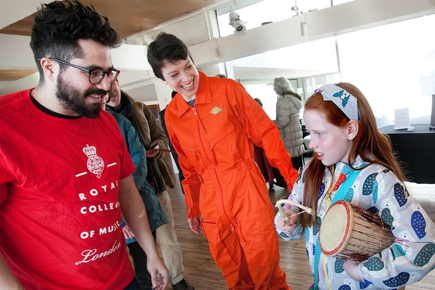
Pop Up Museum event, Royal Festival Hall 2018
Lydia Cracknell, Museum Learning and Participation Officer’s blog (https://www.rcm.ac.uk/about/news/all/2018-03-09museumblogafuturisticviewofmusicalheritage.aspx) from 2018 demonstrates how the RCM regularly surveys the public to inform future engagement planning. Local community members were surveyed during the 2018 ‘Music is Craft’ Museum Roadshow in Kensington Library, which focussed on visually impressive instruments, demonstrated by RCM student performers throughout the day.
Lydia says ‘90% of [the community] had never seen instruments that looked like these before, which seem unique next to the instruments we see around us today. Every person we spoke to learned something new from our display.’
Music and Health
The reach and impact of how RCM research directly engages and helps the public can be seen through the success of an Arts Council funded project which ran from 2015-17:
Music and Motherhood (http://performancescience.ac.uk/musicandmotherhood/), led by The Centre for Performance Science, explored how creative engagement can support the wellbeing of new mothers, winning the 2016 Royal Society for Public Health’s Arts & Health Award. The story was covered by the world-wide press (source, REF2021 impact data). India’s Daily Excelsior in January 2018 reported ‘Mothers who sing in groups with their babies may overcome the symptoms of postnatal depression more quickly, a study suggests…Those with moderate to severe symptoms of post-natal depression reported a much faster improvement than mothers in the usual care and play groups...the singing group had already reported an average 35% decrease in depressive symptoms.’
In 2019 the project was cited in the introduction of the DCMS report ‘Changing Lives: the social impact of participation in culture and sport’ http://data.parliament.uk/writtenevidence/committeeevidence.svc/evidencedocument/digital-culture-media-and-sport-committee/the-social-impact-of-participation-in-culture-and-sport/written/90909.htm) as an example of how ‘Culture and sport are crucial to our national life.’, and has a continuing afterlife with Breathe Arts programme of workshops for mothers and babies (https://breatheahr.org/melodies-for-mums/).
The Centre for Performance Science produces public facing videos for each project. The Music and Motherhood video from 2018 has had 818 views, demonstrating the level of interest in the research (https://youtu.be/vARFFcNbPQI).
Aspect 5: Acting on results
Music for All:
The RCM has adopted its Access Agreement targets as one of the mechanisms by which it measures its compliance with the Equality Act and has committed to publishing achievement of/progress with these targets/milestones on its website. The Sparks learning and participation programme is evaluated through annual OFS monitoring against targets focused on disability, social deprivation and BME populations. In addition, a systematic qualitative impact assessment of the Sparks portfolio was undertaken in autumn 2018, conducted by Sound Connections. This led to improvements in participant monitoring and tracking, and stronger integration with the College’s undergraduate provision.
Many RCM students are involved in the delivery of our outreach programmes. After each activity student feedback is requested to facilitate a detailed reflection on their involvement, and due consideration given to the benefits and challenges of their engagement with each project. This feeds into future planning of outreach activities and has informed enhancements in student and staff training and digital resources.
The BAME scholarships scheme is being closely monitored to assess the success of this programme to ensure it is achieving its objective to increase BAME student representation and participation.
Ticket-booker audience data from RCM events is submitted to The Audience Agency after each season to benchmark against other organisations, and fed back to the Artistic Programmes team to ensure future events are planned to attract and retain the widest possible audience base.
After a 2016 digital communications review the RCM website (https://www.rcm.ac.uk/visit/) was refreshed to offer ‘a more intuitive user experience for priority stakeholders groups’, seeing a 14.3% increase in users. 82% of alumni surveyed for the college’s online ‘Upbeat’ magazine rated it as Good or Very Good.
The RCM Museum’s annual visitor surveys aid understanding of current and potential audiences. Further evaluation during the Museum’s three year closure includes collating desk research on the local catchment area using Audience Finder, a review of research commissioned by the Royal Borough of Kensington and Chelsea and the borough’s Visitor and Arts and Cultural Policies, data drawn from London & Partners who are commissioned by the Mayor of London to promote London as a destination, and RCM Junior Programmes data.
For further information, please send queries to emma.hewett@rcm.ac.uk