Institutional Context
Summary
The Open University (OU) is the largest Higher Education provider in Europe, having delivered teaching to over 2.2 million students in 157 countries over the past 50 years with a mission to be open to people, places, methods and ideas. We provide high-quality, distance-learning education to all who wish to realise their ambitions and fulfil their potential.
The OU has a UK wide presence, delivering world-leading teaching, research and knowledge exchange internationally. The OU specialises in engaged research, working in partnership with the public, third, and private sectors to address three crucial challenges facing people across the globe, namely sustainability, tackling inequalities and living well (Open Societal Challenges (OSC) programme).
Institutional context
Our University’s mission to be open to people, places, methods and ideas is delivered through our values of inclusivity, innovation and responsiveness. Within our mission we state a commitment to conduct world-class research. This is strengthened by our University Strategy (2022-2027) entitled ‘Learn and Live’, a major goal of which is to enhance our societal impact through research, enterprise and skills development.
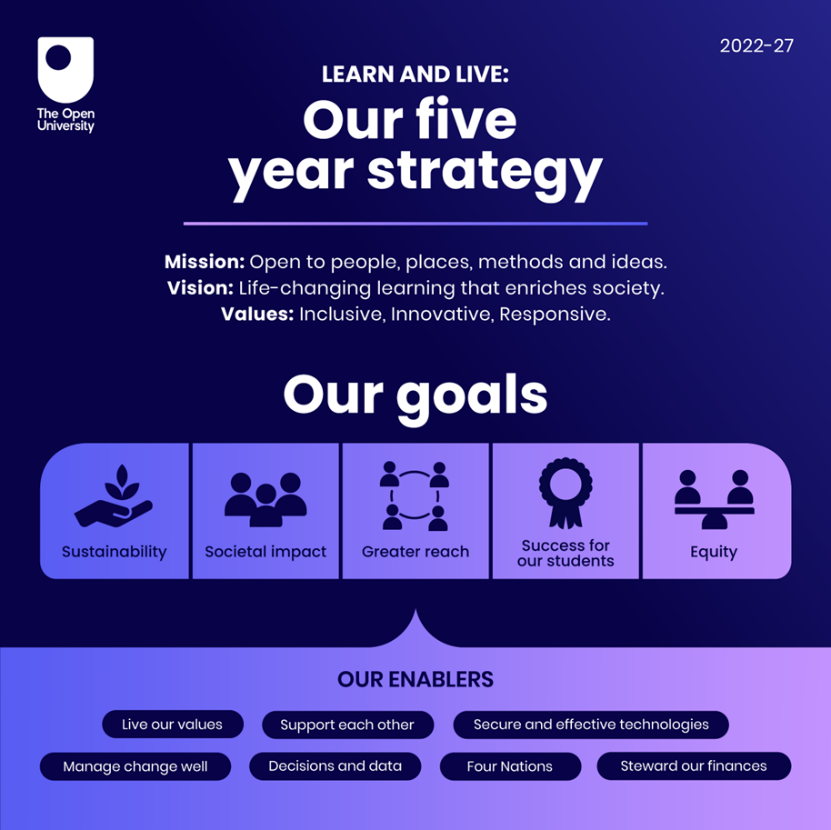
As a values-led organisation, the OU aims to make a positive difference to society by co-designing its knowledge exchange (KE), evaluation and dissemination activities and outcomes, which lead to societal and economically impactful outcomes. With 1,000+ academics working at the forefront of new research and technology, the OU has the creative problem-solving skills to address challenges faced by people and organisations, large or small.
We've been using our research to transform lives for over 50 years. Our new Research Plan 2022-2027 sets out to address three crucial societal challenges:
Sustainability
Tackling Inequalities
Living Well
We have designed an innovative mechanism to launch challenge led, impact focused projects with an online social network tool to engage anyone across the UK and is driving our interdisciplinary and collaborative research.
In March 2023, the University launched its new Knowledge Exchange Plan which aligns with the Research Plan and sets out our KE and Knowledge Transfer (KT) ambitions for the future, drawing on our strength to deliver at scale across the UK and beyond. A flagship activity within the KE Plan will be the provision of world-leading entrepreneurship support for OU students, alumni and staff across the UK, through Open Business Creators.
The OU already engages in a significant breadth of KE and KT, which will be strengthened by the KE Plan. Current activity ranges from technology transfer, public policy influence, engaged research, business-sponsored PhD training & development, citizen science and public engagement. The KE Plan will focus our activities to support the delivery of engaged research, increase commercial activity, capitalise on our presence in all Nations of the UK and help drive business development and growth, responding to need at local, regional and national levels and aligning with UK and devolved Government policies.
The KE Plan facilitates ongoing support for the broad impact and phenomenal reach we achieve via OpenLearn and our unique BBC partnership as well as the deep impact of smaller scale, focused engagement we undertake with, for example, micro NGOs.
For further information, please send queries to Res-Research-Enterprise@open.ac.uk
Local Growth and Regeneration
Summary of approach
The Open University (OU) has its headquarters in Milton Keynes and national offices in Cardiff, Edinburgh and Belfast. This allows the OU to operate across all four Nations of the UK and enables activity to be focused where it can achieve greatest impact for local growth and regeneration.
Our strategy focuses on using our expertise in online learning and educational platforms to address the skills gap at a national scale, and to increase productivity through targeted knowledge exchange (KE) activities.
We achieve these aims through the OU’s unique ability to interact with national governments through our Nations offices, and by building relationships with regional business and public communities to identify needs and provide solutions relevant to the area in question.
Aspect 1: Strategy
The OU’s approach is to target our expertise where it can impact the many and where our work helps create sustainable social and economic development. Our research and KE contribute to national and local growth and regeneration across the UK and is split into two broad areas: (i) addressing skills gaps and (ii) facilitating KE to increase productivity.
The University’s five year strategy, ‘Learn and Live’, commits the University to building on its uniqueness as a university for England, Wales, Scotland and Northern Ireland, leveraging our expertise and four nations presence to develop research and KE capability through working with governments, local authorities, employers, the third sector and communities. In response to the Government’s levelling up agenda and Civic Mission, the OU is developing a localism strategy, the key aims of which will be to enable the OU to deliver educational and social opportunities and develop programmes with regional employers and organisations where they are most needed.
The University’s Knowledge Exchange (KE) Plan (2023-28) sets out our ambitions, drawing on our strength to deliver at scale across the UK. We will capitalise on our presence in all Nations of the UK with a flagship programme to help OU students and alumni start businesses. The development of Open Business Creators (OBC), a high-profile accelerator programme delivered in partnership across the UK will validate, nurture, and helps new business thrive. Via an interconnected, complementary offer across the UK, OBC will deliver training, annual entrepreneurial competitions, support business modelling and help navigate investment opportunities.
The scale at which the OU addresses growth and regeneration across the UK requires strategies for specific regions that contribute to the overall mission. These strategies are developed and led by the OU’s Nations offices in Edinburgh, Cardiff and Belfast, and our main campus in England at Milton Keynes:
In England the OU addresses regional growth needs in the area surrounding Milton Keynes through supporting South-East Midlands Local Enterprise Partnership (SEMLEP) to achieve their economic strategy. Current activity is focused on driving regional growth through SEMLEP’s High Performance and Innovation, and Cultural and Creative showcase sectors. The OU is an active member of the Arc Universities Group to unleash potential for growth in the Oxford to Cambridge Pan Regional Partnership (formerly the Oxford-Cambridge Arc). The OU also responds to growth in other areas of England linked to strategic or significant partnerships.
The approach in Scotland is influenced by the objectives of the Scottish Funding Council and The Scottish Government, covering all local authority areas from the Shetland Isles to the Scottish Borders. Activities are strategically aligned to national priorities, contributing to economic regeneration, addressing social challenges, increasing opportunities and widening access to higher education. The OU in Scotland works collaboratively with businesses, local authorities, the NHS, social care, the third sector and trade unions to provide skills through multiple programmes driving economic recovery.
In Northern Ireland the OU works closely with CBI NI to gain insight into the skills and training challenges faced by employers, and with Invest Northern Ireland, Enterprise Ireland and the Local Enterprise Office to facilitate connections with individual organisations. There is a strong focus on contributions to peacebuilding and regeneration in Northern Ireland.
The OU in Wales aligns its work to Welsh Government and HEFCW priorities, including those of Regional Skills Partnerships. The OU in Wales’ Research Wales Innovation Strategy outlines a commitment to economic prosperity through growing partnerships with FE, developing work with employers on skills development and extending a programme of public engagement and civic mission work through sector-based activity.
The OU has also been committed to international development for over 20 years, with programmes aligned to the UN Sustainable Development goals delivered across sub-Saharan Africa and South Asia that support our vision to reach more students with life-changing learning that meets local needs. The OU works with National Governments to identify priorities and our projects empower teachers, healthcare workers and higher education experts, reaching over 2 million people around the world.
Aspect 2: Activity
The OU’s approach to local growth and regeneration is broadly grouped into two areas: (i) addressing skills gaps and (ii) supporting KE to increase productivity. Highlight activities are described below,
Addressing the skills gap
In Wales, the OU is a member of all four Regional Skills Partnerships, developing opportunities for funding and skills development in collaboration with FE, employers and local government and is currently developing an online tool to streamline interest (Open Skills Academy). Similarly, in Scotland the OU are working with Skills Development Scotland, the national skills agency, to assess and respond to specific organisations needs with an emphasis on skills development.
In addition to CPD, the OU has supported the local growth of businesses through transferring skills, knowledge, and expertise from the university to the businesses. Since 2012 the OU has brokered over 90 students for 3-month Santander Internships across UK companies including the National Energy Foundation and Ulster Wildlife Trust. More recently, the OU has expanded its internship programme via a nationwide online Virtual internships programme that allows knowledge sharing to support organisations wherever the need arises. Knowledge Transfer Partnerships (KTPs) expand upon internships with a funded route to supporting innovation through the transfer of knowledge and skills from university to business. The OU has had a KTP (OU) portfolio for over ten years, partnering with business from across England. Our most recent KTP was with an SME, Albion Environmental, based in Ayr (Scotland), where the OU supported the business in accessing new revenue schemes through transferring skills is bioaerosol monitoring.
Access to quality education is critical for growth in any nation and the OU responds to teacher needs in the global south to improve education and increase access to it. During the COVID-19 pandemic the OU provided rapid online training for educators across the UK and globally to develop their skills in distance learning and teaching through the creation of the Take Your Teaching Online course. The course was aimed at people and organisations having to pivot to online teaching and provided the principles of effective, inclusive and accessible online education. The OU also delivers international development programmes in partnership with governments, NGOs, funding institutions and local partners. Our programmes are aligned to the UN Sustainable Development Goals, delivered across sub-Saharan Africa and South Asia, addressing areas such as frontline health, teacher education and English language teaching.
Supporting enterprise and knowledge exchange to increase productivity
The OU has been a delivery partner on multiple ERDF projects in the SEMLEP region designed to support SMEs and stimulate innovation through supporting partnerships between businesses and academia:
ACTIS (Advanced Clinical Technology Innovation Support) focused on improving the economic performance of the life sciences sector through facilitating interactions between business, research entities and the NHS.
ALPHAS (Accelerating Leadership & Productivity in High Ambition SMEs) provided student placements that focus on solving problems that inhibit SME growth.
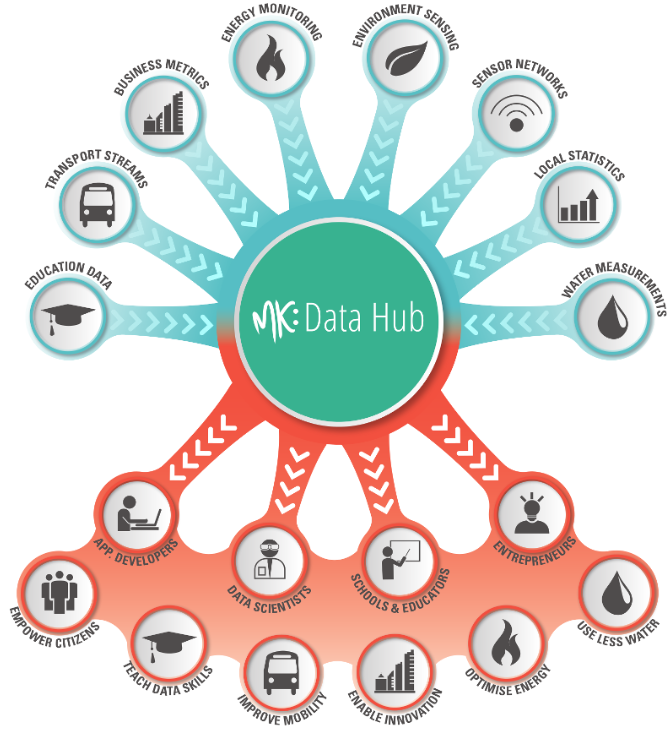
CityLabs focused on data driven and Internet of Things (IoT) developments and supported SMEs with a programme of Urban Business Lab and Tech Design to develop concepts into prototypes for new products and services in the digital economy.
Other projects that support local growth and regeneration through assisting SMEs include ‘Open for Growth’, an online business development pilot program to support SMEs in Northern Ireland. Under the guidance of an OU Learning Adviser experienced in businesses development, this programme enabled over 50 participants from 13 SMEs to develop their understanding of key areas which contribute to business growth. Other SME support initiatives in Northern Ireland include the Connected Project, funded by the Department of Economy, that aims to benefit the NI economy by connecting and creating partnerships between industry (particularly SMEs) and higher/further education providers.
In addition to enabling growth through SMEs support, the OU has numerous knowledge exchange initiatives across the UK. The OU’s Centre for Policing Research and Learning creates and uses knowledge to improve policing for the benefit of society through working with 24 police agency partners across the UK through informal and formal learning to support continuing professional development and putting knowledge into practice. The OU is an active member of the Silverstone Technology Cluster and contributes regularly to special interest groups and events with business partners who are engaged in high performance engineering and technology. As a founding partner of SPRINT (the SPace Research and Innovation Network for Technology) alongside four other top space universities (Leicester, Edinburgh, Surrey and Southampton), the OU provided SMEs across the UK funded access to the expertise (people, knowledge, facilities, applications, technologies and training) required to support the development of new products and services. For example, in Scotland SPRINT funding was used to enable the OU to work alongside the Scotch Whisky Research Institute to develop a mechanism to detect adulterated and fake whisky.
Aspect 3: Results
Addressing the skills gap
The OU provides skills training for millions of people every year through a combination of online educational platforms, national and international programmes. Examples of where the OU has used its expertise and reach to address the skills gap and support local growth and regeneration include:
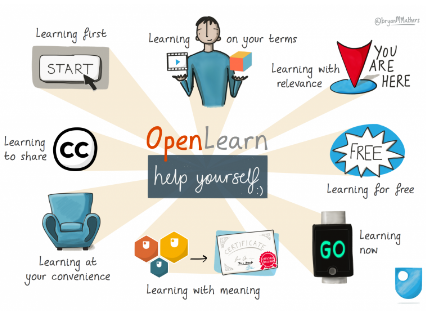
OpenLearn has 14 million annual visitors and offers 1000+ courses. These courses enable learners to enhance their work skills without committing to full-time study and include modules on business and management, health and social care, communication and interpersonal skills and customer service.
A programme of work with Jobcentre Plus in Kingston-Upon-Thames, focussing on core employability skills (leadership, networking and career resilience) to support job seekers getting back into work was shared across the Department for Work and Pensions and the wider Jobcentre Plus network. This resulted in the programme being introduced to 12 Jobcentre Plus locations across south and west London (England), with there being significant interest in further expansion. The pilot in Kingston propagated awareness of courses in organisations such as Kingston Adult Education, local FE colleges, Fulham Football Club and Unilever. The OU OpenLearn courses were included in the Department for Education’s skills toolkit and the Department for Work and Pensions websites which were created in response to the COVID-19 pandemic.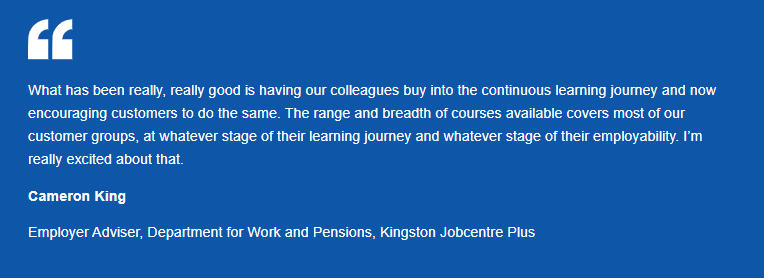
In Wales, the OU worked with Cardiff, Swansea, Denbighshire, Carmarthenshire, Merthyr Tydfil and Blaenau Gwent local authorities to develop local engagement plans and pilots. Monitoring and evaluating the place-based activities in these local authority areas allowed the OU to share the learning and develop sector-based plans to maximise impact across Wales. For example, a placement and workshop programme established in south-east Wales between FE colleges, industry and the OU is now being rolled out across Wales.
In Scotland, we have promoted our Psychology at Work hub in the Dumfries and Galloway region as part of a wider programme to support SMEs post the pandemic.
Globally, the OU has achieved tangible outcomes in international communities. Through participation in OU designed programmes over 3000 women in rural Malawi and Sierra Leone have embarked on pathways to financial independence and undergone personal transformation. Over 50% of these women had not previously passed secondary school exams. During 2021, more than 200 staff across a range of Kenyan universities studied a version of the Take Your Teaching Online course, adapted for their context as part of the Skills for Prosperity initiative.
Supporting enterprise and knowledge exchange to increase productivity
The OU has supported local growth and regeneration by engaging with SMEs across the UK and partnering with non-commercial organisations. Examples include:
As a result of the ACTIS, ALPHAS and CityLabs the OU supported over a hundred SMEs in Southeast England. CityLabs assisted over seventy SMEs with a structured support programme support that included grants for product development, prototype evaluation, hackathons and individual assistance within the MK Data Hub. One recipient (Eduvocation Ltd) noted “The individual programme of support from CityLabs meant we were able to revise our business model to the next level and really deliver something new to market. We would not have achieved this without CityLabs”.
The Open for Growth pilot in Ireland was completed by 13 small businesses from across the island of Ireland, and their achievement was recognised by former OU Pro-Chancellor Lord Haskins at an event in June 2019. An independent evaluation of the pilot is underway in preparation for a full programme launch across the UK.
The benefits of investment in the space sector on the economy in Scotland was discussed at a consultation event hosted by the OU-Scotland and attended by over 20 organisations. Subjects included the socioeconomics of space science and the economic benefits of a space port in Scotland.
The OU’s work with the Scotch Whisky Research Institute to enhance counterfeit detection of Scotch Whisky using technology developed for the space sector has helped protect one of the UK’s biggest industries which contributes £1 billion in taxes to the UK Exchequer and employs more than 10,000 people directly across Scotland. A further 40,000 jobs, across the UK, are supported by the sector indirectly, with 7,000 of these being in rural areas.
The OU contributed to the foundation of the Police Reform and Transformation Board which was directly responsible for the creation of a network of 43 Innovation Brokers, one for each Police Force in England and Wales, whose role is to help and encourage front line officers and staff to share their ideas and knowledge.
Public & Community Engagement
Summary of approach
As a UK-wide university, The Open University (OU) has broad and significant reach across the UK and globally. This is accomplished via direct engagement with the public at events, through participation with innovative citizen science platforms and engaged research, by accessing our free open learning, and because of our unique long-term partnership with the BBC.
We have over 50 years of experience of teaching people at a distance and apply this knowledge and skill when we engage with the public via broadcast and OpenLearn. We have significant experience in how to communicate ideas effectively to huge numbers of people using approaches that don’t rely on face-face interactions. These unique attributes are valued by our co-producers.
Aspect 1: Strategy
The OU’s mission, be ‘open to people, places and ideas’ drives our engagement vision and strategic goals. Our vision rests on three aspirations: To Inform. To Inspire. To Influence. As a UK-wide university, signatory of the NCCPE Public Engagement Manifesto and member of the Social Partnerships Network we are committed to broad reach alongside focused, engaged activity spanning all communities, ages, lifestyles, genders, education and employment status.
The OU has always influenced communities, bringing social and economic benefits through research impact on public policy, culture, social issues and the environment across the UK and internationally. The Research Plan (2022-2027) describes the University’s aim to maximise the impact of OU research through sharing openly and widely, thereby enhancing integrity and minimising waste.
Our Knowledge Exchange (KE) Plan (2023-28) is an ambitious step change in our approach to have major impact across the UK. To achieve this, we will build our capacity in engaged research through increased and widened public and stakeholder engagement.
As a four nations university the OU is distinct from other HEIs, not only in our reach but also in how we are able to engage with governments, organisations and communities across the UK. This allows the OU to undertake public and engagement activities that are strategically relevant for each nation.
A KE Board, chaired by the PVC Research & Innovation with representatives from each Faculty and Nation, sets the strategic direction for and monitors KE, including public engagement. After collecting baseline data, the Board is establishing a dedicated plan for public engagement, which will consider EDI, ongoing evaluation, and continuous improvement. This will address various National priorities, for example in Ireland where there is a strong focus on contributions to peacebuilding and regeneration in Northern Ireland and the strong civic mission in Wales.
The OU’s priority surrounding public and community engagement (P&CE) is to deliver excellence in the planning, enactment and assessment of open and engaged practices. The University engages with and involves communities internationally, nationally and locally. OU academics and students are encouraged to engage stakeholders, end-users and the public through rigorous, responsive and responsible ways of working, using a variety of participation methods and communication modes including:
Media - The BBC/OU partnership co-produces programmes for all BBC platforms, with content coming from both the OU (aligning with institutional objectives) and the BBC.
Citizen science platforms designed by the OU to meaningfully engage the public
Engaged research activity
Free learning platforms
Public events
Aspect 2: Support
Academics are supported by professional support staff, peers and training:
Within faculties, KE and/or external engagement leads champion PE, supported by professional support staff and senior management posts such as Associate Deans of KE (or equivalent). These staff sit on the KE Board and share good practise.
Training is provided either in-house or from appropriately qualified external providers. A researcher development programme and academic monitoring procedures exist to enable alignment of KE evidence capture with personalised academic pathways for public engagement, promotion, and grant acquisition success.
Media fellows are the central point of contact within faculties for development, production and dissemination of public engagement activity for the OU/BBC partnership and help develop projects that link broadcast output and Faculty priorities.
Public engagement or outreach champions sit within Schools and research groups to facilitate engagement with external stakeholders.
Internal resources are available to develop free courses, broadcasts and MOOCs.
Engagement with external professional networks for professional development, sharing expertise and raising the profile of OU P&CE. For example, the Deputy Director of OUiW is Chair of the Welsh Civic Mission Network and professional support staff regularly participate in externally focussed KE events and are members of professional societies including UPEN, University Innovation Network (Scotland) and PraxisAuril.
P&CE is embedded in the Academic Development Programme and the OU has a KE pathway for promotion where community engagement is a key criterion. The OU hosts annual Research Excellence Awards where excellence in external collaboration and KE is celebrated. Externally we participate in the Guardian Impact Awards and Oxford’s ESRC IAA awards to showcase collaborative successes.
National KE funding is used strategically to support P&CE. Areas of focus include public engagement events, partnership creation, training and the delivery and evaluation of engaged research. For example, the award winning OpenSTEM Labs and OpenSTEM Africa have received millions of pounds of internal and external investment and are used by OU students and the public. The OU has developed and part funded CORE, the largest repository of open access articles in the world, which can be freely accessed by the public to find and explore the wealth of open access research articles. In Wales the OU secured UKRI funds to work in one of its targeted local authority areas - the Blaenau Gwent Residents Engaging in Arts, Community and Heritage project (BG REACH) is a collaboration with Aberbeeg Community Group and Linc Cymru Housing Association to celebrate the rich history and culture of Blaenau Gwent. External engagement is also funded internally and in partnership with Oxford University via an ESRC Impact Accelerator Account.
Aspect 3: Activity
OU P&CE activities promote our mission by achieving positive impacts on society, culture and the economy across the four UK nations and beyond. Our activities are broadly separated into three areas (i) Media Engagement and (ii) P&CE and (iii) Citizen Science. Key activities in each area are described below (not a comprehensive list):
Media Engagement
The BBC and OU collaborate to reach the widest possible audience with innovative, exciting and inspiring content. The partnership co-produces programmes for all BBC TV, radio, digital and online channels/platforms, producing up to 35 projects a year. In 2021/22 our broadcast activity generated over:
330 million viewing/listening events
232 thousand print requests
4.5 million digital/social engagement for OU/BBC projects on BBC sites
602 thousand visits to broadcast pages (Connect)
Winners of 5 major broadcast awards along with 16 nominations
Highlights include Green Planet (42m viewers, BBC1) and SpringWatch (22m viewers, BBC2). More or Less (24m listeners, Radio 4) which explains the numbers and statistics used in political debate, the news and everyday life. BBC Inside Science (27m listeners, Radio 4) illuminates the mysteries and challenges the controversies behind the science that's changing our world.
Annually, around one million people progress their engagement from a BBC/OU production via Connect which has animations, short videos, interactives, articles and high-profile interviews that enable exploration of a subject or an issue in more detail, plus there are related courses on OpenLearn. The OU’s social mission for life-long learning has seen over 4 million people enrol onto OpenLearn courses, with 80M+ unique visitors since the platform’s launch. In the last three years there were 29.2M visitors to the 950 free courses on offer.
Public and Community Engagement

Highlight events include those addressing the climate crisis linked to COP26 (2021) at which we held an official flagship event in the Cabinet Office Green Zone showcasing our research and working with Glasgow Museums, attracting an in-person and online audience in excess of 1500 people, a series of joint online events with Voluntary Health Scotland exploring how to age well (20/21) and music workshops hosted by the BG REACH project (2020). To preserve Irish conflict memories, the OU launched Time to Think (2019), a collection of images, artefacts and interviews with Loyalist and Republican ex-prisoners, OU staff, prison education staff and others who studied in the prisons.
The OU had pioneered methods for engaging non academics in research, for example evidence cafes which bridge the gap between research and practice, enabling participants to explore how research might inform their practice and giving academics access to the practice-based insights on the research from practitioners.
The OU has strong engaged partnerships such as the Centre for Policing Research and Learning, a growing partnership between the OU and 24 police forces across the UK. The Centre creates and uses knowledge through research and education to improve policing for the public good. An innovative range of knowledge into practice activities include evidence cafés, peer learning visits, workshops and the secondment of police officers into ongoing research projects.
Stakeholders from across the globe collaborate with the OU on engaged research projects, such as the Covid Chronicles, which investigates the pandemic crisis from the perspectives of asylum seekers and refugees using creative methods and celebrating artful acts of resistance to marginalisation, and AgroEcos, a Research partnership for an agroecology-based solidarity economy. Research teams from three countries (UK, Bolivia and Brazil) jointly deepen their interdisciplinary skills for participatory action research with community organisations developing agroecological innovation
Citizen science
Citizen Science is an important strand of OU P&CE activity. The OU contributed to outlining the Ten Principles for best practice in Citizen Science and this contributes to ensuring our activities are rigorous and leading on a global scale.The award-winning nQuire hosts missions, each with a ‘big question’ that can be answered with the public’s help. Developed in partnership with the BBC it supports organisations to run citizen science projects and has received 24,079 direct contributions from the public over the last three years. iSpot is a free community that helps identify wildlife and Treezilla is a platform to create an online map of all UK trees that can be used for education, outreach, research and biological surveillance. The OpenSTEM Labs make practical experiments and experiences created for our undergraduates more widely available to the public. This includes remote telescopes and virtual microscopes which showcase Moonrocks from the Apollo missions.
Aspect 4: Enhancing practice
The OU monitors P&CE through a combination of metrics and regular reviews of activities to ensure institutional strategic alignment. The central Research and Enterprise team capture qualitative and quantitative information on activity which is summarised to relevant decision making/strategic groups. University wide KPIs for KE are being developed as part of the implementation of the new KE Plan.
The OU has a dedicated impact evidence manager plus impact managers in each Faculty who support planning for how to evaluate activity and evidence its impact. Qualitative and quantitative markers of success are used to assess the effectiveness of wider P&CE activities. These include online surveys and direct exchange with stakeholders. In England and Wales, the Higher Education Innovation Fund (HEIF) and Research Wales Innovation Fund (RWIF) strategies include measurable outcomes and feedback is via annual monitoring reports to Research England/Higher Education Funding Council for Wales.
Training on planning for KE and impact includes project evaluation and capturing and analysis of data for impact and KE. This aims to ensure robust data to inform future strategic decisions, activity planning and increase stakeholder satisfaction. This is delivered by the impact managers and specialist support providers.
Media engagement
P&CE
At the project level, the OU works in partnership with our stakeholders to devise expectations and measures for evaluation. For example, the OU worked with the UNESCO learning study director in Derry to develop baseline expectations for the Learning Cities project against which achievements are being measured. Evaluations focus on social impact and real-world change. Evaluation methodologies are chosen based on project requirements or the activity type.
External awards are an effective route in which the OU monitors the success of P&CE activities. For example, OUiW received a TPAS Cymru Tenant Participation Special Award for BG Reach (2022) and Open Arts Objects was short-listed for the Times Higher Education Awards (KE/Transfer Initiative of the Year 2019) for its impact in changing museums’ educational programmes and professional practice.
Citizen science
Participation is a key metric used to assess the reach of citizen science activities. An increasing number of charities, HEIs and individuals are co-designing citizen science missions on nQuire, with many developing multiple missions, showing the value gained from the experience. In 2020, nQuire was used by almost 120k people to observe changes in their seasonal garden in a mission co-designed with the British Trust for Ornithology. Similarly, engagement numbers and satisfaction levels are monitored annually to monitor and evaluate the activities of The Open Media and Informal Learning (OMIL) unit who commission content and manage the production of OpenLearn, YouTube, Amazon (Kindle), Google Play output.
Aspect 5: Building on success
To enable continual improvement, P&CE performance information is shared with a variety of stakeholders and monitored by internal research governance structures. The KE Board has an institutional remit to improve the communication, evaluation, results processing and learning from KE activities and enhancements will be delivered via the KE Plan. Faculty and Nations monitor local activity against local targets and evaluation also takes place at the project level for implementation in future activity. For example, Learning from BG REACH from an EDI perspective led to adapting the model to be more inclusive as an upscaled approach in Wales REACH – a new project that will engage communities across all of Wales.
In 2021 we established an external advisory board who advise on effectiveness of the delivery of the Research and KE Plans. We are now in the process of compiling citizen science panels to steer the direction of our research to ensure it meets stakeholder needs.
Data on public engagement with free open learning is monitored by the University’s governance committees. Each nation also reports to relevant national bodies and data is monitored internally. For example, the HE-BCI data is reviewed annually at the institution level and performance compared against the sector. Any risks or issues are passed to relevant groups (e.g., KE Board) to mitigate.
The OU shares outcomes with communities and organisations and engages in open dialogues with stakeholders. OU successes are shared extensively internally through various staff communication mechanisms and externally through social media channels, the OU website and through our organisations.
Note You are currently viewing the latest version of this narrative statement. View the previous version as published in previous iterations of the KEF (KEF1 and KEF2)