Institutional Context
Summary
The University of Huddersfield (UoH) is a regional anchor institution, with the strategic aim to be an inspiring, innovative University of international renown.
Our broad portfolio of Teaching, Research and KE spans STEM, health sciences, humanities and social sciences, business, education, art and design.
Supporting our mission of ‘driving and delivering demonstrable societal and economic benefit’ through our knowledge exchange work, our strategic KE priorities reflect our regional demographics, and industry needs/challenges. Our priorities broadly focus on;
enabling the large concentration of local SMEs and public sector organisations to improve productivity and generate positive impact through research and KE partnerships;
enabling all our students to become inspiring and enterprising global professionals and achieve career and personal success.
Institutional context
UoH was designated university status in 1992 and is a member of UUK and Yorkshire Universities. We are in the West Yorkshire region, home to 7 universities and are committed to our role as an anchor institution and major employer in the region and a signatory to the UPP Civic University Agreement.
Significant economic and demographic challenges, including health and well-being, exist which impact on our KE activities. Pre-Covid19, the North’s GVA per capita was 15% below the UK average (excluding London) combined with average life and healthy life expectancy amongst the lowest in England. There are numerous contributary factors to these quite stark metrics e.g. lack of skilled people, technology gaps, low appetite for innovation. The low levels of regional private sector R&D investment presents major challenge in developing collaborative relationships with local industry. These factors remain prevalent in the current economic climate as we emerge from Covid.
The University has six academic schools covering a broad range of disciplines including STEM, health sciences humanities, social sciences, business, art and design. The University submitted almost 600 academic staff, across nineteen Units of Assessment (UoA) to the Research Excellence Framework (REF) 2021, for which we achieved our highest research power rating, up from 68th to 49th in the country.
This broad portfolio of institutional capability is recognised by Huddersfield’s assignment to KEF Cluster E.
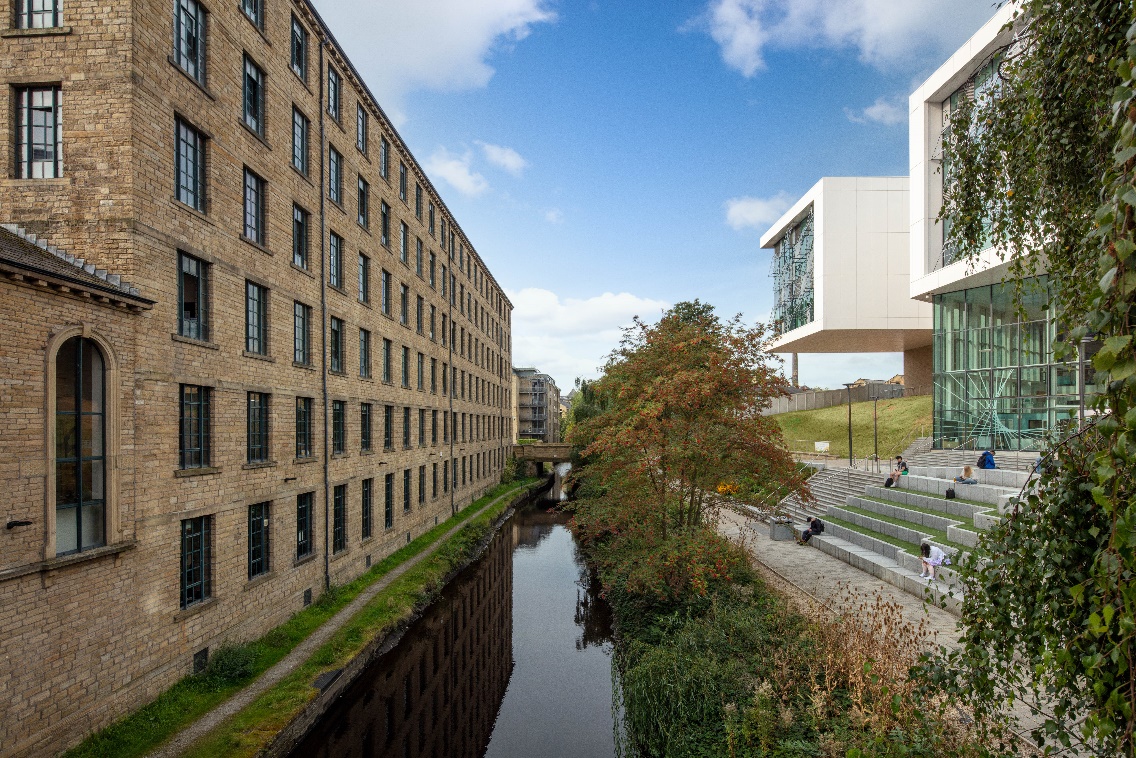
Figure University of Huddersfield Campus featuring the award-winning Barbara Hepworth Building
Knowledge Exchange activities and end-user engagement is influenced by regional business demographics, as ~99% of local and regional businesses are SMEs. Developing mechanisms and support infrastructure to upskill and facilitate innovation and growth in SMEs and their supply chains, is an important driver for the University.
Our commitment to engagement with local businesses is reflected in the University Strategy Map for 2025, where we have a target of engagement with 5000 individual businesses and end users.
Facilitating regeneration of regional legacy industries such as precision engineering, manufacturing and textiles is a priority area as well as direct engagement and participation in new and emerging sectors such as healthcare and medical technology. The University’s Centre for Precision Technologies won the prestigious Queen’s Anniversary Prize in 2022.
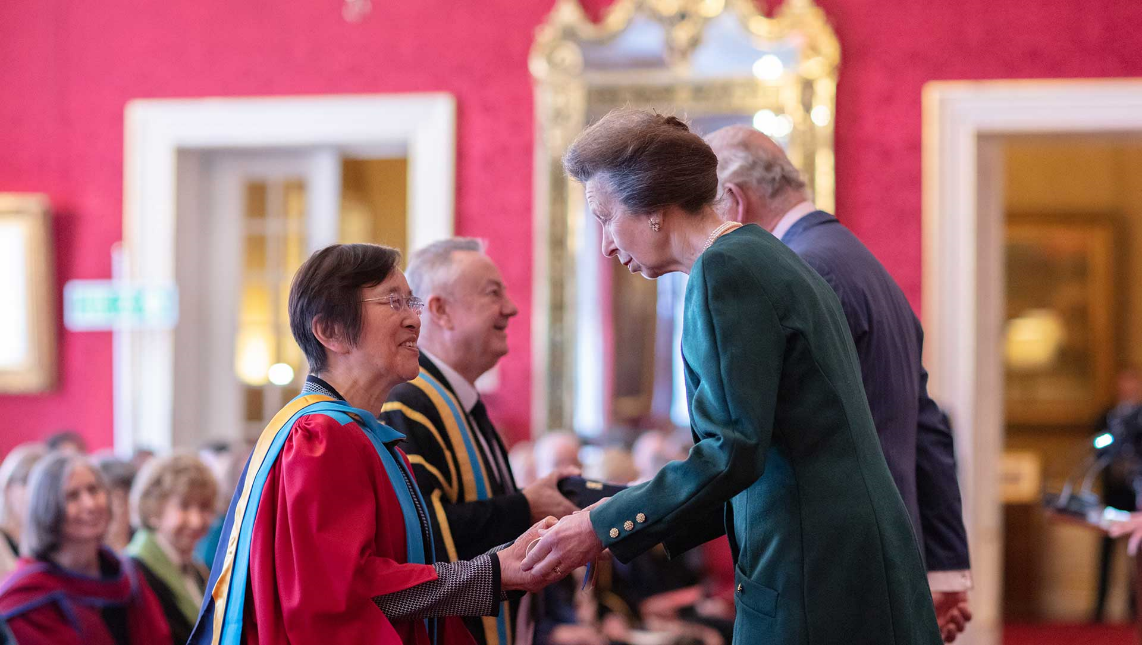
Figure Professor Jane Jiang and Professor Bob Cryan receive the Queen’s Anniversary Prize for the Centre for Precision Technologies
In 2021/22, UK student numbers returned to HESA were 11,075 (FTE) of which 63% registered a West Yorkshire home address. Longitudinal Outcomes Data indicates that the majority of students remain in the Yorkshire and Humber region following graduation.
Therefore, establishing mechanisms to showcase graduate talent to the large population of SMEs, who traditionally don’t recruit graduates, and to public sector employers is an important priority for UoH. In recognition of our commitment to this and from the Student Enterprise perspective, the number of start-up businesses to successfully trade increased by over 50% through implementation and delivery of enterprise on the curriculum initiatives across all academic schools.
The University’s KE objectives are outlined in our Knowledge Exchange Strategy for 2022-25.
For further information, please send queries to business@hud.ac.uk
Local Growth and Regeneration
Summary of approach
The University of Huddersfield recognises its role as an anchor institution and driver of economic, social, community wellbeing for our place and people.
We develop collaborative partnerships that inform local/regional economic and social policy, developing and delivering teaching, research and KE activities with private, public, and third sector organisations to address the needs and challenges of our society and business community.
Our approach and commitments are outlined in our University Strategy Map for 2025 and Knowledge Exchange Strategy, and focus on key areas; facilitating the ‘regeneration through innovation’ of regional legacy industries such as precision engineering, manufacturing and textiles as a priority, as is direct engagement and participation in new and emerging sectors such as healthcare, AI and medical technology.
Aspect 1: Strategy
The University Knowledge Exchange Group (UKEG) oversees all aspects of the KEF including strategy development, delivery and monitoring including Local Growth & Regeneration activities. UKEG has established robust oversight mechanisms to monitor results and impacts alongside proposals to maintain continuous improvement. With a new Director of Research, Innovation and KE, our strategic approach has naturally been reviewed and refocused.
In terms of strategic approach, our Knowledge Exchange Strategy (KES) revised and updated in 2022, outlines in some detail our Regional Growth and Regeneration strategy and activities (pages 8 – 12) .
The University Strategy Map for 2025, has been redeveloped with major input encompassing all stakeholders, emphasising our role and ambitions in this area.
The Local Growth and Regeneration aspects of this strategy are informed and driven by our engagement with decision making bodies and regional representative agencies including Kirklees Metropolitan Council (KMC) and the West Yorkshire Combined Authority (WYCA) West Yorkshire Mayoral Office and the Leeds City Region Local Enterprise Partnership (LCR-LEP). Notably the recently published Innovate UK West Yorkshire Action Plan underpins the combined approach to driving Innovation in our region, and our KES directly aligns with this. Key senior academic and service individuals from the University are active members of specific regional boards e.g.
Vice Chancellor – Board of Yorkshire Universities (YU)
Deputy Vice Chancellor – Employment and Skills Committee, WYCA
Director of Research, Innovation and Knowledge Exchange (RIKE) – West Yorkshire Economic Regeneration and HE Group; YU Regional Development Group
Associate Deputy Director, Regional Enterprise RIKE– Business Enterprise & Innovation Committee, WYCA; YU Regional Development Group; West Yorkshire Innovation Network
Head of Business Partnerships – SME Support Network, WYCA
Likewise, key regional stakeholders and business people are also represented on numerous University Advisory Boards in each School.
Our sustainability strategy Sustainability - University of Huddersfield contributes to the regeneration of surrounding industrial land, it including the redevelopment of a former Kirklees Council brownfield site into the National Health Innovation Campus. The new Health and Wellbeing Academy building on campus is being built to conform to the WELL Building Standard® | WELL Standard (wellcertified.com), one of the highest standards for sustainability and wellbeing globally. Wherever possible the University procures services locally which we recognise as a significant opportunity to develop local and regional businesses.
The strategically important geographical areas of most relevance to us are: Huddersfield – Kirklees – Leeds City Region – Yorkshire & Humber (Y&H) - M62 “Pennine Corridor” and Northern Powerhouse. Wider geographically-defined activity, most notably international, is primarily driven by specific strategic research interests – these are internationally far and wide- most notably by way of example is our Ethiopian coffee wetlands project and the global disaster resilience centre.
At sub-regional levels, the current economic strengths and weaknesses continue to reflect our industrial heritage. The two major Kirklees towns, Huddersfield and Dewsbury, were at the centre of the industrial revolution. Consequently, manufacturing and textiles remain key sectors with many SME companies operating locally at the ‘legacy end’ of the innovation and manufacturing technology spectrum, with low skill and low pay employment opportunities.
In partnership with KMC, we continue to develop the Kirklees Top 100 Companies listing using metrics such as turnover, profit, employee numbers and growth. This is used to forge closer relationships with business communities and to inform our regional engagement activity. Key priorities in the Kirklees Economic Strategy have directly influenced our HEIF strategy – specifically precision engineering and innovative manufacturing, innovation and enterprising business.
Within the local and regional business base, where SMEs dominate with very few ‘primes’, manufacturing remains one of the main key activities. Much of the local/regional manufacturing industry base has enduring low innovation and productivity levels, and is under-prepared for the opportunities arising from Industry 4.0 and the Digital Manufacturing revolution, using old manufacturing technologies.
Interactions with KMC and other local partners transcend the purely economic and embrace societal aspects that support LG&R such as the Huddersfield Blueprint redefining our town. Kirklees is a highly diverse borough with significant population of South East Asian origin and this is an area that we are seeking to develop more partnership working.
The University has recently opened the Jo Cox More in common Faith Centre which provides a multi-faith setting for our students, staff and partners.
At the regional LCR and wider Yorkshire & Humber scale, much activity is collaborative with the Yorkshire Universities (YU) consortium, where need and strategic response(s) are jointly developed. The Yorkshire & Humber Policy Engagement and Research Network (Y-PERN) recently awarded £3.9m of funding from the Research England Development Fund, is a network-based approach to inclusive and place-based academic policy engagement and research, seeking to identify actions and solutions to regional challenges.
Student led activity is vital in contributing to personal and regional development. As outlined, our institution has a higher-than-average local undergraduate base, so a key strategic imperative is to ensure this population reaches its potential and drives up our regional attainment of improved education, skills, health, wealth and wellbeing.
Our strategic approach encompasses strands led by the Student Union, allied to curriculum through the Global Professional Award and to extracurricular KE activities including the ICE+ project, connecting student talent directly to local employers especially SMEs. The University supports and fosters student placements, many with regional businesses and organisations.
The value of placements to the graduate is well documented, and for many regional employers, particularly SMEs, forms a vital part of the innovation and talent pipeline. Graduate Enterprise has remained a high priority, with University investment supporting the Enterprise Hub in the University’s 3M Buckley Innovation Centre (3M BIC) which supports students and graduates.
A key internally-facing strategic undertaking, is to drive up the numbers of KEC trained, engaged and active academics and researchers across all areas, and focus the emerging engagements with regional SMEs, larger businesses and public/3rd sector organisations. This activity links strands together from the Knowledge Transfer Partnerships (KTP) Team, Impact Acceleration Award (IAA) and core Business Partnerships teams into a single coherent approach.
Aspect 2: Activity
With a focus on the 2019-2023 window, our approach and activities are outlined in our first institutional Knowledge Exchange Strategy (KES), which has recently been updated. The following are some examples of our approach and activities grouped under broad groupings that reflect identified needs and their geography as outlined in our KES:-
SME Support
The University successfully runs a variety of regionally funded programmes to support SME growth and productivity.
We lead on two ERDF funded business support programmes managed on behalf of the Leeds City Region Local Enterprise Partnership (LEP) . The University has employed a team of business advisors specialising in working with manufacturing companies. The advisers have worked with many businesses across both programmes, providing consultancy grant funding and introducing many to specialist academic support within the HE sector. This has led to many engagements between UoH and our SME community including consultancy, KTPs and research collaborations.
3M Buckley Innovation Centre (3M BIC)
The University has also run a successful Local Growth Fund project, the Huddersfield Innovation and Incubation Project (HIIP), within the 3M BIC. This project has invested in significant technology assets within the innovation centre, for example additive manufacturing equipment for 3D printing in polymer and metal, which have been made available to local SMEs and entrepreneurs, for technology adoption, prototyping and product development.
Strong take-up of all these programmes has shown that the need from SMEs exists for manufacturing/supply chain expertise, productivity improvement and access to new technology, and has been met significantly through the support provided. Evaluation will be undertaken at the end of the ERDF programmes.
National Health Innovation Campus
The early development of the rationale for the University’s investment in the campus has been undertaken via significant consultation with local/regional stakeholders from within the NHS, public and private sectors. Although still within its development phase, much work is continuing with proposals for an NHS diagnostic centre now confirmed and health tech innovation space in development.
Research Collaboration
The University has increased its collaborative research and development with local and regional businesses, with a strong focus on increasing our number of KTPs. We have established a centralised KTP office and doubled our staffing resources to expand the effort working with academics and employers to promote KTPs. This has proven successful with a strong pipeline of interest, and numerous repeat users of the programme amongst our SME base to support our ambition to be in the top-ten for KTP’s within 18 months.
Recent examples include Coterie Marketing looking to develop a partner marketing membership offer and Pendle Polymer Engineering on advanced product design following a previous successful KTP.
Enterprise & Entrepreneurship
The University has a dedicated Enterprise Hub and Enterprise Team of business advisers and enterprise educational specialists to support students and graduates with enterprise and entrepreneurial interests and ambitions both on and off curriculum. Throughout the pandemic, all provision was moved online, including support, bootcamps, pitch club and enterprise workshops.
The Enterprise Team has run ICE+, an interdisciplinary enterprise and employability initiative funded by OfS, as part of their Student Engagement in Knowledge Exchange bid, providing opportunities for students at all study levels, to engage in real-world challenges, posed by external businesses.
This two-year project (20-22) enabled interdisciplinary student teams to be supported in the development of potentially innovative solutions and concepts for an external ‘client’, and then to pitch their proposals back to the external organisation. Teams with the best proposals were offered short internships with the external organisation, to further develop or implement those ideas, and to gain valuable industry-based experience.

CPD & Skills
The Kirklees Top 100 Companies initiative has set up a peer network of HR Managers who meet 3-4 times annually to discuss areas of common interest. This has improved our relationships with local employers which provides an excellent basis for extending our CPD offer in response to their needs.
Sir George Buckley Leadership Centre has run several cohorts of CMI leadership programmes, at Level 7 for Senior Leaders/Directors and at Level 5 for Operational Managers. These were very well received by the participants and their employers. Plans are in place to expand the Leadership Centre offer within the Huddersfield Business School, to include more leadership apprenticeship programmes in response to employer feedback.
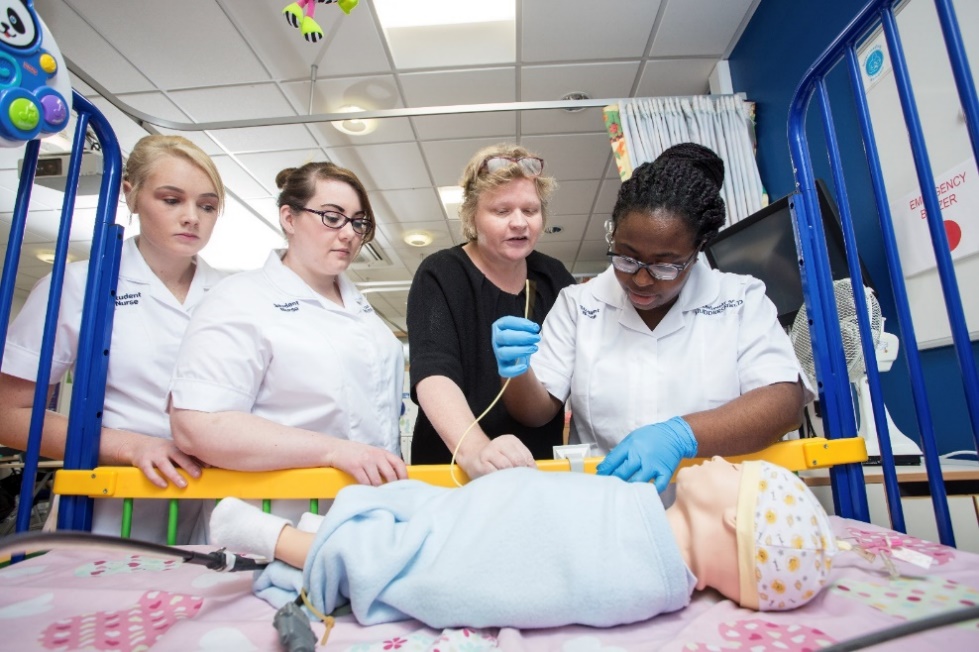
The University has expanded its wider portfolio of degree apprenticeships in response to employer demand in a range of sectors, with particular growth in nursing and allied health programmes e.g. midwifery and physiotherapy.
Public & Community Engagement
The University has developed a new Public Engagement Strategy, achieved a NCCPE Bronze Watermark and continues to invest in a strong programme of public and community engagement, as described in the dedicated PCE statement.
Aspect 3: Results
The following are examples of results directly or indirectly related to our KE Objectives and activities. With a focus on the 2019-2022 window, our strategies have delivered the following outcomes and impacts:-
SME Support
Supply Chain Support Programme £5.6m of company support – 89% had a positive impact on supply chain performance.
Manufacturing Champions Programme £2.5m of company support – 84% had a positive uplift in business performance.
The two programmes above have worked with over 680 businesses, supporting 490 companies directly with consultancy grant funding. Circa 55 referrals have been made to the University for KE activities such as KTPs, collaborative research, work placements and other forms of industry -academic partnership.
3M Buckley Innovation Centre, the University’s enterprise and innovation centre has supported many SMEs, startups and established businesses, including through the Huddersfield Innovation and Incubation programme (HIIP). This was funded via the University and the Local Growth Fund and generated the following outcomes:
6 direct and 128 indirect jobs created
252 enterprises receiving non-financial support (access to technology)
857 potential entrepreneurs assisted to be enterprise ready
National Health Innovation Campus
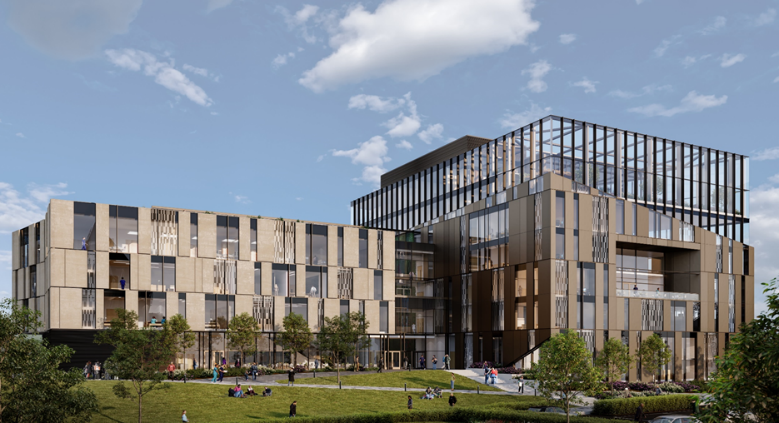
Figure 3 Artist impression of Daphne Steele Building
The outcomes and impact of the new health innovation campus will be realised in several years’ time following its opening in 2024, however the early development work has already stimulated a strong interest from regional partners and a pipeline of enquiries from health and health tech companies. Planning permission has been secured for the first building below, the Daphne Steele Building, named after the first black NHS matron.
Knowledge Transfer Partnerships
The KTP portfolio saw significant growth with 12 KTPs awarded between 2019-2022.
Intellectual Property & Commercialisation
The University has developed a stock of patents, licenses, and associated IP development projects, including:
The University has licensed patented IP generated by two of our key research institutes crucial to the development of Wayland Additives novel e-beam additive manufacturing machines Calibur3 which has recently been commercially launched.
The University developed an agent to pre-treat the scalp with an agent(s) that could significantly improve the efficacy of the Paxman Coolers device in preventing hair loss from cancer treatment. The University and Paxman Coolers have now agreed to co-fund a major collaborative research centre – the Paxman Scalp Cooling Research Centre - as part of our long-term relationship.

Commercialisation Accelerators
The University has prioritised engagement with external commercialisation accelerators to support the expansion – in terms of both volume and quality of our commercial pipeline.
Safe Innovative Debridement is a novel wound model to support healthcare professionals develop their skills in wound debridement, completed the Lean Launch Pad (LLP) programme and subsequently made initial test-market sales to potential partners and customers.
Enterprise & Entrepreneurship
Over 391 students have engaged in ICE+ projects with more than 12 regional organisations, and 44 successful student placements, developing novel solutions to specific employer needs around innovation.
CPD and Skills
The University is a partner in the Kirklees Top 100 Companies initiative. Three editions of the Top 100 listing have been produced and launched the first two of which taking place online during the pandemic, attracting over 80 attendees to the events.
The Kirklees Top 100 Talent Group, of circa 35 HR directors and managers, has been formed, that meets peer-to-peer to share common issues and best practice, informing planning for future CPD provision by the University.
Huddersfield Business School runs Government-backed Help to Grow programmes that are being well taken up by the local SME base.
Public & Community Engagement
PCE is covered within the dedicated PCE statement.
Communication
The University communicates its work in KE through sharing of stories online, through press releases and through promoting case studies/success stories at regional business events, including the Kirklees Business Conference and the Kirklees Top 100 Companies events - Kirklees Top 100 Companies 2022 revealed - 3M Buckley Innovation Centre (3mbic.com) .

Following the success of a local Innovation Week in 2019 hosted at 3M BIC, Inaugural Innovation Week hailed a success - 3M Buckley Innovation Centre (3mbic.com), the University has contributed several events to the subsequent West Yorkshire Innovation Festival | Innovation festival (wyinnovationfestival.com) , where several industry speakers have spoken about their experience working with the University e.g. Paxman Scalp Coolers, Innovate Orthopaedics and AUS.
Public & Community Engagement
Summary of approach
The University of Huddersfield has made a significant commitment to developing our strategic approach to public engagement over the last three years resulting in a new Public Engagement Strategy, completed in August 2022. The strategy embeds public and community engagement across the institution, building on a rich and diverse portfolio of activity.
Underpinning the strategy has been the appointment of a Public Engagement Manager and the establishment of a cross-departmental advisory group. Academic Schools are developing tailored strategic approaches to public engagement via champions, formal plans, and other dedicated resources.
As a direct result of the initial KEF process, we sought a Watermark for Public Engagement from the National Coordinating Centre for Public Engagement (NCCPE) - achieving a Bronze award.
Aspect 1: Strategy
From 2019 the University of Huddersfield has been committed to developing a more strategic approach to public engagement, working to the following model:
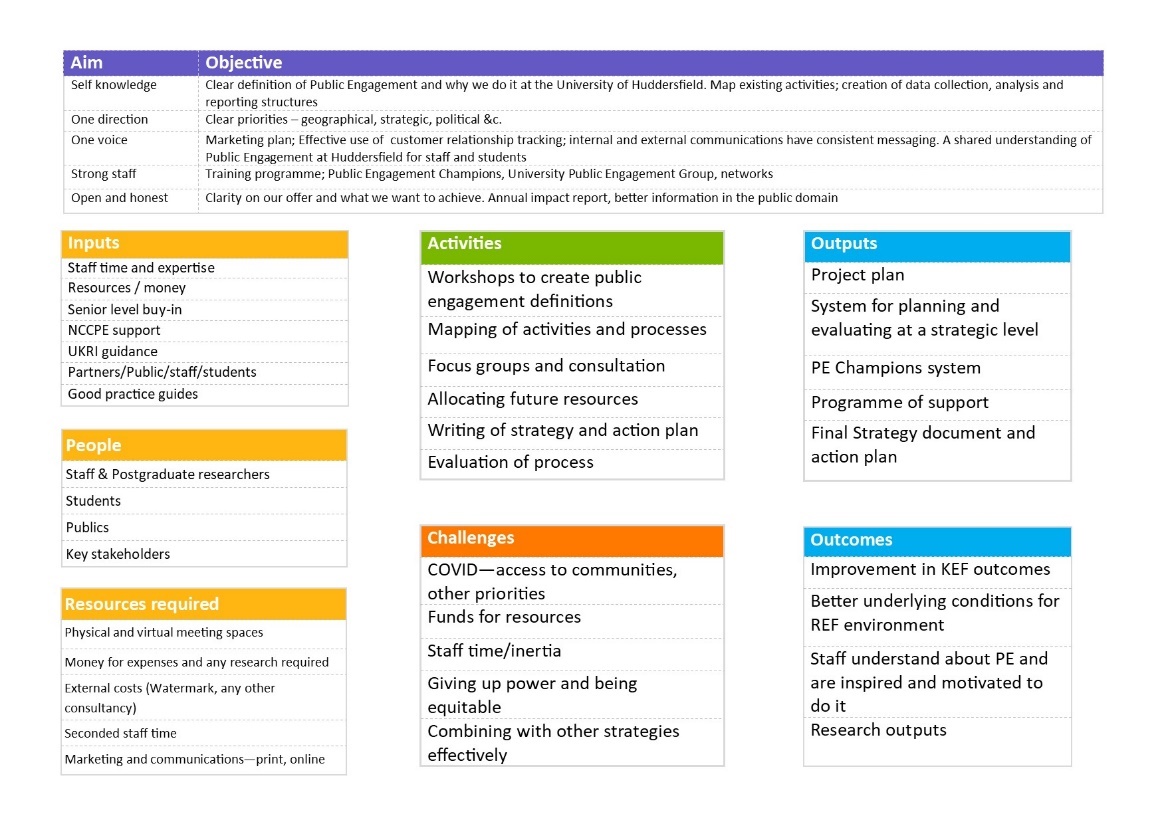
The University applied for a NCCPE Watermark, which provided a structured approach to consultation internally and externally and an action planning process, with expert advice and support. Our action plan set out the steps required for the development of a public engagement strategy and a support structure to deliver it. The key actions were:
Agree key institutional priorities and types of public
Produce a working definition of ‘public engagement’
Create a clear statement of the value of public engagement
Develop a public engagement strategy
The NCCPE recognised our “clear commitment to enhance and develop [public engagement] and a clear understanding of the institution’s current strengths and weaknesses” and we received a Bronze award.
Subsequently, a Public Engagement Strategy was developed in the 2021-22 academic year. The process involved further consultation with senior leaders, research and support staff, students and external partners and incorporated the findings from the Watermark. Internal consultation was undertaken with a broad range of staff and students. External consultation focused on several key partners, identified by senior leadership, with whom we have longstanding, public engagement-related partnerships. This approach allowed us to listen to ‘critical friends’ about our approach and determine how we could replicate the best aspects of the partnerships across the organisation.
The strategy reflects the character of the University and our history as a civic-focused, applied research institution, prioritising two-way engagement and open communication. By focusing on creating the conditions for collaborative working, the strategy allows our Schools and Services to shape their engagement to meet their existing priorities, research interests and partnerships.
Our Strategy has four priorities:
Embed public engagement in our research
Support engaged students
Create open, inclusive and accessible entry points to the University
Communicate and celebrate
The delivery of the strategy is overseen by the Director of Research, Innovation and Knowledge Exchange (RIKE), and informed by the University Public Engagement Group (UPEG). This advisory body provides direct consultation with academic Schools, key services, and the Students’ Union and reports to the University Research Committee.
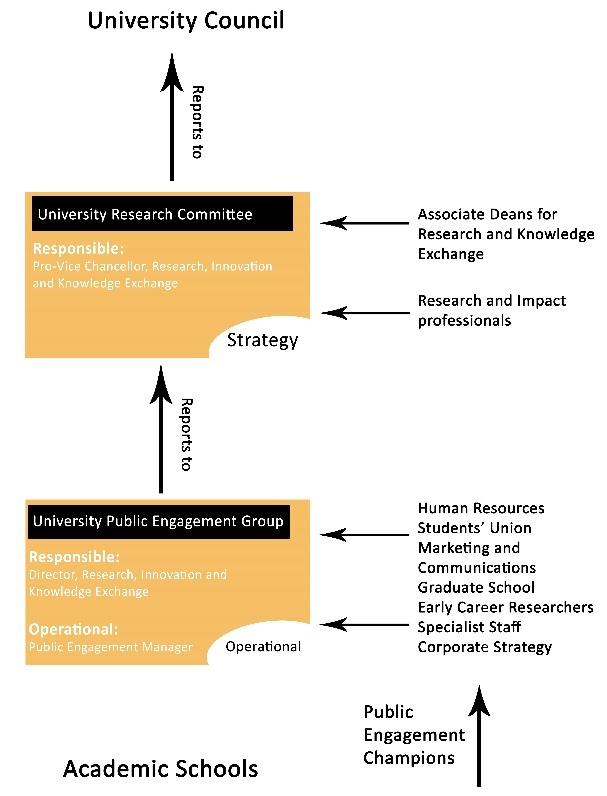
Figure 1 Public Engagement Management
A strategic public engagement budget, funded from central provision, includes a Seed Fund (to start new projects not funded elsewhere), a Public Engagement Manager and a proportion of staff time for senior leadership in Research, Innovation and Knowledge Exchange. Academic staff undertake public engagement as part of their ongoing duties. Each academic School has a Public Engagement Champion.
The Strategy is part of the University’s Knowledge Exchange Strategy.
Aspect 2: Support
Support for public engagement is located with the University Public Engagement Group (UPEG) who:
Advise senior leaders on matters related to public and community engagement
Determine and work towards key strategic aims and objectives
Oversee the development and implementation of the Public Engagement Strategy
Monitor and discuss public engagement performance, at School, Institute and Centre level and monitor progress against the strategy’s Key Performance Indicators
Engage with the Students’ Union, Schools and Services to embed public engagement across the organisation and act as the link between them.
Members collaborate on plans for training, events and other activity. The Public Engagement Manager and Public Engagement Champions meet bi-monthly to coordinate across the organisation. UPEG ensures that any initiatives and decisions take into account the impact on researchers and professional and support staff.
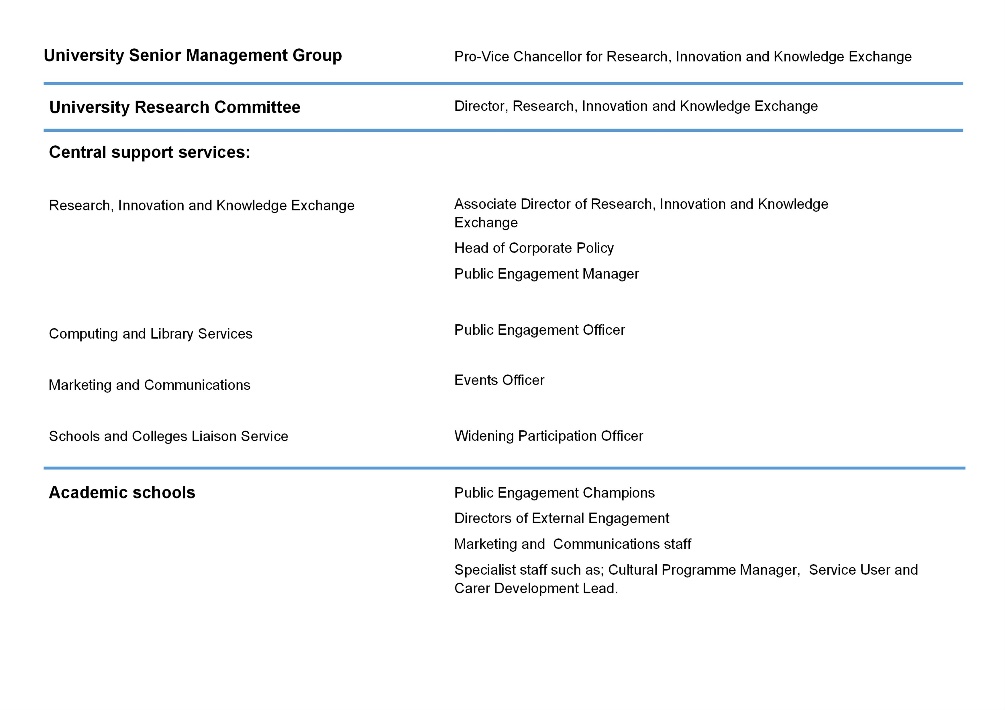
Figure 2 Support at each level
Public Engagement is coordinated by the Research, Innovation and Knowledge Exchange Directorate. There is a central budget to support activity and training including a Public Engagement Manager. Dedicated roles across the institution support public engagement, including Directors of External Engagement, cultural roles, and posts which support student-led clinics, marketing, and stakeholder engagement.
Between 2019-2022 work was undertaken to identify the key areas of training need. A suite of resources for staff and postgraduate researchers is now in production, to include:
Online introduction training materials
A programme of in-person training sessions
Peer Support meetings based on key forms of engagement.
Training for public engagement is written into the University’s HR Excellence in Research action plan.
Academic Schools have Public Engagement Champions who:
Represents their School on UPEG
Ensures that matters arising from UPEG are actioned at School level
Maintains an overview of School’s strategic public engagement activity
Assists in the development and delivery of training
Assists in the strategic evaluation of Schools’ activity
Supports joined up marketing and communications activity
The School of Arts and Humanities have introduced a new student role of Public Engagement Ambassador to assist in the running and evaluating of events and activities.
Support is in place for a range of non-research based public engagement activities. In the School of Human and Health Sciences, dedicated staff manage the patient involvement network and the University operates a range of healthcare clinics for the public. The Huddersfield Business School runs a Legal Advice Clinic. The University’s archive service provides training in public engagement skills for students at undergraduate and postgraduate levels.
Activity at Central and School levels operates in line with the University’s Equality, Diversity and Inclusivity Framework, which is also featured in the HR Excellence in Research plan. EDI is a high priority at the University and the membership of UPEG is designed to include the widest range of viewpoints. Senior level HR representation on UPEG ensures that all policies and initiatives are EDI compliant. Training provision is based on consultation with staff and is available for everyone to access. Online resources are assessed with accessibility tools and are reviewed by the appropriate colleagues to ensure they meet EDI requirements.
Delivery of our strategic priority ‘Create open, inclusive and accessible entry points to the University’ will include further consultation with external stakeholders and will provide an external dimension to our existing EDI activity. The archive services’ Broadening the Archive initiative has included an intersectional advisory group drawn from internal and external places, working to widen access to physical and online spaces and ensure diverse perspectives are represented.
We encourage projects from across the institution including Early Career Researchers and Postgraduate Researchers, following the EDI activity outlined within our HR Excellence in Research award.
Our policy for reward and recognition includes public engagement is part of the University’s conferment progression process for progression at the conferment level.
Aspect 3: Activity
Our Public Engagement Strategy is designed to embed good practice across the University of Huddersfield. We have identified our existing strengths and areas for development, particularly in collaborative research, and these have informed the content and language of the strategy. Examples of our strategic approach:
Embed public engagement in our research
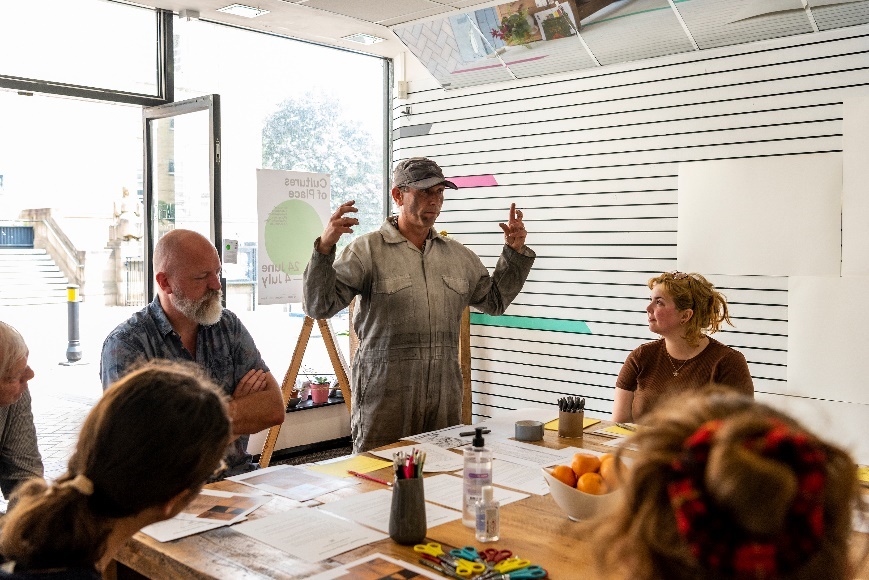
Temporary Contemporary workshop taking place in a disused shop
The University’s partnerships with the Gatsby Foundation and Kirklees Council (e.g. Temporary Contemporary) are examples of the strategic relationships that we form with large organisations for mutual benefit. Other research projects and Centres, such as None-in-Three, HudCres and the Global Disaster Research Centre (page 94) demonstrate an approach in which collaboration with individual participants and members of the public is fundamental.
Support engaged students

Law students associated with the Legal Advice Clinic
Our academic Schools recognise the benefits to students of engagement with the public. Dedicated public engagement modules sit alongside placements to ensure students apply and share their learning outside of the institution. Our student-led Podiatry, Legal Advice and recently opened Optometry clinics are open to the public. The School of Human and Health Sciences has also developed a health clinic offer as part of the National Health Innovation Campus development.

Our new Health and Wellbeing clinic
Engagement takes place on taught courses in all Schools. In the School of Arts and Humanities, students produce public-facing outputs in partnership with external organisations.
We are now increasing our partnership working, particularly with the Students’ Union, to create new opportunities for external organisations to collaborate with the University, the Union, and students themselves.
Create open, inclusive and accessible entry points to the University

Children explore the Holocaust Centre North
The University campus has three dedicated public spaces that are purpose-built to bring research and the public together. Both the Heritage Quay archive centre and the Holocaust Centre North are open to the public for events, researchers and exhibitions. Sovereign Design House includes the Bath House Gallery where visitors can see exhibitions produced by staff, students and our partners.
The University’s support for partners such as Huddersfield Literature Festival, Huddersfield Contemporary Music Festival and Woven bring audiences to the campus to experience high-quality cultural experiences reflecting our research areas.
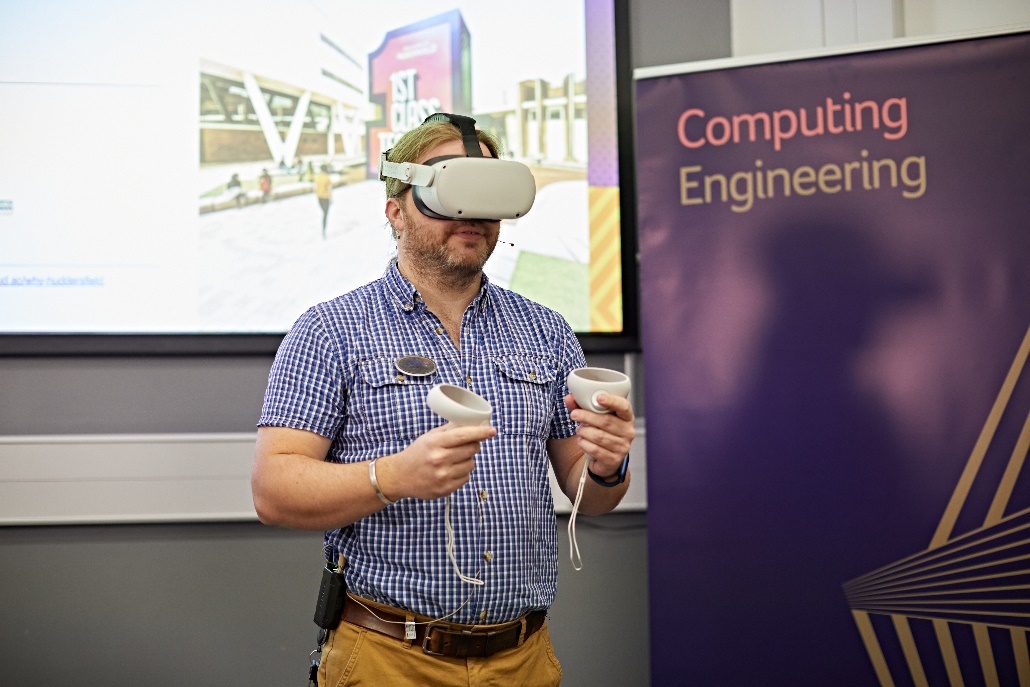
Discover Live lecture!
Public lecture series such as the School of Computing and Engineering’s Discover Live! encourage the public to visit the campus. Many of these programmes are now broadcast online following the pandemic.
Communicate and celebrate
The Watermark process helped us identify that work was required to enhance internal and external communications about our public engagement activity.
Existing web content and event listings are in place to showcase key information and the central marketing team regularly share public engagement stories internally and externally. Outcomes of research-focused public engagement activity are profiled in Discover magazine.

Back Chat project image
A webpage was created to showcase the University’s COVID-response work such as the Back Chat project (see above) and we are developing new public engagement website content, following a review commissioned in 2021.
A range of measures are in place to increase public engagement marketing and communications activity, including the addition of public engagement in our key marketing messages, and the introduction of a schedule of public engagement content to be featured on central channels, as in this example.
Other examples of online public engagement web content include Heritage Quay, the 3M Buckley Innovation Centre and None in Three.
Aspect 4: Enhancing practice
The University of Huddersfield is currently developing evaluation mechanisms to report on our strategic Key Performance Indicators (KPIs):
These measures were developed in response to three evaluative exercises.
The first substantial data gathering project took place in 2019-2020. We commissioned an external organisation to survey staff about public engagement, providing a baseline of knowledge, including the following findings:
Around 60% of staff who responded undertook public engagement activity each year
Knowledge of the REF and KEF was good, but more work was required around public engagement
Priorities for development were; support, training, and communication, as identified by researchers, support staff and strategic leaders.
Further resource was invested in the Watermark process. The NCCPE conducted a survey and focus group interviews with staff, students and key stakeholders. This required significant financial and staff resources to facilitate, including a dedicated 0.4fte staff role assigned to the project from existing resources.
The development of the Public Engagement Strategy was undertaken by a consultant and a new 0.5fte Public Engagement Manager post. Interviews, focus groups and other analysis were features of the process.
Strategic evaluation is being undertaken within our academic Schools. The School of Human and Health Sciences has instituted a unified evaluation matrix and provides planning and evaluation templates, codified into policy documentation and training. The School of Arts and Humanities has worked with Arts Council England on the development of the Impact & Insight Toolkit which was used to evaluate the Cultures of Place project in 2022.
The University has invested in infrastructure to manage data produced from public engagement activities. The research outputs system Pure, CRM system Microsoft Dynamics and customer management system Topdesk provide information about various aspects of our public-facing activity.
Future work will seek to continue to better unify evaluation across all areas of the University, supported by the Public Engagement Manager. This will produce clear and publicly available evaluation against our KPIs.
Priority
Key Performance Indicator
Produce collaborative researchers
Number of staff supported in public engagement training
Support engaged students
Number of engaged student projects
Create an open, inclusive and accessible front door
Number of bookings to use University facilities by external groups
Communicate and celebrate our engagement
Number of public engagement stories featured on staff and student portals and as media stories
Aspect 5: Building on success
Over the past three years the University of Huddersfield’s primary objective has been to develop a more strategic (and formal) approach to our public and community engagement. The establishment of the University Public Engagement Group, the successful award of the Bronze Watermark and the introduction of a Public Engagement Strategy demonstrate that we have met this objective. Public consultation has featured throughout, and we are committed to developing regular methods for consulting with our partners.
Progress on the strategy is reported on via UPEG, the University Knowledge Exchange Group and at University Research Committee, where minutes of group meetings are shared and key elements of the programme agreed.
We measure progress towards the key actions identified in the Watermark Action Plan, as follows:
Formal training and support is evaluated with the support of the People and Organisational Development team and reporting on progress takes place at UPEG meetings. The Central team employs the Generic Learning Outcomes framework for session and event evaluation and research is being conducted into appropriate frameworks and methodologies for strategic analysis.
Significant progress has been made in evaluative processes in several academic Schools. The School of Human and Health Sciences have put in place a series of measures to standardise evaluation and regularly review guidance and procedures.
As part of their successful application to be an accredited member of the Association to Advance Collegiate Schools of Business (AACSB), in 2022 Huddersfield Business School undertook a comprehensive review of their public and community engagement activities. This involved mapping all the school's teaching and learning and research against the Sustainable Development Goals (SDGs), which strongly emphasised their partnerships with a range of regional stakeholders.
The University will publish an annual public engagement report from the summer of 2023.
Measure
Progress as of August 2022
Agree key institutional priorities and types of public
Agreed Autumn 2021
Design, develop and finalise a public a public engagement strategy
Strategy agreed summer 2022
Report annually on the delivery of the strategy
First report due summer 2023
Establish the University Public Engagement Group and Public Engagement Champions
Group meeting termly since 2022
Review website to include more content and information about working with the University
Initial planning and content drafting complete summer 2022
Increase number of stories about public engagement on staff and student portals
Plans in place for monthly scheduled content July 2022
Increase public engagement stories that feature in local, national and international media
Plan agreed July 2022
Amend PR boiler plate to include reference to PE activity
Amendment made July 2022
New training programme
Training group established Spring 2022
Head of Enterprise and Knowledge Exchange (Interim) to establish the Seed Fund with appropriate business case for UPEG to deliver
Documentation completed August 2022
Involve Students’ Union team in and student voice in UPEG and strategy development
Students’ Union members of UPEG. Students interviewed as part of strategy development process
Public and partner conversations to inform the strategy
Completed March 2022
Pilot a ‘public’ open day
Discussions ongoing for 2024
Note You are currently viewing the latest version of this narrative statement. View the previous version as published in previous iterations of the KEF (KEF1 and KEF2)